
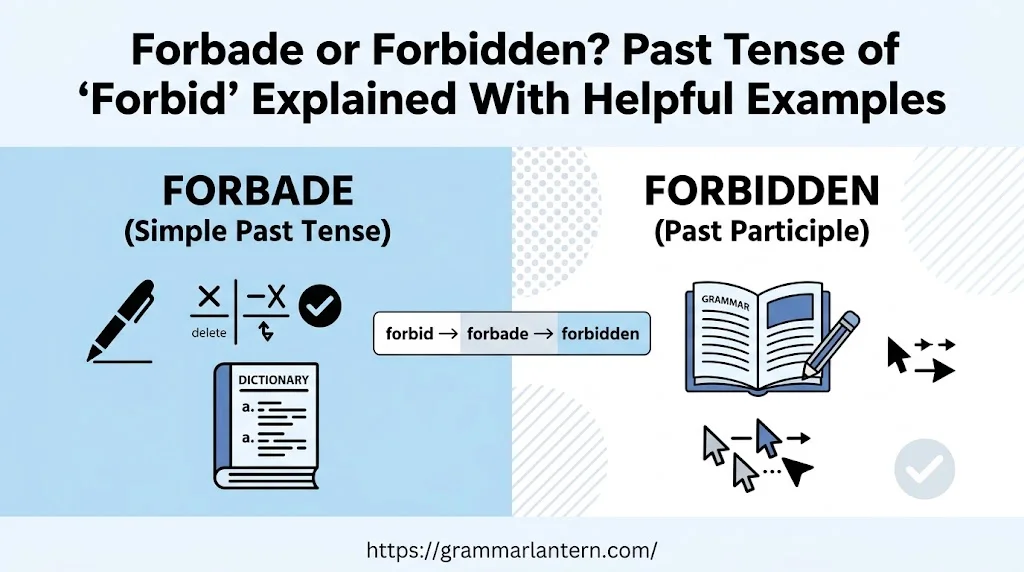
Forbade or Forbidden often confuses English learners because forbid, forbade, and forbidden come from the same verb but have different grammatical uses. Forbid is the base form, forbade is the past tense, and forbidden is the past participle. This difference becomes easier to understand when you connect forbade with a completed past action and forbidden with an auxiliary verb. Learning each form helps you avoid a common grammar mistake and use these verb forms with greater precision.
For writers, students, and professionals, choosing the correct word improves English knowledge, writing, and clear sentences. These forms appear when discussing rules, restrictions, prohibition, or things that are not allowed. They can also appear in formal writing, professional writing, workplace communication, business communication, meetings, project management, and daily tasks. Correct usage supports clarity, consistency, and credibility.
Real-world examples make the meanings easier to recognize. You may encounter these verbs while discussing scheduling, time management, online booking, or a booking rule. Understanding their grammatical functions helps readers follow your message and prevents verb-form mistakes. Regular learning and practice can make this common verb much easier to use.
Quick Answer
Forbade is the simple past tense of forbid.
Forbidden is the past participle of forbid.
Here’s the basic verb form:
| Verb Form | Word | Example |
| Base form | forbid | They forbid smoking here. |
| Simple past | forbade | They forbade smoking here. |
| Past participle | forbidden | They have forbidden smoking here. |
| Present participle | forbidding | They are forbidding smoking here. |
So, if you’re talking about a completed action in the past, use forbade.
“The principal forbade students from leaving early.”
If you use has, have, or had, use forbidden.
“The principal has forbidden students from leaving early.”
One useful shortcut is to remember:
Forbade = simple past
Forbidden = past participle
What Does “Forbid” Mean?
Forbid means to officially or personally refuse to allow something. When someone forbids an action, they make it clear that the action isn’t permitted.
The verb can describe rules, orders, personal decisions, laws, or restrictions.
For example:
- The school forbids students from smoking.
- My parents forbade me from driving at night.
- The company has forbidden employees from sharing confidential information.
- The sign says photography is forbidden.
The person or authority doing the forbidding usually appears as the subject.
Common situations where “forbid” appears
You’ll often see forbid in contexts involving:
- School rules
- Workplace policies
- Laws and regulations
- Family rules
- Safety instructions
- Religious or social restrictions
- Official orders
- Personal boundaries
The word can sound stronger than ask or discourage because it suggests that something isn’t allowed.
For example, “My manager discouraged me from leaving early” isn’t as strong as “My manager forbade me from leaving early.”
“Forbade” as the Simple Past Tense of “Forbid”
Forbade is the standard simple past form of forbid.
Use it when someone prevented or didn’t allow something at a particular time in the past.
Consider this sentence:
“The teacher forbade the students from using their phones during the exam.”
The action happened in the past. The teacher made the rule at that time. Because the sentence uses the simple past, forbade is the appropriate form.
More examples include:
- The doctor forbade him from drinking alcohol before the procedure.
- Her parents forbade her to attend the party.
- The captain forbade the crew from entering the restricted area.
- The judge forbade the witness from discussing the case publicly.
- Our coach forbade us from using the field after dark.
Notice the pattern. Forbade can stand on its own as the main past-tense verb.
Read More: Comment vs Coment: Correct Spelling, Meaning, and Usage Guide
How to Use “Forbade” in a Sentence
Two common structures are particularly useful.
Forbid + object + from + -ing
The manager forbade employees from entering the room.
The teacher forbade students from talking during the test.
Forbid + object + to + verb
Her parents forbade her to travel alone.
The officer forbade the visitors to enter the building.
The from + -ing pattern is especially common in everyday English.
A simple way to remember the first structure is:
Someone forbade someone from doing something.
For example:
The security guard forbade us from entering the building.
“Forbidden” as the Past Participle of “Forbid”
Here’s where many learners get caught.
Forbidden isn’t normally the simple past form. It is the past participle. That means it commonly appears with auxiliary verbs such as has, have, and had. It also appears in passive constructions.
Compare these sentences:
The school forbade phones.
The school has forbidden phones.
The first sentence uses the simple past. The second uses the present perfect, which requires the past participle forbidden.
You can also use it with had:
The school had forbidden phones before the new principal arrived.
How to Use “Forbidden” in a Sentence
The past participle forbidden appears in several useful constructions.
Present perfect:
The company has forbidden employees from using personal devices.
Present perfect with plural subject:
The authorities have forbidden visitors from entering the area.
Past perfect:
The manager had forbidden staff from discussing the issue.
Passive construction:
Visitors are forbidden from entering this area.
Past passive construction:
Visitors were forbidden from entering the area.
The important point is that forbidden doesn’t simply replace forbade whenever you talk about the past.
Grammar determines which form belongs in the sentence.
What’s the Difference?
The easiest way to understand the difference is to look at their grammatical roles.
| Word | Grammatical Form | Typical Function | Example |
| forbid | Base form | Present, infinitive, or after modals | They forbid outside food. |
| forbade | Simple past | Completed past action | They forbade outside food. |
| forbidden | Past participle | Perfect and passive structures | They have forbidden outside food. |
| forbidden | Adjective | Describes something prohibited | Outside food is forbidden. |
| forbidding | Present participle | Continuous forms | They are forbidding outside food. |
The distinction becomes much clearer when you place the words side by side.
Yesterday, the manager forbade employees from entering the room.
The manager has forbidden employees from entering the room.
Employees are forbidden from entering the room.
All three sentences communicate a restriction. The verb form changes because the grammar changes.
Examples
Seeing several examples in context makes the difference easier to remember.
Examples With “Forbade”
Use forbade when the sentence describes a completed past action.
- The teacher forbade students from using calculators.
- The doctor forbade him from exercising for a week.
- Her father forbade her to leave the house.
- The government forbade the sale of the product.
- The coach forbade the players from entering the stadium early.
- The guard forbade visitors from taking photographs.
- The manager forbade employees from discussing the matter.
- The law forbade people from dumping waste in the river.
The time reference can be explicit or implied.
“Last year, the company forbade employees from working remotely.”
Here, forbade clearly describes a past event.
Examples With “Forbidden”
Use forbidden when grammar calls for a past participle or when forbidden works as an adjective.
- The company has forbidden employees from sharing passwords.
- The authorities have forbidden access to the site.
- The previous manager had forbidden visitors from entering.
- Smoking is forbidden inside the building.
- Parking is forbidden in this area.
- Photography is forbidden during the performance.
- The children entered the forbidden room.
- The sign clearly states that entry is forbidden.
The last few examples show something important. Forbidden can also function as an adjective.
Side-by-Side Comparison
| Simple Past | Past Participle |
| The teacher forbade phones. | The teacher has forbidden phones. |
| The law forbade the practice. | The law has forbidden the practice. |
| Her parents forbade her to go. | Her parents had forbidden her to go. |
| The guard forbade entry. | The guard has forbidden entry. |
Think of forbade as the action itself in the simple past. Think of forbidden as the form that works with certain auxiliary verbs or describes something that isn’t allowed.
Is “Forbidden” Ever Used Without a Helping Verb?
Yes.
This is one reason the forbade vs. forbidden distinction can feel confusing.
Although forbidden is the past participle of forbid, it can also function as an adjective.
Consider:
“Smoking is forbidden.”
Here, forbidden describes the status of smoking. It tells you that smoking isn’t allowed.
Another example:
“They entered the forbidden area.”
In this sentence, forbidden modifies the noun area. It works adjectivally.
You can therefore see forbidden without has, have, or had.
Common examples include:
- Forbidden area
- Forbidden practice
- Forbidden behavior
- Forbidden knowledge
- Forbidden activity
- Forbidden substance
However, its grammatical identity depends on how it functions in the sentence.
Can You Say “Forbidded”?
No. Forbidded isn’t the standard English past tense of forbid.
Learners sometimes create forbidded because many English verbs form their past tense with -ed.
For example:
- walk → walked
- clean → cleaned
- open → opened
But forbid is an irregular verb.
Its forms are:
forbid → forbade → forbidden
Therefore:
❌ The teacher forbidded us from leaving.
✅ The teacher forbade us from leaving.
And:
❌ The teacher has forbidded us from leaving.
✅ The teacher has forbidden us from leaving.
There isn’t a need to add -ed to either form.
Forbid, Forbade, and Forbidden in Different Tenses
Understanding the complete verb pattern helps prevent mistakes.
| Tense | Correct Form | Example |
| Simple present | forbid / forbids | The rules forbid smoking. |
| Simple past | forbade | The rules forbade smoking. |
| Present perfect | has/have forbidden | The rules have forbidden smoking. |
| Past perfect | had forbidden | The rules had forbidden smoking. |
| Future | will forbid | The rules will forbid smoking. |
| Present continuous | is/are forbidding | The school is forbidding smoking. |
| Past continuous | was/were forbidding | The school was forbidding smoking. |
Why “Has Forbade” Is Wrong
A frequent mistake is combining has with forbade.
❌ The school has forbade smoking.
✅ The school has forbidden smoking.
Why?
Because has requires a past participle in the present perfect.
The pattern is:
has/have + past participle
So:
- has eaten
- has written
- has spoken
- has forbidden
Not:
- has ate
- has wrote
- has spoke
- has forbade
The same rule applies to had in the past perfect.
❌ The company had forbade employees from entering.
✅ The company had forbidden employees from entering.
Common Mistakes
Using “Forbidden” as the Simple Past
❌ The principal forbidden phones yesterday.
✅ The principal forbade phones yesterday.
The word yesterday points toward a completed past action. Without another auxiliary structure, forbade fits the simple past.
Using “Forbade” After “Has” or “Had”
❌ The manager has forbade the practice.
✅ The manager has forbidden the practice.
❌ The manager had forbade the practice.
✅ The manager had forbidden the practice.
Remember the formula:
has/have/had + forbidden
Using “Forbidded”
❌ The law forbidded the practice.
✅ The law forbade the practice.
✅ The law had forbidden the practice.
The verb doesn’t follow the regular -ed pattern.
Confusing “Forbid” With “Prohibit”
Prohibit has a different conjugation pattern.
| Verb | Simple Past | Past Participle |
| forbid | forbade | forbidden |
| prohibit | prohibited | prohibited |
For example:
The law prohibited the activity.
The law has prohibited the activity.
Unlike forbid, prohibit uses the same form for its simple past and past participle.
That contrast can make forbid seem unusual. It isn’t, though. English has many irregular verbs with forms that don’t follow the regular -ed pattern.
Forbid vs. Prohibit: Are They the Same?
Forbid and prohibit have closely related meanings. Both can mean that something isn’t allowed.
However, prohibit often sounds more formal or official.
Compare:
The school forbids students from using phones during exams.
School regulations prohibit students from using phones during exams.
Both sentences communicate a restriction. The second has a more formal, regulatory tone.
You might encounter prohibit in laws, policies, regulations, official notices, and formal writing. Forbid works naturally in both formal and everyday situations.
The important grammatical difference is their verb forms:
- forbid → forbade → forbidden
- prohibit → prohibited → prohibited
How to Remember
A simple memory trick can save you from repeated mistakes.
Remember “Forbade” as the past action
If you’re describing what someone did in the past, forbade is usually the form you need.
The teacher forbade talking during the test.
Remember “Forbidden” after has, have, and had
If you see has, have, or had, think forbidden.
The teacher has forbidden talking during the test.
The teacher had forbidden talking during the test.
This isn’t the only use of forbidden, but it’s a useful first check.
Use the “Did” Test
Try putting did into the sentence mentally.
The teacher did forbid phones.
That tells you the simple past form is forbade:
The teacher forbade phones.
Now try has:
The teacher has forbidden phones.
That points you toward the past participle.
This little test works like a grammatical flashlight. It helps illuminate which form belongs in the sentence.
Forbade or Forbidden? Quick Grammar Test
Choose forbade, forbidden, or forbid.
Practice Sentences
- The school ___ students from using phones during exams.
- The school has ___ students from using phones during exams.
- The law ___ the practice many years ago.
- The company had ___ employees from entering the facility.
- Smoking is ___ inside the building.
- The new rules ___ outside food.
- The manager ___ us from entering the office yesterday.
- The authorities have ___ access to the area.
Answers
- forbade — simple past
- forbidden — follows has
- forbade — completed past action
- forbidden — follows had
- forbidden — used in a passive construction
- forbid — simple present with a plural subject
- forbade — completed past action
- forbidden — follows have
The pattern becomes much easier once you stop treating forbade and forbidden as interchangeable words.
A Practical Case Study: “The School Forbade Phones”
Consider three versions of the same idea:
The school forbade phones during exams.
This sentence describes a past action. Forbade is the simple past.
Now change the tense:
The school has forbidden phones during exams.
The present perfect requires the past participle forbidden.
Now change the construction:
Phones are forbidden during exams.
Here, forbidden appears in a passive construction.
The meaning remains closely connected, but the grammar changes each time.
This is the central lesson. Don’t choose between “forbade” and “forbidden” based only on meaning. Choose based on grammatical structure.
A Simple Rule to Keep
When you’re unsure which form to use, check the sentence around the verb.
Use forbade for the simple past:
“The officer forbade entry.”
Use forbidden with has, have, or had:
“The officer has forbidden entry.”
Use forbidden in passive constructions:
“Entry is forbidden.”
Use forbidden as an adjective when it describes something:
“They entered the forbidden area.”
And never use forbidded in standard English.
Read More: Gradual vs. Insidious: Understanding the Real Difference
FAQs
1. What is the past tense of forbid?
The simple past tense of forbid is forbade. For example, “The teacher forbade the students from using phones.”
2. What is the past participle of forbid?
The past participle is forbidden. It is commonly used with auxiliary verbs, such as “has forbidden” or “was forbidden.”
3. Is “forbade” grammatically correct?
Yes. Forbade is the correct simple past form of forbid.
4. Is “forbidden” a past tense?
No. Forbidden is the past participle, not the simple past tense.
5. What does forbid mean?
Forbid means to officially or clearly say that something is not allowed.
6. What is the difference between forbade and forbidden?
Forbade describes a completed past action, while forbidden is a past participle used with auxiliary verbs or in certain adjective-like constructions.
7. Can I say “He forbidden it”?
No. You should say, “He forbade it.” Alternatively, you could say, “He has forbidden it.”
8. Is forbid an irregular verb?
Yes. Its main forms are forbid, forbade, forbidden.
9. How can I remember forbade and forbidden?
Remember that forbade is the simple past form, while forbidden usually needs an auxiliary verb in perfect or passive constructions.
10. Why do English learners confuse these words?
They come from the same verb and have similar meanings, but their grammatical forms and functions are different.
Conclusion
Understanding forbid, forbade, and forbidden becomes much easier when you learn the role of each form. Forbid is the base form, forbade is the simple past tense, and forbidden is the past participle. Keeping this pattern in mind can help you choose the correct form when describing rules, restrictions, or actions that were not allowed.
With regular practice and real-world examples, you can use these forms naturally in everyday, academic, and professional writing. When you’re describing something that happened in the past, forbade is usually the form you need. When you need a past participle, use forbidden in the appropriate grammatical structure.

For Shafiq ur Rehman, writing is an art form and grammar is the toolbox that makes it beautiful. As a dedicated content writer at Grammar Lantern, Shafiq approaches every topic like an architect carefully laying down strong foundations of understanding before adding the finer details. He loves diving into the trickiest grammar points and resurfacing with simple, bite-sized takeaways that anyone can grasp. When he’s not crafting articles, you’ll likely find him strategizing over a game of chess, exploring dusty local bookshops, or quietly jotting down poetic observations in his notebook.



[…] Read More: Forbade or Forbidden? Past Tense of “Forbid” Explained […]