Dought vs Doubt explains why writers confuse these spellings, as both words look and sound similar but only doubt fits modern English rules today. Many writers become confused when choosing between these words because they look and sound similar.
In modern English, doubt is the correct word, while dought is an archaic form from old English and historical English that is rarely used.
While explaining English spelling, I have noticed that many learners see spelling as a maze while blindfolded, especially when thought, bought, and brought create familiar word patterns. However, this is a different story because doubt follows the accepted rules of current English spelling. Using the wrong word can affect clarity, meaning, reader trust, and overall writing quality.
A clear understanding of the difference builds confidence and reduces common writing mistakes, simple spelling errors, misspelling, and typo issues.
These homophones may sound the same, but they have different meanings and a different role in language. Pronunciation habits, silent letters, and historical language changes can create spelling confusion, but selecting the proper word improves communication.
This article uses simple English so readers can apply the lesson easily in exams and professional communication while they avoid repeating the same mistake yourself.
Quick Answer: Dought vs Doubt What Is the Difference?
Doubt is the correct and commonly used modern English word. It means uncertainty, disbelief, hesitation, or a lack of confidence about something.
Dought is an old English word that means strength, courage, ability, or worth. It is considered archaic, which means it is rarely used in modern conversations and usually appears only in historical or literary contexts.
| Word | Meaning | Modern Usage | Example |
| Doubt | Feeling uncertain or unsure about something | Very common | “I doubt that he will arrive on time.” |
| Dought | Strength, courage, ability, or bravery | Extremely rare | “The knight showed great dought in battle.” |
For almost all modern writing situations, doubt is the word you need.
What Does Doubt Mean?
The word doubt describes a feeling of uncertainty. When you doubt something, you are not completely sure whether it is true, possible, or correct.
People experience doubt when they question information, decisions, promises, or future outcomes. Doubt can appear in everyday situations, professional decisions, relationships, education, and personal growth.
For example:
- “I doubt the weather will improve today.”
- “She had doubts about accepting the new job.”
- “There is no doubt that practice improves performance.”
In each sentence, doubt shows uncertainty or questioning.
The word can function as both a noun and a verb.
Doubt as a Noun
When used as a noun, doubt refers to a feeling, idea, or situation involving uncertainty.
Examples:
- “He had doubts about the accuracy of the report.”
- “Her confidence disappeared because of self-doubt.”
- “There is some doubt about the final result.”
Common noun phrases include:
| Expression | Meaning | Example |
| A doubt | A question or uncertainty | “I have a doubt about this answer.” |
| Self-doubt | Lack of confidence in yourself | “Self-doubt can prevent people from taking opportunities.” |
| Without a doubt | Completely certain | “She is without a doubt the best candidate.” |
| No doubt | Probably or certainly | “He will no doubt succeed.” |
Doubt as a Verb
As a verb, doubt means to question whether something is true or likely.
Examples:
- “I doubt his explanation.”
- “They doubt the company’s future success.”
- “She never doubted her ability.”
The verb form often appears in everyday conversations.
For example, when someone says:
“I doubt it.”
They mean:
“I don’t think it is likely to happen.”
What Does Dought Mean?
The word dought is a historical English term that has almost disappeared from everyday language.
Unlike doubt, which relates to uncertainty, dought describes positive qualities such as:
- Strength
- Courage
- Skill
- Ability
- Bravery
- Worth
The word developed from older forms of English and was connected with ideas of power and capability.
Although dictionaries may still include dought, modern speakers rarely use it. You are more likely to find it while reading medieval literature, historical documents, or studies about the development of English vocabulary.
For example:
- “The warrior was known for his dought and courage.”
This sentence sounds old-fashioned because modern English would normally use words like:
- bravery
- strength
- courage
- ability
instead.
Read More: Unenroll vs. Disenroll: Meaning, Differences, and Correct Usage
Historical Background of Dought
The history of dought shows how languages change over time.
English has developed through many influences, including:
- Old English
- Norse languages
- French
- Latin
- Germanic languages
Many words that were common hundreds of years ago have disappeared or changed meaning.
Dought belonged to an older stage of English where words describing personal strength and heroic qualities were common.
Over time, English speakers replaced many older words with simpler and more familiar alternatives. Words such as brave, strong, and capable became more common, while dought faded from everyday use.
This change is normal in language. Every generation changes the way people speak and write.
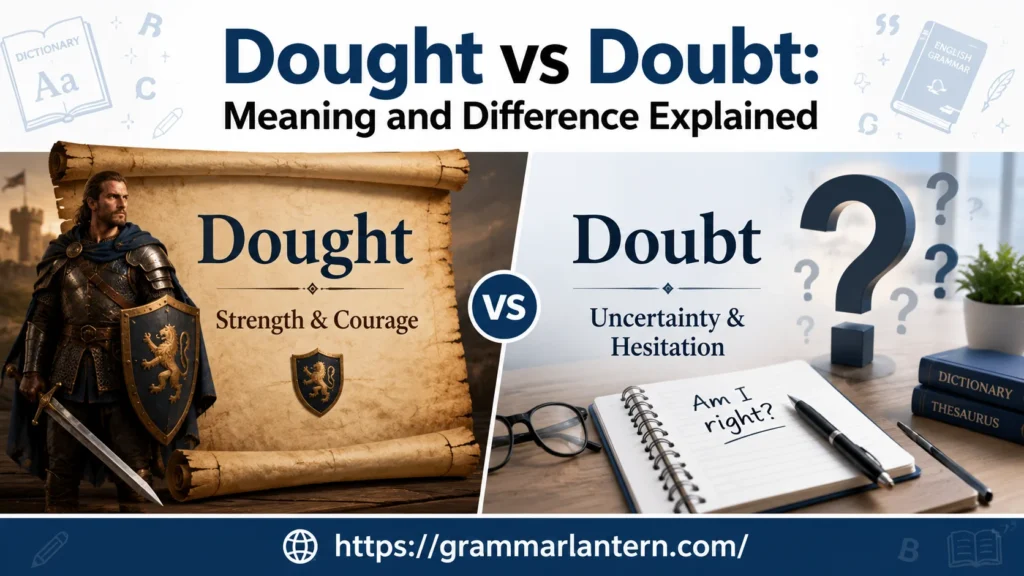
Dought vs Doubt: Key Differences Explained
Although dought and doubt look similar, they are completely different words.
| Difference | Dought | Doubt |
| Meaning | Strength or ability | Uncertainty or hesitation |
| Word origin | Old English | French/Latin influenced English |
| Frequency | Rare and historical | Common in modern English |
| Purpose | Describes courage or skill | Describes questioning or uncertainty |
| Common today? | No | Yes |
The easiest way to remember the difference is:
Doubt means you are unsure. Dought means someone has strength or ability.
Difference in Pronunciation
Pronunciation is another reason people confuse these words.
The word doubt is pronounced:
/daʊt/
It sounds like:
“dowt”
The letter b is silent.
Examples:
- doubt → dowt
- doubtful → dowtful
English has many silent letters because spelling often preserves historical changes.
Other examples include:
| Word | Silent Letter |
| Knight | K |
| Honest | H |
| Island | S |
| Doubt | B |
The pronunciation of dought depends on the historical context where it appears. Because it is an outdated word, many modern speakers have never heard it spoken.
Why Do People Confuse Dought and Doubt?
The confusion happens mainly because English spelling can be unpredictable.
Several factors create this problem.
Similar Letter Patterns
Both words contain:
- D
- O
- U
- G
- H
- T
The only major difference is the position of the letters gh.
When people see a familiar spelling pattern, their brains often connect it with words they already know.
For example:
- thought
- bought
- brought
- doubt
These words share unusual letter combinations, which can create spelling confusion.
English Has Many Historical Spellings
English spelling often keeps traces of the past.
A word may look complicated because its spelling developed hundreds of years ago.
For example:
- “doubt” originally had a pronounced connection to its Latin origin.
- Over time, English speakers stopped pronouncing the “b,” but the spelling remained.
This explains why English sometimes feels inconsistent.
Typing Mistakes
Many people accidentally write dought when they mean doubt because the letters are close together in their memory.
Common mistake:
❌ “I dought his story.”
Correct:
✅ “I doubt his story.”
Spell-check tools may catch this error, but understanding the difference helps you recognize the mistake yourself.
Is Dought a Correct Word?
Yes, dought is technically a correct word, but it is not a normal modern English choice.
It appears mainly in:
- Historical writing
- Medieval studies
- Literature analysis
- Old English discussions
Using dought in regular communication may confuse readers because most people do not know its meaning.
For example, writing:
“Her dought helped her overcome challenges.”
would sound unusual.
Modern English would normally say:
“Her courage helped her overcome challenges.”
or:
“Her strength helped her overcome challenges.”
Is Doubt Always the Correct Choice?
In modern writing, doubt is almost always the correct choice when you want to express uncertainty.
Use doubt when you mean:
- You are unsure about something.
- You question information.
- You lack confidence in an outcome.
- You do not believe something is likely.
Examples:
✅ 1. “I doubt the meeting will finish early.”
✅ 2. “There is no doubt that education changes lives.”
✅ 3. “She doubted whether she made the right decision.”
Do not replace doubt with dought because the meanings are unrelated.
Common Mistakes With Dought and Doubt
Mistake: Using Dought Instead of Doubt
Incorrect:
❌ “I dought he understands the instructions.”
Correct:
✅ “I doubt he understands the instructions.”
Mistake: Confusing Doubt With Disbelief
Doubt and disbelief are related, but they are not exactly the same.
Doubt means you are uncertain.
Disbelief means you strongly do not accept something as true.
Example:
- “I doubt his explanation.”
(I am unsure.) - “I disbelief his explanation.”
(Incorrect grammar. The correct form is “I disbelieve his explanation.”)
Mistake: Forgetting the Silent B
Many learners spell doubt incorrectly because they write based on pronunciation.
Incorrect:
❌ dout
Correct:
✅ doubt
The silent b is part of the standard spelling.
Common Expressions With Doubt
The word doubt appears in many common English expressions.
Without a Doubt
Meaning: Completely certain.
Example:
“Without a doubt, she is one of the strongest players on the team.”
No Doubt
Meaning: Certainly or probably.
Example:
“He will no doubt achieve his goals.”
Cast Doubt on Something
Meaning: To make people question something.
Example:
“The new evidence cast doubt on the original decision.”
Beyond a Shadow of a Doubt
Meaning: Completely certain.
Example:
“The evidence proved his innocence beyond a shadow of a doubt.”
Case Study: Why Word Choice Matters
Imagine two students writing an essay.
Student A writes:
“The leader showed great dought during the difficult situation.”
Most readers may stop because the word feels unfamiliar.
Student B writes:
“The leader showed great courage during the difficult situation.”
The second sentence communicates the idea immediately.
This example shows an important writing principle:
A correct word is not always the best word. The best word is the one your audience understands clearly.
Final Comparison: Dought vs Doubt
| Feature | Dought | Doubt |
| Meaning | Strength, courage, ability | Uncertainty, hesitation |
| Modern usage | Very rare | Very common |
| Used in conversation | Almost never | Frequently |
| Example | “His dought was legendary.” | “I doubt the result.” |
| Best choice today | Only for historical contexts | Everyday writing |
FAQs
1. What is the correct spelling between dought and doubt?
The correct spelling in modern English is doubt. It is the commonly used word that means uncertainty, hesitation, or a lack of confidence about something. Dought is an archaic form that is rarely found in modern writing.
2. Why do people confuse dought and doubt?
People often confuse dought vs doubt because both words look similar. English spelling can sometimes feel unpredictable, especially with words like thought, bought, and brought that follow similar patterns.
3. Is dought a real English word?
Yes, dought was used in older forms of English. However, it is considered an archaic word and is not normally used in modern English communication.
4. Does dought have the same meaning as doubt?
Historically, dought was related to older language forms, but it is not used with the same meaning as doubt today. Modern English speakers use doubt when referring to uncertainty.
5. How do you use doubt in a sentence?
You can use doubt when you are unsure about something. For example: “I have some doubt about the accuracy of this information.”
6. Is dought a spelling mistake?
In most modern writing situations, using dought instead of doubt is considered a spelling mistake or typo because readers expect the standard spelling.
7. How can I remember the spelling of doubt?
A simple way to remember doubt is to focus on the silent “b.” Many English words contain silent letters, so pronunciation does not always show the complete spelling.
8. Why is the letter b silent in doubt?
The silent “b” in doubt comes from historical language changes. The word developed from older forms where the letter was pronounced, but modern English kept the spelling while changing the pronunciation.
9. Can I use dought in academic writing?
No, you should avoid using dought in academic writing, exams, and professional communication. Doubt is the accepted and correct spelling for modern English.
10. How can I avoid mistakes between dought and doubt?
You can avoid this mistake by learning the correct usage, checking spelling carefully, and practicing common English word patterns. Understanding the difference helps improve your writing accuracy.
Conclusion
Understanding dought vs doubt becomes easier when you know their history and modern usage. Although both words may look similar, doubt is the correct spelling used in everyday English, academic writing, and professional communication. Dought belongs mainly to old English and historical language contexts, making it uncommon today.
Learning these spelling differences helps you write with more confidence and avoid common mistakes. By paying attention to word patterns, silent letters, and correct usage, you can improve your English skills and communicate your ideas more clearly.