
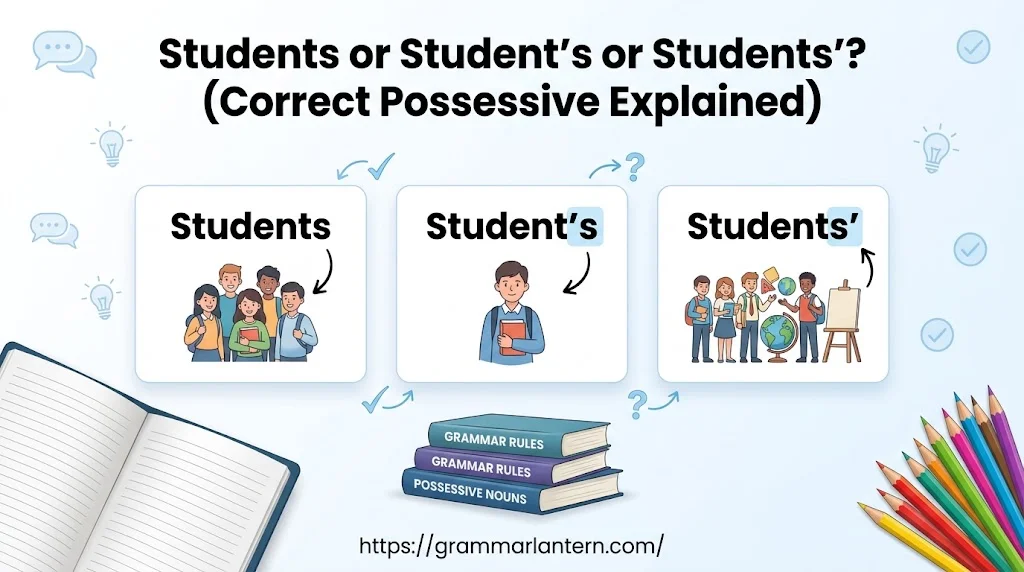
When writing about students, knowing the difference between student’s and students’ can make your sentences clearer. Both forms show possession, but they follow different English grammar rules. The singular possessive form, student’s, refers to something belonging to one student. For example, “The student’s notebook is missing.” Here, adding ’s to the singular noun shows ownership. This simple apostrophe usage is an important part of correct writing.
The plural possessive form, students’, refers to something belonging to multiple students. For example, “The students’ classroom looks tidy.” Since students is already plural and ends in s, you add only an apostrophe after the final s. Understanding apostrophe placement, plural nouns, and possessive rules helps you avoid common grammar mistakes. The key is to identify whether one student or several students own something before choosing the correct form.
A helpful grammar tip is to remember that student’s means one student owns something, while students’ means several students share ownership. With practice, these possessive forms become easier to recognize and use correctly.
Quick Answer
The correct form depends on what you want to say.
| Form | Grammatical use | Example |
| Students | Plural noun; two or more learners | The students arrived early. |
| Student’s | Singular possessive; something associated with one learner | The student’s notebook is missing. |
| Students’ | Plural possessive; something associated with multiple learners | The students’ notebooks are missing. |
Here’s the easiest way to remember the difference:
- Students = more than one student.
- Student’s = belonging to one student.
- Students’ = belonging to multiple students.
For example, consider these three sentences:
- The students completed their assignments.
- The student’s assignment received an excellent grade.
- The students’ assignments were collected by the teacher.
The first sentence refers to multiple learners without expressing possession. The second identifies an assignment belonging to one learner. The third refers to assignments associated with multiple learners.
Remember: The apostrophe doesn’t make a noun plural. It helps show possession or, in certain cases, marks a contraction.
What Does Students Mean?
Definition and Meaning of Students
Students is the regular plural form of the noun student. It refers to two or more people who study at a school, college, university, or another educational institution.
Unlike student’s and students’, the word students doesn’t require an apostrophe when you’re simply talking about a group of learners.
For example:
- Students attend classes to develop their knowledge.
- The students prepared for their final examinations.
- Several students participated in the science competition.
- The teacher congratulated the students after the presentation.
In each sentence, students identifies more than one learner. None of these examples expresses ownership through the noun itself, so an apostrophe isn’t necessary.
When to Use Students Without an Apostrophe
Use students whenever you want to refer to multiple learners without showing possession.
You might use it as the subject of a sentence, the object of a verb, or part of a descriptive phrase.
Consider these examples:
- As a subject: Students need regular opportunities to practice their skills.
- As an object: The instructor helped the students understand the lesson.
- After a preposition: The library offers several resources for students.
- In a general statement: Students often benefit from clear feedback.
Notice that none of these sentences requires an apostrophe. The word simply identifies a group of people.
However, the rule changes when the sentence expresses ownership or association.
Compare these examples:
- The students completed their projects.
- The students’ projects received positive feedback.
In the first sentence, students is an ordinary plural noun. In the second, students’ shows that the projects belong to or are associated with multiple students.
Why Students Doesn’t Need an Apostrophe
One common punctuation mistake is adding an apostrophe whenever a word ends in s.
For example, someone might write, “The student’s are waiting outside” when referring to an entire class.
The correct sentence is “The students are waiting outside.”
The word students already expresses plurality. Adding an apostrophe and another s changes the grammatical form rather than making the plural more correct.
Use this simple rule: If you’re only talking about multiple students, write students without an apostrophe.
What Does Student’s Mean?
Definition and Meaning of Student’s
Student’s is the singular possessive form of student. It shows that something belongs to, relates to, or is associated with one student.
To form the singular possessive, start with the singular noun student and add an apostrophe followed by s.
The pattern is simple:
Student + ’s = Student’s
For example:
- The student’s notebook is on the desk.
- The student’s answer impressed the teacher.
- The student’s performance improved throughout the semester.
- The student’s responsibility includes completing the assigned reading.
Each sentence refers to one student. The possession might involve a physical object, such as a notebook, or something less tangible, such as an answer, performance, or responsibility.
Importantly, possession doesn’t always mean legal ownership. In grammar, it can also describe a connection between people and the things, qualities, or activities associated with them.
Read More: 27 Best Replies to “I Don’t Care” Witty & Clever
When to Use Student’s in a Sentence
Use student’s when you’re discussing something connected to one particular learner.
Here are some common situations.
1.To show ownership
- The student’s backpack was left in the classroom.
- I found the student’s pencil under the chair.
- The student’s laptop needs to be charged.
2.To describe academic work
- The student’s essay contains a strong argument.
- The student’s assignment is due on Friday.
- The student’s research earned recognition at the conference.
3.To describe qualities, experiences, or responsibilities
- The student’s confidence increased after the presentation.
- The student’s progress impressed the instructor.
- The student’s attendance record improved this month.
The key is to identify the person associated with the noun. If you’re referring to one student, the singular possessive form is usually appropriate.
Student’s Can Also Mean Student Is or Student Has
Here’s a detail that makes this topic slightly more interesting: student’s doesn’t always indicate possession.
In certain sentences, student’s is a contraction of student is or student has.
For example:
– The student’s ready for the examination.
This means the student is ready for the examination.
– The student’s finished the assignment.
This can mean the student has finished the assignment.
The surrounding words help you identify the intended meaning. If student’s is followed by an adjective such as ready, it may represent student is. If it’s followed by a past participle such as finished, it may represent student has.
However, not every sentence permits both interpretations. Context and sentence structure determine which expansion makes sense.
For formal academic writing, spelling out student is or student has can sometimes improve clarity. In everyday writing and dialogue, contractions are perfectly natural.
What Does Students’ Mean?
Definition and Meaning of Students’
Students’ is the plural possessive form of student. It shows that something belongs to, relates to, or is associated with more than one student.
The rule differs slightly from the singular possessive form. Because the regular plural students already ends in s, you add only an apostrophe after that final letter.
The pattern looks like this:
Students + ’ = Students’
For example:
- The students’ projects were displayed in the hallway.
- The students’ opinions influenced the final decision.
- The students’ lounge remains open until evening.
- The students’ achievements deserve recognition.
Each sentence connects something to a group of learners. The projects, opinions, lounge, and achievements are associated with multiple students.
When to Use Students’ in a Sentence
Use students’ when you need to express possession or association involving two or more students.
Common examples include:
- Students’ assignments: Assignments belonging to multiple students.
- Students’ rights: Rights held by students as a group.
- Students’ experiences: Experiences associated with multiple learners.
- Students’ responsibilities: Responsibilities assigned to several students.
- Students’ opinions: Opinions expressed by multiple students.
- Students’ records: Records associated with multiple students.
Notice that the possessed noun doesn’t have to be plural. For instance, students’ classroom may refer to one classroom used by a group of students.
Likewise, the possessive form doesn’t tell you whether the students own something jointly or separately. The rest of the sentence supplies that information.
Shared Ownership vs. Individual Ownership
A common misconception is that students’ must describe something shared by an entire group. That’s not always true.
The plural possessive can describe one shared item, several individually owned items, or a general relationship with a group.
Consider these examples:
One shared item
“The students’ classroom was renovated during the summer.”
Here, students’ identifies the group associated with one classroom.
Several individual items
“The students’ backpacks were lined up outside the office.”
Each student may own a different backpack. The plural possessive still works because the backpacks belong to multiple students.
A group-wide right
“The students’ rights were discussed during the meeting.”
The sentence refers to rights associated with the student population.
The important distinction is the number of students, not the number of objects. If the possession involves multiple students, students’ is generally the correct form.
Key Differences
The quickest way to master these three forms is to compare them side by side.
Comparison Table
| Feature | Students | Student’s | Students’ |
| Base meaning | More than one learner | One learner’s possession or association | Multiple learners’ possession or association |
| Grammatical form | Plural noun | Singular possessive or contraction | Plural possessive |
| Apostrophe placement | No apostrophe | Before the final s | After the final s |
| Number of students | Two or more | One, when possessive | Two or more |
| Example | Students entered the room. | The student’s bag is missing. | The students’ bags are missing. |
This comparison highlights the main rule: Determine whether you’re referring to a group, one student’s possession, or multiple students’ possessions.
Three Examples That Show the Difference
Imagine a teacher collecting homework from a class.
Students completed their homework.
The word students identifies the learners. It doesn’t show possession through an apostrophe.
The student’s homework is on the desk.
The singular possessive identifies homework associated with one particular student.
The students’ homework is on the desk.
The plural possessive identifies homework associated with multiple students.
Notice something important: homework is uncountable in ordinary English usage, so it doesn’t become homeworks in these examples. The number of students changes, but the noun referring to their work remains the same.
This is a useful reminder that the possessive form and the noun describing the possessed item follow separate grammatical rules.
How to Form the Singular and Plural Possessive of Student
Once you understand the three forms, choosing between them becomes much easier. Follow these steps whenever you feel uncertain.
Step One: Identify Whether You Mean One Student or Several
First, establish the number of people involved.
Use student when referring to one learner and students when referring to two or more.
Examples:
- One student answered the question.
- Three students answered the question.
At this stage, you don’t need an apostrophe because you haven’t expressed possession.
Step Two: Decide Whether You’re Showing Possession
Next, ask whether the sentence connects a person to something they own, use, experience, or are associated with.
Compare:
- The student entered the library.
- The student’s library card was missing.
The first sentence simply describes an action. The second identifies a card associated with one student.
Now consider the plural version:
- The students entered the library.
- The students’ library cards were missing.
The first sentence identifies a group. The second connects the cards to multiple students.
Step Three: Place the Apostrophe Correctly
Once you’ve identified the grammatical form, placing the apostrophe is straightforward.
- Singular possessive: student’s
- Regular plural possessive: students’
- Ordinary plural: students
Don’t add another s after the apostrophe in students’. The plural noun already ends in s, so the apostrophe alone completes the possessive form.
Step Four: Read the Sentence for Meaning
Sometimes, a sentence can look correct at first glance but communicate the wrong idea.
Consider this example:
“The students’ report was excellent.”
This sentence refers to a report associated with multiple students.
Now compare it with:
“The student’s report was excellent.”
This sentence refers to a report associated with one student.
Both sentences are grammatically correct. The right choice depends on the meaning you intend.
A useful editing trick is to replace the possessive phrase with a longer explanation. If you mean “the report belonging to one student,” use student’s. If you mean “the report belonging to several students,” use students’.
Common Mistakes
Even experienced writers occasionally misplace apostrophes. Fortunately, most mistakes become easy to spot once you recognize the pattern.
Using Students’ When You Mean a Simple Plural
Incorrect: The students’ are waiting outside.
Correct: The students are waiting outside.
The sentence simply refers to multiple learners. No ownership or association needs to be expressed by the noun, so the apostrophe doesn’t belong there.
Remember that an apostrophe isn’t a general marker for plural words.
Using Student’s When You Mean Multiple Students
Incorrect: The student’s submitted their projects.
Correct: The students submitted their projects.
The original sentence incorrectly uses a singular possessive form where an ordinary plural noun is needed.
If multiple learners performed the action, use students. If something belongs to one learner, use student’s.
Forgetting the Apostrophe in Students’ Assignments
Incorrect: The students assignments were collected.
Correct: The students’ assignments were collected.
The corrected sentence uses the plural possessive because the assignments are associated with multiple students.
Without the apostrophe, students assignments is not the standard possessive construction.
Using Students’ Instead of Student’s
Incorrect: One students’ book was missing.
Correct: One student’s book was missing.
The word one identifies a single student. Therefore, the singular possessive form is required.
A simple rule helps here: Don’t let the noun after the possessive distract you from identifying the owner. Start by checking how many students the sentence describes.
Confusing Possessives With Contractions
Consider this sentence:
“The student’s late.”
Depending on context, this could mean “The student is late.”
Now consider:
“The student’s notebook is late.”
Here, student’s shows possession or association rather than contraction.
A practical test is to replace student’s with student is or student has. If the sentence still makes sense, you’re probably looking at a contraction. If it doesn’t, the possessive interpretation may be correct.
This test is helpful, but context still matters.
Students’ vs. Students’s: Which Is Correct?
The correct standard plural possessive form is students’, not students’s.
The reason is simple: students is already a regular plural noun ending in s. To make it possessive, you add an apostrophe after the existing s.
Correct examples include:
- The students’ classroom was cleaned.
- The students’ projects received awards.
- The students’ questions were answered.
The form students’s adds an unnecessary extra s and isn’t the standard possessive spelling for this noun.
Compare the singular and plural forms:
- One student’s desk
- Several students’ desks
The singular form adds ’s to student. The plural form places the apostrophe after the s already present in students.
This rule applies to many regular plural nouns ending in s, not just students.
Student’s vs. Students’ in Academic and Everyday Writing
Choosing the correct possessive form matters in more than grammar exercises. It can help prevent confusion in school documents, reports, emails, and everyday communication.
In School Assignments and Essays
Academic writing often discusses students’ work, performance, behavior, and progress.
Use the singular possessive when referring to one learner:
- The student’s argument needs further evidence.
- The student’s analysis identifies three major themes.
Use the plural possessive when referring to multiple learners:
- The students’ arguments differed considerably.
- The students’ analyses identified several shared themes.
In formal writing, consistency also matters. If you’re describing an entire group throughout a paragraph, make sure the possessive forms match the meaning of each sentence.
In Emails, Reports, and Notices
Teachers and administrators frequently write about attendance, performance, responsibilities, and school resources.
Compare these examples:
- The student’s attendance record requires review.
- The students’ attendance records require review.
The first sentence concerns one student’s record. The second concerns records associated with multiple students.
The same distinction applies to emails:
- Please review the student’s application.
- Please review the students’ applications.
Correct apostrophe placement makes it easier for readers to understand whether a message concerns one person or an entire group.
In Signs and Headings
Titles and signs can be especially confusing because they often contain only a few words.
For example:
- Student’s Handbook: A handbook associated with one student.
- Students’ Handbook: A handbook intended for or associated with students as a group.
- Students Handbook: A nonstandard possessive construction if the intended meaning is a handbook belonging to students.
The appropriate title depends on the intended meaning and the institution’s naming conventions. A handbook written for all students may more naturally be titled Student Handbook, without an apostrophe, because the phrase can function as a noun modifier rather than a possessive.
That distinction is worth remembering: not every noun placed before another noun requires an apostrophe.
A Real-World Example: Choosing the Correct Form
Imagine a teacher preparing a report after a class project. The report discusses individual assignments, group achievements, and the students who participated.
The teacher writes:
“The students completed their research projects. Each student’s presentation covered a different topic. The students’ final reports were submitted on Monday.”
Each form serves a different purpose.
- Students identifies the group that completed the projects.
- Student’s refers to one learner’s presentation.
- Students’ connects the final reports to multiple learners.
This example shows why apostrophes matter. The sentences describe related events, but each form communicates a slightly different relationship.
As a general writing principle, the goal isn’t to add punctuation everywhere it might fit. It’s to use punctuation when it communicates the meaning you intend.
How to Remember the Difference
You don’t need to memorize complicated grammar terminology to use these forms correctly. A few simple checks can help you choose the right one.
Remember the Apostrophe Rule
Think of the three forms this way:
- Students: Several learners. No apostrophe.
- Student’s: One learner’s possession or association. Apostrophe before the s.
- Students’: Several learners’ possession or association. Apostrophe after the s.
The apostrophe’s position follows the noun’s grammatical form.
Use the Belonging-To Test
When you’re unsure, rewrite the sentence using the phrase “belonging to.”
For example:
“The book belonging to one student is missing.”
This meaning corresponds to the student’s book.
Now consider:
“The books belonging to several students are missing.”
This meaning corresponds to the students’ books.
The test also works for less tangible relationships:
- The student’s progress = progress associated with one student.
- The students’ progress = progress associated with multiple students.
However, don’t assume every possessive relationship expresses literal ownership. The same grammatical pattern can describe relationships, characteristics, responsibilities, and experiences.
Check Whether You Can Remove the Apostrophe
If the sentence doesn’t express possession or use a contraction, you probably don’t need an apostrophe.
For example:
“The students participated in the discussion.”
The word students simply identifies the participants. Adding an apostrophe would change the grammatical meaning unnecessarily.
By contrast, “The students’ discussion continued for an hour” uses the plural possessive to connect the discussion with the students.
Practice Exercises
Test your understanding with the following sentences. Fill each blank with students, student’s, or students’.
- The ______ completed their science projects before the deadline.
- The ______ pencil rolled under the desk.
- The teacher collected the ______ assignments.
- Several ______ participated in the spelling competition.
- The ______ backpack was hanging beside the door.
- The ______ opinions were considered during the meeting.
- One ______ answer was selected as the best response.
- The school displayed the ______ artwork in the hallway.
- The ______ are preparing for their final examinations.
- The ______ classroom was decorated for the celebration.
Answer Key With Explanations
- Students — The sentence refers to multiple learners completing their projects.
- Student’s — The pencil belongs to or is associated with one student.
- Students’ — The assignments are associated with multiple students.
- Students — The word identifies several participants without expressing possession.
- Student’s — The sentence describes one student’s backpack.
- Students’ — The opinions belong to or are expressed by multiple students.
- Student’s — The word one identifies a single student.
- Students’ — The artwork is associated with multiple students.
- Students — The noun simply identifies a group preparing for examinations.
- Students’ — The classroom is associated with a group of students.
One detail deserves attention in sentence eight: artwork can refer to a collective body of creative work. It doesn’t need to become plural simply because multiple students contributed to it.
Read More: Chose vs. Chosen: Which Is Correct? A Complete Guide
FAQs
1. What is the difference between student’s and students’?
Student’s shows possession by one student, while students’ shows possession by multiple students. The apostrophe placement depends on whether the noun is singular or plural.
2. Is student’s grammatically correct?
Yes, student’s is correct when you want to show that something belongs to one student. For example, “The student’s pencil fell on the floor.”
3. Is students’ correct in English?
Yes, students’ is the correct plural possessive form. For example, “The students’ projects were displayed in the classroom.”
4. When should I use students without an apostrophe?
Use students when referring to more than one student without showing possession. For example, “The students are studying for their exams.”
5. Should I write students or student’s?
It depends on your meaning. Use students for a plural noun, such as “The students arrived early.” Use student’s to show that something belongs to one student.
6. Where does the apostrophe go in students’?
Place the apostrophe after the final s in students’. This form indicates possession by two or more students.
7. Is students’s ever correct?
No, students’s is not the standard plural possessive form. Since students already ends in s, add only an apostrophe to form students’.
8. What is the singular possessive form of student?
The singular possessive form is student’s. You add an apostrophe and s to the singular noun to show ownership.
9. What is an example of students’ in a sentence?
“The students’ books were stacked on the desk.” This sentence means that the books belong to several students.
10. How can I remember the difference between student’s and students’?
Remember that student’s refers to one student, while students’ refers to several students. Check whether the noun is singular or plural before placing the apostrophe.
Conclusion
Understanding the difference between students, student’s, and students’ makes your writing clearer and more accurate. Although these forms look similar, each serves a different purpose. Students refers to more than one learner, student’s shows possession by one learner, and students’ indicates possession by multiple learners.
The easiest way to choose the correct form is to identify the owner first. If one student owns something, use student’s. If several students own something, use students’ and If you are simply talking about a group of learners, use students without an apostrophe. With a little practice, these simple English grammar rules will become second nature.

Muhammad Haroon is the voice behind many of the clear, practical grammar guides you’ll find on Grammar Lantern. With a strong background in content writing and a genuine love for the English language, Haroon specializes in breaking down intimidating grammar topics into simple, digestible lessons. His goal is simple: to empower readers to write with confidence and clarity. Whether he’s explaining tricky tenses or demystifying punctuation, Haroon approaches each topic with patience, precision, and a touch of warmth—because he knows that learning grammar is a journey, not a race.