
A whistle sound can add energy, emotion, and realism to your writing. The right onomatopoeia helps readers imagine exactly what they hear, whether it’s a short, sharp whistle or a long, piercing one. In creative writing, sound words can make dialogue, stories, and scenes feel more vivid and natural.
Different whistle spellings can suggest different tones and intensities. For example, a quick “tweet” may sound light or playful, while “pheeew” can suggest a longer, louder whistle. Choosing the right sound effect depends on the situation, the character, and the feeling you want to create. Context plays an important role in making your word choice feel authentic.
Understanding onomatopoeic expressions can also improve your overall writing clarity and communication skills. Whether you’re writing fiction, descriptive content, dialogue, or informal messages, a well-chosen whistle word can strengthen the scene. The six examples in this guide give you practical options for representing a whistle sound while keeping your writing engaging, clear, and expressive.
Quick Answer
There isn’t one fixed way to spell a whistle sound in English. The best choice depends on its pitch, length, volume, rhythm, and purpose.
Here are six useful forms:
| Whistle spelling | What it suggests | Best context |
| Whee-oo | A rising and falling whistle | A clear, melodic or signaling whistle |
| Whew | A short whistling or breathy sound | A brief whistle, surprise, or relief |
| Tweet | A light, high-pitched sound | A small or birdlike whistle |
| Peep | A tiny, sharp sound | A faint or very short whistle |
| Fiu | A smooth whistle sound | Creative sound writing |
| Fiu-fiu | A repeated or two-part whistle | A wolf whistle or attention-getting whistle |
One important point: these spellings aren’t equally standard in American English. For example, whew is a recognized English interjection with a long history, while fiu-fiu is particularly associated with wolf whistles in Spanish and Portuguese contexts.
What Is the Onomatopoeia for a Whistle?
Onomatopoeia refers to a word or expression that imitates or suggests a sound. English has many familiar examples, including buzz, hiss, boom, clang, and crackle.
Whistling is different because the sound can vary enormously. A person can whistle a single note, a melody, a rising pitch, or a two-tone call. As a result, writers often create a spelling that matches the particular sound they want readers to imagine.
That’s why you may see forms such as whee-oo in descriptive writing rather than one official “whistle word.”
The spelling itself can also show movement. A hyphen in whee-oo, for example, can suggest that the pitch changes between two parts of the sound. In other cases, repetition can indicate that the whistle happens more than once.
Why Whistle Spellings Vary
Think of written sound effects as a rough sketch of an audio recording. Letters can’t reproduce every detail of a real whistle. They can only give the reader clues.
A writer might describe the same basic action in different ways:
- “Peep!” suggests something brief and high.
- “Whee-oo!” suggests movement between pitches.
- “Whew!” can suggest a short, breathy or whistling exclamation.
- “Fiu-fiu!” can suggest a repeated wolf whistle.
The surrounding sentence then fills in the missing information.
1. Whee-oo
Whee-oo works well when you want to represent a whistle that moves from one pitch to another. The hyphen makes the change easier to visualize because readers naturally treat the two parts as one connected sound.
This form can work particularly well for a clear, rising-and-falling whistle. It can also suggest the kind of musical call that carries over a distance.
A similar spelling appears in descriptions of the American wigeon, whose male call is commonly rendered as “whee-oo, whee-oo.”
When Should You Use “Whee-oo”?
Use whee-oo when the whistle has some movement or melody rather than sounding like one flat note.
For example:
“Whee-oo!” The signal echoed across the field.
Or:
From the trees came a distant whee-oo, whee-oo.
The repetition here suggests that the sound occurred more than once.
Why the Hyphen Helps
Without the hyphen, wheeoo becomes difficult to read. The eye may not immediately recognize where one sound changes into another.
The hyphen acts almost like a tiny musical cue. It tells the reader to move smoothly from the first part to the second.
2. Whew
Whew is one of the most established English options on this list. Dictionaries describe it as an interjection associated with relief, surprise, astonishment, admiration, or a sharp breath. It is also described as a whistling exclamation or sound.
That makes whew useful, but it also creates a potential problem.
Most American English readers will usually interpret “Whew!” as an expression of relief or surprise rather than a literal whistle. Cambridge, Oxford, and Collins all primarily describe the modern interjection in terms of emotional reaction or a sharply exhaled breath.
When Does “Whew” Work as a Whistle?
Context makes the difference.
For example:
“Whew!” he whistled, impressed by the singer.
Here, the verb whistled tells the reader how the sound was produced.
Historically, however, whew has a stronger connection with whistling than many modern readers realize. Historical dictionary evidence records whew as a verb meaning to whistle or make a whistling noise.
So, whew has legitimate sound-related roots, but modern writers should use context when they want readers to understand it as an actual whistle.
Read More: 7 Good Words for the Sound of Thunder and Onomatopoeia
3. Tweet
Tweet can represent a short, high-pitched sound. It is strongly associated with birds, but writers can use it more broadly when the intended noise is light and sharp.
The key is context.
If you write:
A tiny tweet came from the hallway.
Most readers will probably imagine a bird or birdlike sound.
If you write:
She gave a quick tweet through her fingers to get his attention.
The action tells readers that the sound came from a human whistle.
When Is “Tweet” a Good Whistle Sound?
Use tweet when the whistle is:
- High-pitched
- Short
- Light
- Sharp
- Birdlike
- Repeated in quick bursts
It isn’t the strongest choice for a deep, loud stadium whistle. For that kind of sound, a descriptive phrase such as a piercing whistle may communicate the scene better.
Example Sentences
A quick tweet came from behind the door.
He answered with a sharp tweet from across the street.
The referee’s whistle sounded more like a piercing tweet than a low blast.
The third example shows why context matters. The word doesn’t have to carry the entire meaning by itself.
4. Peep
Peep suggests a very small, short, high-pitched sound. It’s especially useful when the whistle is faint or delicate.
Unlike whee-oo, which gives the impression of a moving pitch, peep feels compact. The sound seems to begin and end almost instantly.
What Kind of Whistle Is a “Peep”?
Imagine someone trying to get attention without disturbing a quiet room. A tiny whistle escapes from their lips.
That is where peep can work.
For example:
He gave a soft peep from the doorway.
Or:
A faint peep of a whistle came from the garden.
The word can also suggest animal sounds, especially those made by young or small creatures. Therefore, the context should make the source clear if you’re using it specifically for human whistling.
Peep vs. Tweet
The difference is subtle but useful.
| Word | General impression |
| Peep | Tiny, faint, short |
| Tweet | Brighter, sharper, more birdlike |
| Whee-oo | More melodic and pitch-changing |
Choosing among them is less about finding a single “correct” answer and more about matching the sound to the scene.
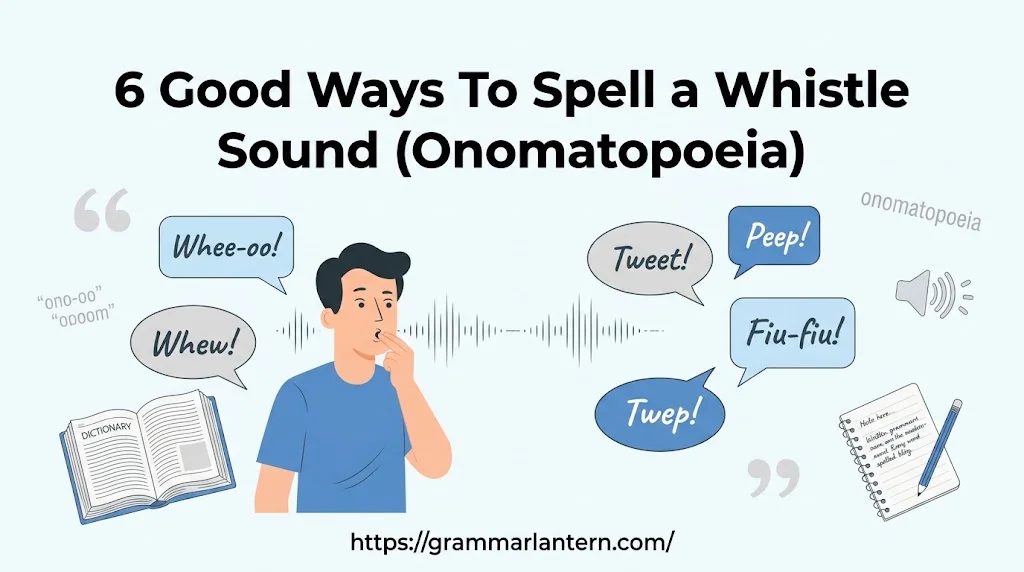
5. Fiu
Fiu is useful as a creative representation of a whistle, but it needs a little more explanation for an English-speaking audience.
It isn’t a standard English whistle word in the same way that whew is. Instead, similar forms appear in other languages and writing traditions. For example, fiu fiu is used as an onomatopoeic representation of a wolf whistle in Spanish-language contexts.
A similar form also appears in discussions of Portuguese usage, where fiu fiu represents the whistle people use to attract someone’s attention.
How Can “Fiu” Work in English Writing?
If you’re writing fiction or another creative form, you can use fiu as a deliberately stylized sound effect.
For example:
Fiu! The boy whistled across the street.
However, readers familiar only with mainstream American English may not immediately recognize it. If clarity matters, pair it with a descriptive verb.
Fiu! He gave a playful whistle from the other side of the road.
That small addition removes ambiguity.
When Is “Fiu” Most Useful?
Fiu can work particularly well when:
- You’re using playful sound effects.
- You’re writing dialogue.
- You’re representing a foreign-language sound convention.
- You want a stylized rather than dictionary-standard sound.
- The surrounding context clearly establishes that someone is whistling.
6. Fiu-Fiu
Fiu-fiu is especially interesting because it has a recognizable connection with the wolf whistle in several languages and cultures.
The expression fiu fiu is explicitly described as the Spanish-language onomatopoeia for a wolf whistle.
In Portuguese discussions, the same form is used to represent the whistle people make when they find someone attractive or want to attract attention.
However, English does not normally rely on fiu-fiu as its standard written representation of this sound. In English prose, wolf-whistled or gave a wolf whistle is often clearer.
What Is a Wolf Whistle?
A wolf whistle is a distinctive whistle used to attract someone’s attention, traditionally often toward a person considered attractive.
It usually involves a noticeable change in pitch rather than one unchanging note. That’s why simply writing one flat syllable may fail to capture the sound.
For example:
Fiu-fiu! he called playfully from across the street.
Or, in more conventional English:
He wolf-whistled as she walked past.
The second version is clearer for a general American English audience.
Whistle Sound Spellings Compared
Choosing a sound effect becomes much easier when you compare the options side by side.
| Sound spelling | Pitch | Length | Feeling | English familiarity |
| Whee-oo | Changing | Medium | Melodic or signaling | Moderate |
| Whew | Usually falling or breathy | Short | Relief, surprise, whistle-like exclamation | High |
| Tweet | High | Short | Light or birdlike | High |
| Peep | High | Very short | Tiny or faint | High |
| Fiu | Variable | Short | Stylized whistle | Low in US English |
| Fiu-fiu | Changing/repeated | Medium | Wolf whistle or playful attention | Low in US English |
The table reveals an important writing principle: sound spelling and sound description aren’t the same thing.
A sound effect tries to imitate what the reader should hear. A descriptive phrase tells the reader what happened.
Both tools have a place.
How To Choose the Right Whistle Sound in Writing
The strongest choice starts with the sound itself. Before picking a spelling, ask what the whistle actually does.
Consider the Pitch
Pitch is one of the easiest ways to separate whistle sounds.
A very high whistle may work with peep or tweet. A whistle that rises and falls can work better with whee-oo.
For example:
- High and tiny: peep
- High and birdlike: tweet
- Rising and falling: whee-oo
- Two-part wolf whistle: fiu-fiu
Consider the Volume
Volume changes the emotional effect.
A quiet whistle might need a word like peep. A loud whistle may be better represented through description:
A piercing whistle cut through the crowd.
Trying to spell every loud whistle can sometimes make prose look cartoonish. In serious fiction, he let out a piercing whistle may be stronger than an elaborate sound effect.
Consider the Purpose
Ask why the character whistles.
Is the person:
- Calling a friend?
- Signaling danger?
- Showing approval?
- Attracting attention?
- Imitating a bird?
- Expressing admiration?
- Making a playful sound?
- Producing a musical tune?
Purpose gives the sound meaning.
A referee’s whistle and a playful wolf whistle aren’t interchangeable, even though both involve whistling.
How To Write a Whistle Sound in Dialogue
Sound effects can work well in dialogue, but don’t force them into every scene.
For example:
“Whee-oo! Over here!”
The sound immediately establishes that the character is trying to attract attention.
You can also combine the sound with an action:
“Peep!” She put two fingers to her lips and whistled softly.
This approach gives the reader two clues. The sound effect creates the audio impression, while the action explains what produced it.
Sound Effect vs. Description
Compare these versions:
“Whee-oo!”
and:
He gave a long whistle that rose sharply before dropping away.
The first is faster and more playful. The second is more descriptive and controlled.
Neither is automatically better. The right choice depends on the tone of the writing.
Is a Whistle Sound an Example of Onomatopoeia?
Yes, a written whistle can function as onomatopoeia when the spelling imitates or evokes the sound.
However, not every whistle spelling has the same status.
Some forms are established words. Others are creative representations that writers use to help readers imagine a sound.
Whew is a good example of an established English word with an imitative origin. Etymonline traces whew to an early English exclamation imitative of a whistling sound.
By contrast, forms such as fiu-fiu depend more heavily on linguistic and cultural context. That doesn’t make them useless. It simply means that readers may not interpret them automatically as an English sound effect.
Common Mistakes
A few problems appear repeatedly when writers try to represent whistles.
Assuming There Is One Correct Spelling
English doesn’t provide one universal spelling for every whistle.
A writer has to consider the specific sound.
Using “Whew” Without Context
Modern readers often understand whew as an expression of relief or surprise.
If you mean an actual whistle, add context.
He whistled, “Whew!”
is clearer than simply writing:
“Whew!”
Using “Tweet” for Every High Sound
Tweet can suggest a whistle, but it also strongly evokes birds.
If the sound comes from a person, make that clear when necessary.
Overusing Punctuation
Writing:
“WHEEEEEEE-OOOOOOO!!!”
can work in a comic or exaggerated scene. In ordinary prose, however, it quickly becomes distracting.
Use repetition and punctuation with purpose.
Forgetting the Verb “Whistle”
Sometimes the simplest solution is the best one.
Instead of inventing a complicated spelling, write:
He whistled sharply.
That’s clear, concise, and natural.
How To Make a Whistle Sound More Realistic in Writing
A convincing sound description doesn’t depend entirely on the onomatopoeia. Pitch, rhythm, volume, duration, and reaction can make the scene much more vivid.
Compare:
“Whee-oo!”
with:
A sharp whee-oo sliced through the quiet street. He whistled again, shorter this time, until someone answered from the dark.
The second example gives the sound movement and purpose.
Useful Descriptive Words for Whistles
You can combine a sound spelling with words such as:
- sharp
- shrill
- piercing
- soft
- faint
- melodic
- high-pitched
- low
- breathy
- clear
- distant
- shrill
- playful
- prolonged
- short
- two-toned
These details help readers hear the scene rather than simply see a strange collection of letters.
A Practical Case Study: Choosing the Right Whistle
Imagine three characters using whistles in different situations.
Character A needs to call a friend across a large park. The sound rises and falls and carries a long distance.
“Whee-oo!”
This works because the spelling suggests pitch movement.
Character B wants to make a tiny sound without disturbing anyone.
“Peep.”
The short spelling matches the quiet action.
Character C gives a playful wolf whistle.
“Fiu-fiu!”
This can work in a multilingual or stylized context. For general American English, however, “He wolf-whistled” will usually communicate the meaning more directly.
The lesson is simple: don’t choose the spelling first. Choose the sound first.
Read More: Trama vs Trauma: Correct Spelling, Meaning, and Usage Explained
FAQs
1. What is the onomatopoeia for a whistle sound?
Common whistle sound words include “tweet,” “toot,” “phew,” “whee,” “wolf-whistle,” and “fiu.” The best choice depends on the type and intensity of the whistle.
2. How do you spell a sharp whistle sound?
You can write a sharp whistle as “tweet!”, “whee!”, or “fiu!” depending on the tone you want. Adding an exclamation mark can make the sound feel sudden and energetic.
3. Is “phew” a whistle sound?
“Phew” can represent a breathy whistle or an exhaled sound in creative writing. However, it can also express relief, so the surrounding context should make your meaning clear.
4. What is the best whistle sound effect for writing?
There isn’t one universally correct spelling. “Tweet” works well for a short, light whistle, while “toot” can suggest a brief, clear blast. Choose the spelling that best matches your scene.
5. Can I write “whistle” instead of using onomatopoeia?
Yes. You can simply use “whistle” as a verb or noun. For example, “He whistled loudly across the field.” Onomatopoeia is useful when you want readers to almost hear the sound.
6. Is “tweet” an onomatopoeia for a whistle?
Yes, “tweet” can imitate a short, high-pitched sound. It is also strongly associated with birds, so your context should make it clear that a person is whistling.
7. How do you write a long whistle in a story?
You can stretch the spelling to show duration, such as “wheeeeee!” or “fiuuuuu!” This technique works especially well in dialogue, comics, and informal creative writing.
8. How do you describe a loud whistle?
You can write something like “A sharp whistle pierced the silence” or “He let out a piercing whistle.” Descriptive language often creates a stronger effect than relying on the sound word alone.
9. Are whistle spellings standardized?
No. Onomatopoeic spellings are flexible because writers use letters to imitate sounds rather than follow one fixed spelling system. Different languages, cultures, and writing styles may represent the same sound differently.
10. Why is context important when using whistle onomatopoeia?
Context tells readers how to interpret the sound. A short “tweet!” might suggest a playful whistle, while a drawn-out “wheeeeee!” could represent excitement or a sustained sound. The surrounding action gives the sound its meaning.
Conclusion
Finding the right whistle sound onomatopoeia can make your writing more lively and memorable. Words such as “tweet,” “toot,” “phew,” and “whee” can represent different types of whistles, but the best choice depends on the scene, tone, and intensity you want to convey.
There’s no single spelling that works in every situation. Think about what the whistle sounds like and what emotion it should create. A quick, playful whistle needs a different treatment from a loud, piercing blast. With the right sound effect and a little descriptive detail, you can help readers hear the moment instead of simply reading about it.

Muhammad Haroon is the voice behind many of the clear, practical grammar guides you’ll find on Grammar Lantern. With a strong background in content writing and a genuine love for the English language, Haroon specializes in breaking down intimidating grammar topics into simple, digestible lessons. His goal is simple: to empower readers to write with confidence and clarity. Whether he’s explaining tricky tenses or demystifying punctuation, Haroon approaches each topic with patience, precision, and a touch of warmth—because he knows that learning grammar is a journey, not a race.

[…] Read More: 6 Good Ways To Spell a Whistle Sound and Onomatopoeia […]