The 6 Words for the Sound of Throwing Up can make your writing more vivid and natural. Onomatopoeia uses words that imitate real sounds, helping readers imagine what is happening. When someone is sick, you have several options for describing vomit and related noises. The best choice depends on the situation and the style of your story.
Blech works well for a quick expression of disgust, while Blargh creates a louder, more exaggerated effect. Gack can suggest a sharp choking or gagging sound. These choices add spice to your writing when you’re talking about throwing up. I usually focus on how the sound should feel before choosing one.
Retching noises are useful when you want a direct description of repeated heaving. Barf feels familiar and casual, while Keck can suggest an attempt to throw up. In my experience, matching each sound to the right situation makes the scene easier to imagine and keeps your creative writing from sounding repetitive.
Quick Answer
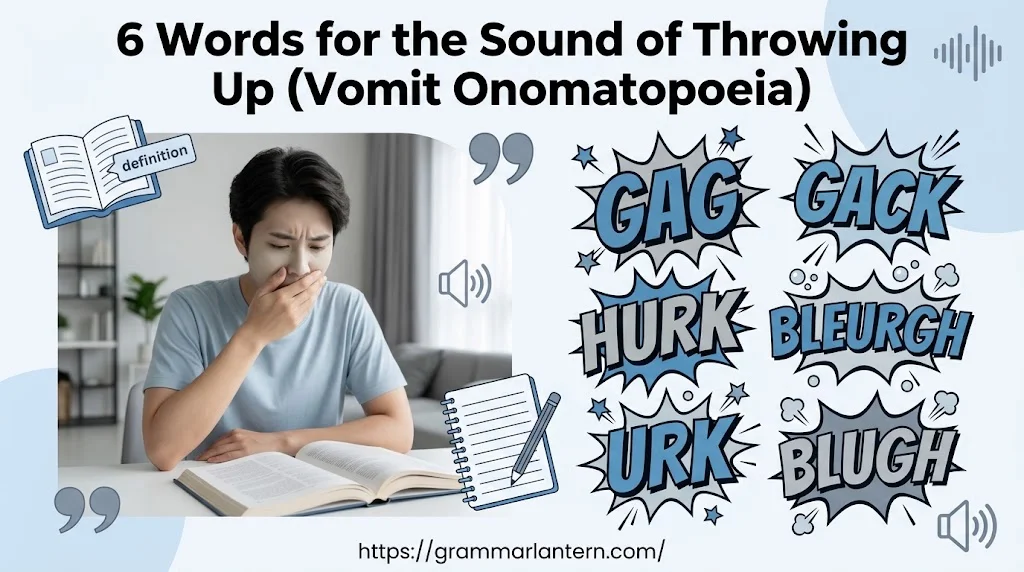
Six useful words for the sound of throwing up include gag, gack, hurk, bleurgh, urk, and blugh.
However, these words don’t all represent exactly the same noise. Some suggest the gagging or retching that happens before vomiting, while others imitate the unpleasant sound of vomiting itself.
| Sound word | What it suggests | Best writing use |
| Gag | Choking or retching | Realistic descriptions |
| Gack | Harsh, abrupt retching or vomiting | Informal fiction and comics |
| Hurk | Forceful heaving or retching | Fiction and exaggerated scenes |
| Bleurgh | Messy, exaggerated vomiting | Humor and comics |
| Urk | Short gagging or choking reaction | Sudden reactions |
| Blugh | Wet, unpleasant expulsion | Informal and comic writing |
If you want the most natural-sounding choice, gag often works better than an exaggerated sound effect. If you want a deliberately gross or comic effect, words such as bleurgh or blugh can make the scene more theatrical.
What Is Vomit Onomatopoeia?
Onomatopoeia refers to words that imitate, echo, or suggest the sounds they describe. Words such as buzz, hiss, crash, and bang are familiar examples.
Vomiting presents a different challenge.
There isn’t a single standardized English spelling for the sound of someone throwing up. Writers therefore use different combinations of letters to suggest the noise. The spelling often depends on the character, genre, mood, and level of exaggeration.
For example, a realistic novel might say:
He gagged and retched over the sink.
A comic might instead use:
“Bleurgh!”
Both communicate the basic idea. They simply use different tools.
Why Vomiting Sounds Are Hard to Spell
A person rarely makes only one sound while vomiting. The sequence might begin with a sharp gag, develop into repeated retching, and end with a wet expulsion.
The body also produces different sounds depending on the situation.
A dry heave sounds different from actual vomiting. A quiet bout of nausea sounds different from violent retching. A character trying desperately not to make noise creates another variation.
That’s why writers often combine sound words with action verbs rather than expecting one onomatopoeia to do all the work.
Gag
Gag is one of the most useful words for describing the sound or action associated with vomiting.
Strictly speaking, gag primarily names a physical reflex rather than a pure sound imitation. A person gags when the throat contracts because of nausea, irritation, or something unpleasant.
The word works well because readers immediately understand the reaction.
What Does “Gag” Sound Like?
A gag is usually short and abrupt. It can sound like a strained cough mixed with a choking or retching reaction.
You might use it when someone has just smelled spoiled food, seen something disgusting, or started feeling sick.
For example:
- He gagged when the rotten smell reached him.
- She covered her mouth and gagged.
- The foul odor made him gag instantly.
Notice that these examples don’t need a dramatic sound effect. The verb itself gives the reader enough information.
When to Use “Gag”
Use gag when you want the scene to feel relatively natural.
It’s particularly useful when the character hasn’t actually vomited yet. The word can signal that vomiting might happen next.
A useful sequence might look like this:
nausea → gagging → retching → vomiting
That progression gives the scene physical movement instead of dropping a random sound effect into the paragraph.
Gack
Gack is a harsher and more exaggerated sound-effect spelling. It can suggest a sudden gag, retch, or unpleasant vomiting noise.
Unlike gag, it has a stronger comic-book quality. You probably wouldn’t use it in every serious literary scene. In the right context, though, it can be extremely effective.
What Does “Gack” Suggest?
The hard g and abrupt ending make gack feel sharp and unpleasant.
It works particularly well when you want the reader to imagine a character suddenly reacting to something disgusting.
For example:
- “Gack!” He doubled over the trash can.
- Gack! The smell hit him before he reached the kitchen.
- She turned away with a quick “gack” and covered her mouth.
The word becomes more effective when the surrounding action supports it.
Read More: Rung or Rang? Difference Explained with Helpful Examples
When to Use “Gack”
Use gack in:
- Comics
- Informal fiction
- Humorous stories
- Exaggerated scenes
- Cartoon-style dialogue
- Playful sound effects
It isn’t the best choice for every context. If you’re writing a serious medical scene, a restrained description such as he retched may sound more believable.
Hurk
Hurk is another informal sound-effect spelling that can suggest forceful retching or vomiting.
Its heavy opening sound makes it feel more physical than delicate. The word works especially well when you want to show that the character is struggling through a strong heaving reaction.
What Does “Hurk” Mean in a Sound Effect?
In creative writing, hurk can represent the rough sound produced during forceful retching.
It can also function as a quick action sound in comics or humorous prose.
For example:
- “Hurk!” He grabbed the edge of the sink.
- She bent forward with a harsh hurk.
- Another hurk escaped before he could speak.
The exact spelling isn’t as important as the impression it creates.
When to Use “Hurk”
Hurk fits scenes where the vomiting reaction feels sudden, forceful, or exaggerated.
It can also work when the writer wants a sound that sits somewhere between a gag and a full vomiting noise.
Think of it as a sound-effect word, not a universally recognized formal term for a particular bodily sound.
Bleurgh
Bleurgh is one of the most recognizable playful spellings for an exaggerated vomiting sound.
It has a deliberately messy quality. The unusual cluster of letters makes the word look unpleasant before the reader even reaches the end.
That visual effect is part of its appeal.
What Does “Bleurgh” Represent?
Bleurgh usually suggests an exaggerated, wet, disgusting vomiting sound.
It works particularly well in comic writing because the spelling itself feels dramatic.
For example:
- “Bleurgh!” The character stumbled toward the bathroom.
- Bleurgh! The spoiled milk had finally defeated him.
- A loud “bleurgh” came from behind the door.
This type of spelling doesn’t aim for clinical precision. It aims for an immediate reaction.
When to Use “Bleurgh”
Choose bleurgh for:
- Comics
- Children’s humorous fiction
- Satirical writing
- Cartoon scenes
- Informal dialogue
- Deliberately exaggerated descriptions
It can feel too playful for a serious scene. That’s not a flaw. It simply means the word carries a strong tone.
Urk
Urk is a short, abrupt sound that can represent gagging, choking, or a sudden retching reaction.
Its greatest strength is brevity.
A character doesn’t always have time for a dramatic sound effect. Sometimes the reaction is quick and involuntary.
What Does “Urk” Sound Like?
The clipped structure of urk makes it feel like a sound that escapes suddenly.
For example:
- “Urk!” He clapped a hand over his mouth.
- She gave a sharp urk and backed away.
- An involuntary “urk” escaped as the smell reached him.
Because the word is short, it works particularly well in fast-paced scenes.
When to Use “Urk”
Use urk when you want to show:
- A sudden gag
- A brief choking reaction
- An unexpected wave of nausea
- The beginning of retching
- A comic or exaggerated response
It can also work well in graphic storytelling because short sound effects are easy to place visually.
Blugh
Blugh is an informal and exaggerated sound-effect word that can suggest a wet, unpleasant vomiting sound.
Like bleurgh, it isn’t intended as a scientific spelling of a specific bodily noise. Instead, it creates a sensory impression.
The unusual vowel-consonant combination gives it a thick, messy feel.
What Does “Blugh” Suggest?
Blugh can suggest the unpleasant expulsion associated with vomiting.
For example:
- “Blugh!” He leaned over the bucket.
- A miserable blugh came from the bathroom.
- Blugh! That was definitely not the breakfast he remembered eating.
The word becomes especially effective when the surrounding sentence establishes the setting.
When to Use “Blugh”
Use blugh when you want a sound to feel:
- Gross
- Exaggerated
- Comical
- Informal
- Cartoon-like
- Visually memorable
For serious prose, however, retch, heave, or vomit will usually provide more natural narration.
Vomiting Sounds vs. Retching Sounds
One of the biggest mistakes writers make is treating gagging, retching, and vomiting as identical actions.
They’re related, but they’re not interchangeable.
Gagging involves an involuntary contraction of the throat. It can happen without vomiting.
Retching refers to forceful attempts to vomit. A person can retch without producing anything.
Vomiting involves the actual expulsion of stomach contents.
Choking is different again. It involves difficulty breathing because something blocks or interferes with the airway.
This distinction helps you choose a more accurate word.
| Physical reaction | Useful words | What the reader imagines |
| Gagging | Gag, urk | Short throat reaction |
| Retching | Hurk, gack | Forceful heaving |
| Vomiting | Gack, blugh | Actual expulsion |
| Exaggerated vomiting | Bleurgh, blugh | Comic or dramatic effect |
| Quiet nausea | Gag, retch | Controlled physical reaction |
The best choice depends on what the character is actually doing.
How to Write the Sound of Throwing Up Naturally
A good vomiting scene doesn’t need a sound effect in every sentence. In fact, too many can make the writing feel cartoonish.
Instead, combine sound, movement, and physical reaction.
Pair the Sound With an Action
A sound effect becomes much stronger when the reader knows what produced it.
Compare these two approaches:
“Bleurgh!”
That’s clear, but limited.
Now consider:
“Bleurgh!” He gripped the sink and squeezed his eyes shut.
The second version gives the reader a complete physical picture.
The sound becomes part of the scene rather than a decoration pasted onto it.
Match the Word to the Tone
Tone matters enormously.
For a serious scene, consider verbs such as:
- gagged
- retched
- heaved
- vomited
- choked
- coughed
For a humorous scene, exaggerated forms can work better:
- bleurgh
- blugh
- gack
- hurk
- urk
The difference is similar to choosing between a photograph and a caricature. One aims for realism. The other exaggerates recognizable features.
Avoid Repeating the Same Sound
Repeated sound effects can quickly lose their punch.
Imagine a paragraph containing:
“Gack!”
“Gack!”
“Gack!”
“Gack!”
The effect becomes mechanical.
Instead, vary the description:
He gagged once before a harsh retch forced him over the sink. A second heave followed. Then silence.
The second version feels more physical and less repetitive.
Six Vomit Onomatopoeia Compared
Choosing among the six words becomes easier when you look at their tone and purpose side by side.
| Word | Realistic | Comic | Harsh | Short | Exaggerated |
| Gag | High | Medium | Medium | High | Low |
| Gack | Medium | High | High | High | Medium |
| Hurk | Medium | High | High | High | High |
| Bleurgh | Low | Very high | Medium | Medium | Very high |
| Urk | Medium | High | Medium | Very high | Medium |
| Blugh | Low | Very high | Medium | High | High |
These aren’t strict linguistic categories. They simply show how each spelling tends to feel on the page.
If realism is your priority, gag is usually the safest option. If you’re writing a comic scene, bleurgh can make the moment instantly obvious.
Vomit Onomatopoeia in Different Types of Writing
Different genres call for different levels of exaggeration.
Fiction and Novels
Narrative fiction usually benefits from moderation.
Instead of filling a paragraph with sound effects, describe the character’s physical reaction.
For example:
He gagged once, swallowed hard, and bent over the sink. The next retch came without warning.
This approach lets the reader experience the scene without turning it into a cartoon.
Comics and Graphic Stories
Comics provide more freedom.
A large “BLEURGH!” across a panel can communicate an entire action almost instantly.
Short sound effects work especially well because visual storytelling has limited space. One unusual word can replace several sentences of narration.
Humorous Writing
Comedy welcomes exaggeration.
A deliberately ridiculous sound can make an uncomfortable scene funny without needing a long explanation.
For example:
“Bleurgh!”
The sandwich had officially lost the argument.
The humor comes from the contrast between an unpleasant physical reaction and a playful narration style.
Dialogue and Text Messages
Informal sound effects can also appear in dialogue.
For example:
“Urk. I can’t even look at that.”
Or:
“Gack! What is that smell?”
These choices work because casual communication often uses exaggerated spellings to mimic real reactions.
How to Describe Throwing Up Without Onomatopoeia
Sometimes the best choice is not to use an onomatopoeia at all.
If the scene needs a serious or realistic tone, descriptive verbs may work better.
Useful alternatives include:
- Gagged — reacted with a throat contraction
- Retching — made forceful attempts to vomit
- Heaved — made a strong abdominal effort
- Choked — struggled with breathing or swallowing
- Vomited — expelled stomach contents
- Spewed — expelled something forcefully
- Regurgitated — brought swallowed material back up
- Wretched — attempted to vomit, though this form is often confused with retched
The choice should match the exact action.
For example, heaved can describe the physical effort without explicitly stating that vomiting occurred. Retching emphasizes repeated attempts to vomit. Vomited gives the clearest and most direct meaning.
A Practical Example: Choosing the Right Sound
Imagine three characters experiencing the same unpleasant smell.
The first character is in a serious novel:
He gagged and turned away from the sink.
The second appears in a comic:
“Gack!” He doubled over.
The third belongs in an exaggerated cartoon:
“BLEURGH!” He vanished behind the trash can.
All three scenes communicate a similar reaction. Yet the vocabulary changes the reader’s emotional response.
That’s the real power of vomit onomatopoeia. The word doesn’t merely describe a noise. It also establishes tone.
Common Mistakes
Treating Every Sound Effect as a Formal Word
Some spellings exist mainly as creative sound effects. Don’t treat every one as a standard dictionary term with one fixed meaning.
Words such as bleurgh and blugh are useful because readers can interpret their sound and context.
Using a Comic Word in a Serious Scene
A word like bleurgh can instantly make a serious scene feel humorous.
That’s useful when intentional. It’s distracting when accidental.
Confusing Gagging With Vomiting
A character can gag without vomiting.
If the character only reacts to an unpleasant smell, gagged may be more accurate than vomited.
Overloading the Scene With Gross Details
You don’t need to describe every physical detail.
A single strong sound followed by a clear action can create a more effective image than a paragraph of graphic description.
Read More: Seal vs Seel: Meaning, Differences, and Correct Usage Explained
FAQs
1. What is an onomatopoeia for throwing up?
Blech, Blargh, Gack, Barf, and Keck can represent the sound or action of throwing up in creative writing.
2. What is the best word for the sound of vomiting?
Blargh works well when you want a loud, exaggerated sound, while Gack can suggest gagging or choking.
3. Is “Blech” a vomiting sound?
Yes. Blech can represent a sound of disgust and may work when describing someone reacting strongly to something unpleasant.
4. What does “Gack” mean?
Gack is a sound effect that can suggest gagging, choking, or struggling to keep something down.
5. Can I use “Barf” as a sound?
You can use Barf creatively, although it more commonly describes the act of vomiting rather than the actual sound.
6. What does “Keck” represent?
Keck can describe a gagging or retching sound, especially when someone is trying to vomit.
7. Are retching noises onomatopoeia?
Retching noises are a descriptive phrase rather than one specific onomatopoeic word. They clearly describe the sounds produced while retching.
8. Which vomiting sound is best for dialogue?
Blech, Blargh, or Gack can work well in dialogue, especially in comics, humorous scenes, or informal fiction.
9. Can these words make writing more vivid?
Yes. These words help readers imagine the sounds and can make a scene feel more immediate and expressive.
10. How should I choose a vomiting sound?
Consider the situation, tone, and character. Use a softer sound for subtle writing and a stronger one when the scene needs a dramatic or humorous effect.
Conclusion
The right sound effect can make a vomiting scene much easier for readers to imagine. Blech, Blargh, Gack, retching noises, Barf, and Keck each create a slightly different impression. Your choice should match the mood, character, and situation.
Whether you’re writing fiction, dialogue, comics, or a humorous scene, these onomatopoeia options give you simple ways to describe throwing up without repeating the same expression. Pick the sound that best fits the moment, and your writing will feel more natural and lively.

[…] Read More: 6 Words for the Sound of Throwing Up and Vomit Onomatopoeia […]