
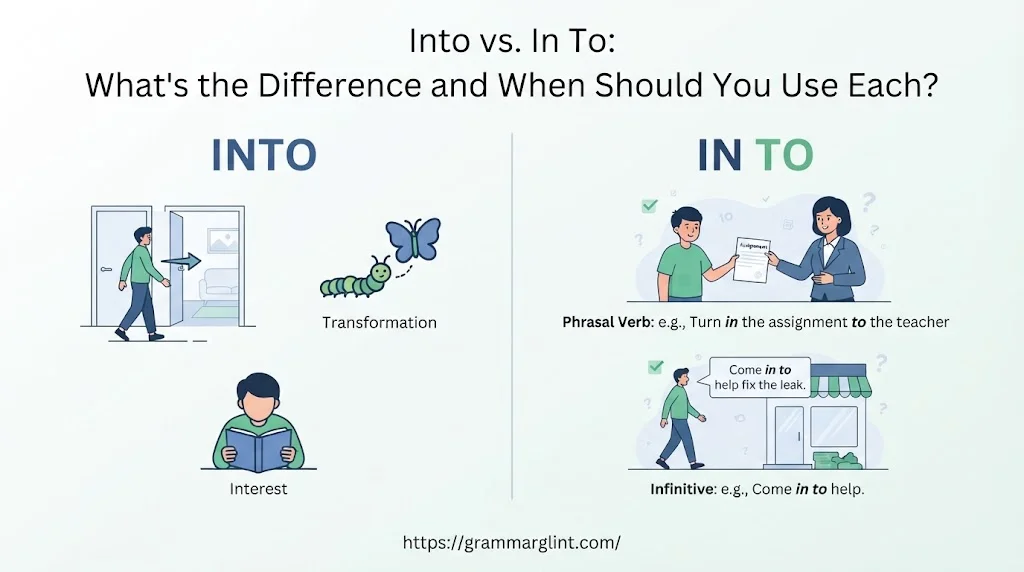
When you’re stuck on the distinction between into and in to, Into vs. In To can seem confusing because they look nearly identical, yet they have different uses and slightly different meanings. A common error is to confuse them because into is spelled as one word, while in to contains two words. When deciding which is right for a sentence, remember that into is a preposition that shows movement or direction within or inside something. For example, if you’re walking into a room, you’re moving toward it and going inside. This simple distinction can make the difference much easier to understand.
The significant difference becomes clearer when in to works as two separate words. Here, in is an adverb followed by the preposition to, and the exact meanings can depend on the verb that comes before in. A common meaning is in order to, which expresses a specific purpose. For example, someone may walk in to get a glass of water. In that example, the person enters the room for a particular reason or purpose. The two words remain separate because each one performs its own grammatical job.
From my experience, these quick grammar rules make this often misplaced two-word phrase easier to handle. If in and to simply wind up next to each other because of the sentence structure, don’t combine them automatically. In to sometimes appears after a verb, while into usually expresses movement or direction toward an interior space or position. Once you focus on the meaning rather than how the words look, you can avoid this common error and stop letting the two forms confuse you. This approach also helps you use the correct form when you need to do something in a sentence and want your meaning to remain clear.
The Quick Answer
Use into when it functions as one word and one grammatical unit. It commonly expresses movement toward the inside of something, direction, transformation, involvement, interest, or investigation.
Use in to when in and to perform separate grammatical functions. In many cases, in belongs to a phrasal verb while to introduces a noun phrase or an infinitive.
| Form | What It Is | Common Function | Example |
| into | One word | Movement inside | She walked into the room. |
| into | One word | Transformation | The caterpillar turned into a butterfly. |
| into | One word | Interest | He’s into photography. |
| into | One word | Investigation | We looked into the complaint. |
| in to | Two words | Phrasal verb + phrase | She turned the form in to her teacher. |
| in to | Two words | Phrasal verb + infinitive | He came in to help. |
| in to | Two words | Separate grammatical functions | She went in to ask a question. |
A useful rule of thumb is:
Into is one word when it works as a single preposition. In to uses two separate words when in and to have different grammatical jobs.
That rule won’t solve every unusual sentence, but it handles the vast majority of cases.
What Does “Into” Mean?
Into has several established meanings. Its most familiar use describes movement from outside to inside. However, the word can also express transformation, direction, interest, involvement, and other relationships.
Understanding these meanings makes the difference between into and in to much easier to recognize.
Into Shows Movement From Outside to Inside
The clearest use of into describes movement across a boundary.
Imagine someone standing outside a room. When that person crosses the doorway, the movement is into the room.
Examples:
- She walked into the kitchen.
- He stepped into the elevator.
- The children jumped into the pool.
- We drove into the garage.
- The dog ran into the house.
- She poured the juice into the glass.
The central idea is movement toward an interior space.
Compare these two sentences:
- The children are in the pool.
- The children jumped into the pool.
In the first sentence, in describes their location. In the second, into describes movement toward that location.
This distinction is worth remembering because in and into often appear in the same kinds of sentences while performing different jobs.
Into Can Show Direction or Contact
Physical movement doesn’t always mean entering an enclosed space.
Into can also indicate movement toward or against something.
For example:
- The car crashed into a wall.
- She walked into a lamppost.
- The ball flew into the window.
- He bumped into an old friend.
- She stared into his eyes.
The object doesn’t necessarily contain the moving thing.
A car can crash into a wall without passing through it. Someone can bump into another person without entering that person. Likewise, you can stare into someone’s eyes without any literal movement inside them.
The word still connects an action with a direction, target, or point of contact.
Into Shows Transformation or Change
Another major use of into involves transformation.
When one thing changes into another form, state, or category, into commonly connects the two.
Examples:
- The caterpillar changed into a butterfly.
- The company turned the warehouse into offices.
- The small discussion developed into an argument.
- The artist transformed the sketch into a finished painting.
- The team divided the class into four groups.
- The machine converts waste into usable energy.
Common expressions include:
- change into
- turn into
- transform into
- convert into
- develop into
- divide into
Consider this sentence:
The magician turned the paper into a flower.
The paper supposedly changed form.
Now compare:
The student turned the paper in to the teacher.
Here, turned in means submitted. The words to the teacher identify the recipient.
The difference is only a space, yet the meaning changes completely.
Read More: Son vs. Están in Spanish: Meaning, Differences, and Examples
Into Shows Interest
English also uses into to describe someone’s interests.
Examples:
- She’s really into photography.
- He’s into jazz.
- They’re into hiking.
- I’m not particularly into horror movies.
- She’s been into vintage clothing for years.
Here, into has nothing to do with physical movement.
It means interested in, enthusiastic about, or involved with something.
This informal use is extremely common in everyday American English.
Compare:
She’s into photography.
with:
She walked into the photography studio.
The first sentence describes interest. The second describes physical movement.
The same word can handle both meanings because context does the heavy lifting.
Into Can Show Involvement in a Situation
Into can also describe becoming involved in a condition, activity, or situation.
Examples include:
- He got into trouble.
- She got into an argument.
- They went into business together.
- He got into photography.
- The company went into debt.
- She got into a difficult situation.
The movement here is figurative.
You aren’t literally walking into trouble. Instead, you become involved in a situation.
This use follows the same broad idea as physical movement: something moves from one state or condition into another.
Into Can Mean “Investigate”
Some verbs naturally pair with into.
One of the most familiar is look into.
Look into means to investigate, examine, or consider something carefully.
Examples:
- The police will look into the complaint.
- We need to look into the cause of the problem.
- The manager agreed to look into the issue.
- She is looking into several possible solutions.
- The committee will look into the allegations.
Here, into isn’t describing physical movement.
It’s part of the expression look into, which means investigate.
That’s important because look into and look in to can have different grammatical structures depending on the sentence.
Into Can Describe Progress Within a Period
Into can also describe how far something has progressed within a period, stage, or process.
Examples:
- We are well into the second half of the year.
- The project is three months into its schedule.
- They were already into the final stage of the process.
- The team is two weeks into the training program.
- We’re several chapters into the book.
In each case, into indicates progress within something.
The meaning is not physical. Instead, it describes a position or stage reached during a period or process.
Into Has a Mathematical Use
There’s also a mathematical use that many readers don’t immediately recognize.
Examples:
- Four goes into eight two times.
- How many times does six go into thirty?
- Twelve goes into sixty five times.
- Five goes into twenty four times.
In these sentences, into describes a division relationship.
Again, the word doesn’t refer to literal physical entry. English often extends spatial expressions into abstract areas such as mathematics, time, and ideas.
What Does “In To” Mean?
Unlike into, in to isn’t one preposition.
It’s simply two separate words appearing next to each other.
That distinction matters because each word may have a different grammatical role.
Usually, in belongs to the preceding verb or functions separately, while to introduces another phrase.
In To After a Phrasal Verb
This is one of the most important patterns to understand.
English contains many phrasal verbs that use in, including:
- turn in
- give in
- check in
- tune in
- hand in
- break in
- come in
- go in
- dive in
- call in
When to follows one of these constructions, you may need to keep in to separate.
Consider:
She turned the assignment in to her professor.
Break it apart:
turn in = submit
to her professor = identifies the recipient
Now compare:
The story turned into a disaster.
Here, turned into means transformed or became.
These aren’t spelling variations of the same construction. They’re different grammatical structures.
In To Before an Infinitive
Another common pattern occurs when to introduces a verb.
Examples:
- She came in to help.
- He went in to speak with the manager.
- I stopped in to say hello.
- They stepped in to rescue the child.
- She went in to check the equipment.
- He came in to explain what happened.
In these sentences, to + verb forms an infinitive phrase:
- to help
- to speak
- to say
- to rescue
- to check
- to explain
The word in remains separate because it has its own role.
Think of the structure like this:
in + to help
not:
into + help
A useful clue is that to + verb often expresses purpose.
She came in to help.
The idea is:
She came in in order to help.
The expanded version isn’t always elegant, but it reveals the underlying structure.
The Core Grammar Difference
The easiest way to understand into vs. in to is to stop treating the issue as a spelling problem.
It’s really a question of grammatical structure.
Into Is One Grammatical Unit
Into functions as a single preposition.
Examples:
- walk into the room
- jump into the pool
- turn into ice
- crash into a wall
- look into the matter
- get into trouble
- be into music
The word stays together because it performs one grammatical function.
In To Contains Two Separate Words
With in to, the words keep their individual jobs.
For example:
He turned the application in to the office.
Break it down:
- turned in = submitted
- to the office = identifies the recipient
Another example:
She came in to talk to us.
Here:
- in = part of the movement or entry construction
- to talk = infinitive phrase expressing purpose
Once you identify those separate roles, the correct spelling becomes much easier.
A Reliable Test: Look at the Verb First
When you’re unsure about into vs. in to, don’t stare at the two words.
Look at the verb before them.
Ask:
Does the verb form a phrasal verb with “in”?
If yes, in may need to remain separate from to.
Consider:
He gave in to pressure.
The phrasal verb is give in, which means surrender or stop resisting.
The phrase to pressure identifies what caused the surrender.
So the structure is:
give in + to pressure
Now compare:
He went into the room.
Here, into functions as a preposition showing movement inside.
This method works particularly well because many common English phrasal verbs contain in.
The “In Order To” Test
Here’s another practical test.
When you see in to + verb, ask whether to + verb expresses purpose.
For example:
She came in to ask a question.
The meaning is essentially:
She came in in order to ask a question.
That makes in to a strong choice.
More examples:
- He stopped in to check the machine.
- She came in to speak with the director.
- They stepped in to help.
- I went in to see what happened.
- He came in to explain the situation.
This isn’t an infallible replacement test. English grammar depends on context. Still, it’s an excellent clue when to is followed by a base-form verb.
Examples Side by Side
Seeing the two forms together makes the distinction easier to remember.
| Sentence | Correct Form | Why? |
| She walked into the room. | into | Movement inside |
| He jumped into the lake. | into | Movement inside |
| The car crashed into the wall. | into | Movement toward/contact |
| The caterpillar changed into a butterfly. | into | Transformation |
| She’s really into music. | into | Interest |
| We looked into the problem. | into | Investigation |
| He turned the paper in to his teacher. | in to | turn in = submit |
| She came in to help. | in to | to help = purpose |
| They gave in to pressure. | in to | give in = surrender |
| We tuned in to the broadcast. | in to | tune in + to |
| She went into the building. | into | Movement inside |
| She went in to speak with him. | in to | to speak = purpose |
Common Confusions
Some combinations cause far more trouble than others. These examples are worth studying because the space can affect both grammar and meaning.
Turn Into vs. Turn In To
This is one of the clearest contrasts.
Turn into means transform, become, or change.
The small stream turned into a raging river.
Turn in can mean submit, deliver, or surrender.
Please turn your assignment in to the instructor.
The second sentence contains two separate pieces:
turn in + to the instructor
Compare the meanings:
| Construction | Meaning | Example |
| turn into | Transform | The seed turned into a plant. |
| turn in | Submit | She turned the report in. |
| turn in to | Submit to someone | She turned the report in to her supervisor. |
A missing space can therefore create an entirely different interpretation.
Give In To vs. Give Into
The standard construction is:
give in to
Examples:
- Don’t give in to fear.
- He finally gave in to pressure.
- The company refused to give in to the demands.
- She didn’t want to give in to temptation.
Here, give in is the phrasal verb.
To introduces the thing that caused the person to surrender.
Writing give into combines two separate grammatical elements into one word.
Tune In To vs. Tune Into
A traditional grammatical analysis treats tune in as the phrasal verb.
Examples:
Tune in to the evening news.
Millions tuned in to the broadcast.
We tuned in to hear the announcement.
Here, tune in means listen to or watch a broadcast, while to introduces what follows.
However, tune into also appears in modern English, particularly when speakers treat the expression as a more tightly connected verb phrase.
If you want a form that clearly preserves the separate phrasal-verb structure, tune in to is a straightforward choice.
Log In To vs. Log Into
Digital language creates another interesting case.
You’ll see both:
- log in to your account
- log into your account
The first follows a clear structure:
log in + to your account
Here, log in is the verb and to your account identifies the destination.
Log into has also become widespread in modern usage.
For formal writing, log in to makes the grammatical structure especially clear.
Examples:
Please log in to your account.
Log in to the portal before submitting the form.
The important point is that this expression differs from an ordinary movement construction such as:
She walked into the building.
Break Into vs. Break In To
These forms can express different ideas.
Break into commonly means entering somewhere forcibly or suddenly.
Someone broke into the house.
It can also mean beginning something suddenly:
She broke into laughter.
By contrast, break in to can occur when break in functions separately and to introduces another phrase.
For example:
He broke in to explain what had happened.
Here, break in means interrupt, while to explain expresses purpose.
The sentence structure determines the spelling.
Look Into vs. Look In To
Look into commonly means investigate.
The committee will look into the complaint.
We need to look into the financial records.
But in to can occur when in and to belong to separate constructions.
For example:
She looked in to check whether everyone was ready.
The sentence is less common than some alternatives, such as She went in to check, but the underlying distinction still matters.
The key lesson is simple: don’t memorize the spelling alone. Identify the grammatical structure.
Why Context Matters
Sometimes the difference becomes obvious only when you examine the entire sentence.
Consider:
She walked into the office.
This means she entered the office.
Now consider:
She walked in to speak with the manager.
Here, to speak expresses purpose.
The two expressions can sound almost identical in normal speech. On the page, however, the spacing tells the reader how the sentence is constructed.
That makes into vs. in to more than a spelling issue.
It’s a matter of grammar and meaning.
Common Mistakes to Avoid
Using “Into” Every Time You See “In To”
Not every sequence of these sounds represents the preposition into.
Incorrect:
He turned the assignment into his teacher.
Correct:
He turned the assignment in to his teacher.
The intended meaning is that he submitted the assignment to his teacher.
Using “In To” for Physical Movement Inside
When you mean movement toward the inside, into is normally the correct choice.
Correct:
She walked into the store.
Not:
She walked in to the store.
The first sentence uses into as a preposition showing destination.
Ignoring Phrasal Verbs
Phrasal verbs are often the hidden reason behind in to.
Watch for combinations such as:
- give in
- turn in
- tune in
- check in
- hand in
- break in
- come in
If in belongs to the verb, don’t automatically attach it to the following to.
Relying on Pronunciation
Pronunciation won’t reliably solve this problem.
Into and in to can sound nearly identical in ordinary speech.
That means you need to analyze the sentence rather than listen for a pause that may not exist.
Treating Every Construction as an Absolute Rule
English contains constructions where usage varies.
Log in to and log into are a good example.
Instead of assuming that every expression has only one possible form, consider:
- The grammatical structure.
- The intended meaning.
- The context.
- The level of formality.
- The established usage of the expression.
That approach gives you a more accurate understanding of English.
When “In” and “Into” Can Both Work
There’s another distinction worth knowing: in and into can sometimes both follow certain verbs without a meaningful difference in everyday usage.
For example:
Put the milk in the refrigerator.
Put the milk into the refrigerator.
Both sentences are natural.
Likewise:
The keys fell in the canal.
The keys fell into the canal.
The choice can depend on context, rhythm, regional usage, and the speaker’s preferred phrasing.
However, this flexibility doesn’t erase the distinction between into and in to.
In and into are different from the separate sequence in to.
A Practical Decision Guide
When you’re proofreading a sentence, ask these questions.
Do You Mean Movement Inside?
If yes, into will often be correct.
She walked into the room.
He drove into the tunnel.
Do You Mean Transformation?
If something changes from one form or state into another, use into.
The discussion turned into an argument.
The company transformed the building into a hotel.
Do You Mean Interest or Involvement?
Use into in constructions such as:
She’s into photography.
He got into trouble.
Does “In” Belong to the Verb?
If the verb is something like turn in, give in, or tune in, check whether the following to introduces something separate.
She turned the form in to the office.
He gave in to pressure.
Does “To” Introduce a Verb?
If to is followed by a base-form verb, you may have an infinitive.
She came in to help.
He went in to ask a question.
This is a strong clue that in to should remain separate.
A Simple Decision Tree
Use this quick process whenever you’re stuck.
Does the sentence describe movement toward the inside?
→ Use into.
Does it describe transformation or change?
→ Use into.
Does it describe interest or involvement?
→ Into is often correct.
Does “in” belong to a phrasal verb?
→ Keep in separate and examine what follows.
Does “to” introduce a verb?
→ Consider whether to + verb forms an infinitive expressing purpose.
Would changing the space change the meaning?
→ Choose the form that matches the intended grammatical structure.
A More Detailed Comparison
| Feature | Into | In To |
| Number of words | One | Two |
| Basic grammatical structure | Preposition | In + to |
| Movement inside | Yes | Usually no |
| Transformation | Yes | No |
| Interest | Yes | No |
| Phrasal verb construction | Usually not | Often |
| Infinitive after to | No | Often |
| Example | She walked into the room. | She came in to help. |
| Example | The ice turned into water. | He turned the form in to his boss. |
| Main test | What does into mean here? | What jobs do in and to perform? |
Case Study: “Turn Into” vs. “Turn In To”
Few examples demonstrate the issue better than turn into and turn in to.
Imagine a student completing a report.
The report turned into a detailed research paper.
Here, the report changed or developed into something else.
Now imagine the student submitting it:
She turned the report in to her professor.
Here, turn in means submit.
Now remove the space:
She turned the report into her professor.
The sentence suddenly suggests that the report transformed into the professor.
That’s obviously not the intended meaning.
This example shows why word spacing isn’t merely cosmetic. Word boundaries can carry grammatical information.
Case Study: “Come Into” vs. “Come In To”
Consider these two sentences:
The child came into the kitchen.
The child moved from outside the kitchen to inside it.
Now:
The child came in to ask for some water.
The child came inside, and to ask expresses the purpose.
The difference becomes even clearer if you separate the second sentence mentally:
came in + to ask
That simple split exposes the grammar.
Case Study: “Give Into” vs. “Give In To”
Consider:
The manager finally gave in to the demands.
The phrasal verb give in means surrender or stop resisting.
The phrase to the demands identifies what the manager surrendered to.
Writing give into removes the boundary between the phrasal verb and the following phrase.
The correct structure is:
give in + to the demands
This pattern appears frequently in formal writing, essays, journalism, and everyday conversation.
Practice Quiz
Choose into or in to in each sentence.
- She walked ___ the classroom.
- He came ___ ask a question.
- The frog jumped ___ the pond.
- She turned the assignment ___ her teacher.
- The discussion turned ___ an argument.
- He’s really ___ jazz.
- They gave ___ the pressure.
- We looked ___ the complaint.
- She went ___ help her friend.
- The car crashed ___ the fence.
- Please tune ___ the broadcast.
- The company turned the building ___ a hotel.
- He got ___ trouble.
- She came ___ check the equipment.
- The water changed ___ ice.
Answers
| No. | Answer | Reason |
| 1 | into | Movement inside |
| 2 | in to | to ask is an infinitive |
| 3 | into | Movement inside |
| 4 | in to | turn in = submit |
| 5 | into | Transformation |
| 6 | into | Interest |
| 7 | in to | give in = surrender |
| 8 | into | look into = investigate |
| 9 | in to | to help expresses purpose |
| 10 | into | Movement/contact |
| 11 | in to | tune in + to |
| 12 | into | Transformation |
| 13 | into | Becoming involved in a situation |
| 14 | in to | to check expresses purpose |
| 15 | into | Transformation |
Common Patterns Worth Memorizing
You don’t need to memorize every possible sentence. A handful of high-frequency patterns will cover much of your everyday writing.
Common “Into” Patterns
- walk into a room
- drive into a tunnel
- jump into a pool
- crash into a wall
- turn into something
- change into something
- divide into sections
- look into an issue
- get into trouble
- be into music
- go into business
- put something into a container
Common “In To” Patterns
- turn something in to someone
- give in to pressure
- tune in to a program
- come in to help
- go in to ask
- stop in to see someone
- step in to explain
- dive in to rescue someone
These patterns aren’t substitutes for grammar analysis, but they give you useful structures to recognize quickly.
A Final Proofreading Strategy
When editing an article, essay, email, report, or academic assignment, use this three-step method.
First, identify the verb.
Ask whether in belongs to that verb.
Second, examine “to.”
Ask whether it introduces a noun phrase or an infinitive.
Third, check the meaning.
If the sentence expresses movement inside, transformation, interest, involvement, or investigation, into may be the right choice.
If in belongs to a phrasal verb and to performs another job, keep them separate.
This method is more reliable than memorizing isolated spelling rules.
Read More: Healthcare vs. Health Care: Which Is Correct?
FAQs
1. What is the difference between into and in to?
Into is usually a preposition that shows movement, direction, or a change toward something. In to contains two separate words that perform different grammatical roles.
2. When should I use into?
Use into when something moves from outside to inside or changes into another state. For example, “She walked into the office.”
3. When should I use in to?
Use in to when in and to belong to different parts of the sentence. For example, “He came in to ask a question.”
4. Is into always a preposition?
In most common uses, yes. It can show movement, direction, position, involvement, or transformation.
5. Can into and in to be used interchangeably?
No. Although they look similar, their grammatical functions and meanings can differ. Replacing one with the other can change the meaning or make the sentence incorrect.
6. Does into always show physical movement?
No. Into can also describe a change or involvement. For example, “The discussion turned into an argument.”
7. Is “walked into” correct?
Yes. Walked into is correct when someone moves from outside to inside a place, such as “She walked into the classroom.”
8. Is “came in to help” correct?
Yes. In “He came in to help,” in and to have separate functions. The phrase can mean that he came in for the purpose of helping.
9. What is an easy way to remember into vs. in to?
Ask whether into expresses movement toward an inside position or a change. If in and to perform separate jobs, keep them as in to.
10. Why do people confuse into and in to?
They’re easy to confuse because they sound and look almost identical. Checking the meaning and grammatical role of each word can help you choose the correct form.
Conclusion
Understanding into vs. in to becomes much easier when you focus on how each form works in a sentence. Into is generally used as a single preposition to express movement, direction, entry, or transformation. In to, on the other hand, keeps in and to separate because they serve different grammatical purposes. Looking at the words around them can quickly reveal which form you need.
The best way to avoid this common mistake is to pause and check the sentence’s meaning. If something moves into a place or changes into something else, the single word is usually correct. If in belongs to the verb or acts separately from to, keep them apart. With a little practice, you’ll be able to recognize the difference naturally and use both forms with confidence.

For Shafiq ur Rehman, writing is an art form and grammar is the toolbox that makes it beautiful. As a dedicated content writer at Grammar Lantern, Shafiq approaches every topic like an architect carefully laying down strong foundations of understanding before adding the finer details. He loves diving into the trickiest grammar points and resurfacing with simple, bite-sized takeaways that anyone can grasp. When he’s not crafting articles, you’ll likely find him strategizing over a game of chess, exploring dusty local bookshops, or quietly jotting down poetic observations in his notebook.


[…] Read More: Into vs. In To: What’s the Difference and When Should Use Each? […]