
If you’ve ever paused over “as of,” “as at,” and “as from,” you’re not alone. These expressions all connect an idea to a particular time or date. That overlap makes them look interchangeable, especially in business writing, reports, contracts, emails, and official announcements.
The difference becomes much clearer when you focus on what the date is doing in the sentence. Are you describing a situation that existed at a particular point? Are you giving information that is current from a certain date? Or are you announcing when a new rule, arrangement, or condition begins?
Those small distinctions matter. A financial report might describe a company’s position as at December 31. A company announcement might say a new policy applies as of January 1. A formal notice might state that a revised procedure takes effect as from January 1.
The expressions can overlap, but they aren’t identical in emphasis. Regional usage matters, too. “As of” is especially common in American English, while “as at” and “as from” occur more often in formal British English.
This guide breaks down as of vs. as at vs. as from with practical examples, comparisons, common mistakes, and simple rules you can actually remember.
Quick Answer
The easiest way to separate these expressions is to look at their relationship with the date.
| Expression | Basic meaning | Main emphasis | Example |
| As of | At a particular date or starting on that date | Status, information, or effective date | As of Monday, the office is closed. |
| As at | At a particular point in time | A specific state or position | As at December 31, the balance was $50,000. |
| As from | Starting at a particular date | Beginning of a change or arrangement | As from January 1, the new rules apply. |
A useful shortcut is:
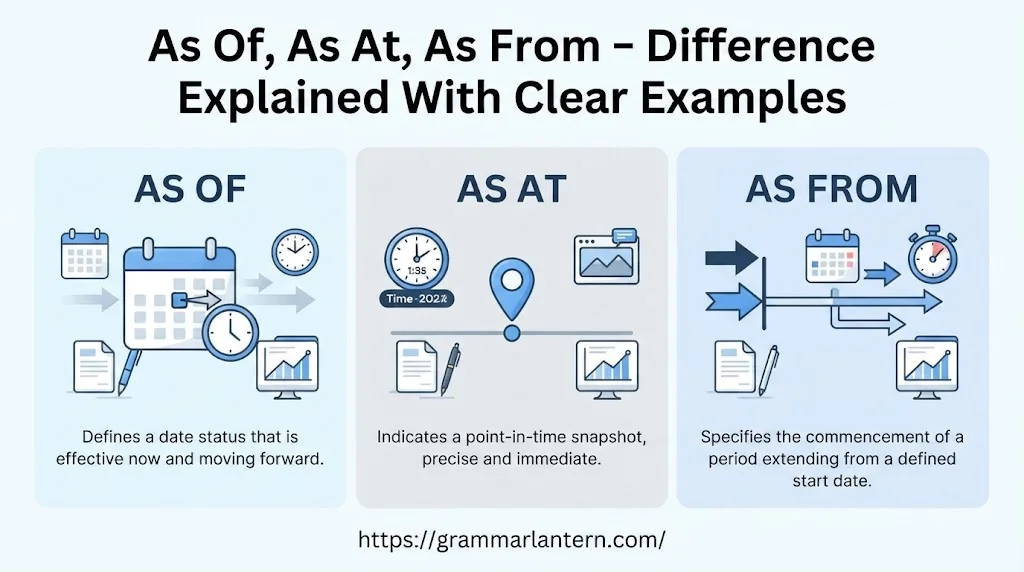
- As of = what is true by or from a date
- As at = what was true at that exact point
- As from = what starts from that date
There are situations where “as of” and “as from” can communicate nearly the same practical result. However, their emphasis differs.
For most everyday American English, “as of” is the safest and most natural choice. “As at” has a more formal reporting flavor, while “as from” often sounds distinctly formal or British.
What Does “As Of” Mean?
“As of” connects information, status, or a condition with a particular date or time.
In many sentences, it means “at that date” or “starting from that date.” The exact sense depends on the surrounding context.
For example:
As of June 30, the company had 250 employees.
Here, June 30 functions as a reporting date. The sentence tells you the company’s employee count at that point.
Now consider:
As of July 1, employees must use the new system.
Here, July 1 functions as an effective date. The new requirement begins on that date.
That dual use explains much of the confusion surrounding “as of.”
Examples of “As Of”
Consider these examples:
- As of Monday, the store is open seven days a week.
- As of December 31, the company had $2 million in cash.
- As of today, no final decision has been announced.
- The figures are accurate as of June 30.
- As of next month, parking fees will increase.
- As of January 1, all applications must use the new form.
Notice how the expression works naturally in both reporting and announcement contexts.
“As Of” in Business Writing
Business writers use “as of” constantly because dates often determine whether information remains current.
You might see it in:
- Financial reports
- Sales updates
- Employee records
- Project reports
- Inventory summaries
- Company announcements
- Legal notices
- Policy updates
- Statistical reports
- Website updates
For example:
The sales report shows 18,400 units sold as of September 30.
The date establishes the cutoff point for the information.
Without the date, readers might reasonably wonder whether the figure represents yesterday, last month, or the end of a reporting period.
What Does “As At” Mean?
“As at” usually describes the state, condition, amount, or position of something at a particular point in time.
It often appears in formal financial, accounting, legal, and administrative writing.
For example:
As at December 31, the company had total assets of $8 million.
The phrase focuses attention on the company’s financial position at that particular date.
You can think of “as at” as taking a snapshot.
Imagine pressing a camera shutter at exactly 11:59 p.m. on December 31. The resulting picture represents the company’s position at that moment. That’s the flavor “as at” often carries.
Examples of “As At”
- As at December 31, the company had 120 employees.
- The account balance was $45,000 as at March 31.
- As at the reporting date, the project remained incomplete.
- The figures were correct as at June 30.
- As at Monday morning, the investigation remained ongoing.
These sentences focus on the condition that existed at a particular point.
“As At” in Financial and Accounting Writing
This expression appears especially often when writers describe a financial position.
Common contexts include:
- Balance sheets
- Asset values
- Liability figures
- Account balances
- Shareholdings
- Financial statements
- Reporting periods
- Corporate records
For example:
As at March 31, 2026, the business held $750,000 in current assets.
The date identifies the point at which the financial position is being described.
That makes “as at” particularly useful when precision matters.
Read More: Given vs. Gave: Difference Explained With Helpful Examples
What Does “As From” Mean?
“As from” means starting from a particular date or time.
Unlike a simple snapshot, it points toward the beginning of a new situation.
For example:
As from January 1, employees must complete the training.
The important idea isn’t merely what existed on January 1. The sentence tells readers that the requirement starts on January 1.
You can often replace “as from” with “from” or “starting on,” especially in everyday American English.
For example:
As from July 1, the new fees will apply.
can become:
From July 1, the new fees will apply.
Or:
Starting July 1, the new fees will apply.
The meaning remains clear while the wording becomes less formal.
Examples of “As From”
- As from April 1, employees must use the new system.
- The revised fees will apply as from next month.
- As from Monday, visitors will need identification.
- The agreement takes effect as from January 1.
- As from June 15, the service will operate under new hours.
The phrase is grammatically established, but it has a noticeably formal tone.
As Of vs. As At: What’s the Difference?
The difference between “as of” and “as at” often comes down to emphasis and regional style.
Both can introduce a date connected to a factual condition.
Compare:
As of December 31, the company had 500 employees.
As at December 31, the company had 500 employees.
Both sentences can communicate the company’s employee count at that date.
The main difference is stylistic and contextual.
“As of” is extremely natural in American English. “As at” sounds more formal and appears frequently in British English and professional reporting.
Snapshot Meaning
When “as at” appears in formal reporting, it often creates a strong sense of a fixed snapshot.
For example:
As at December 31, total liabilities were $3.2 million.
The writer is describing the company’s financial position at the reporting date.
“As of” can perform the same job:
As of December 31, total liabilities were $3.2 million.
The difference isn’t that one sentence is automatically correct while the other is wrong. The distinction lies mainly in usage, register, and regional preference.
American English Preference
In American business writing, “as of” generally sounds more natural.
For example:
As of June 30, the project was 80% complete.
That sentence sounds ordinary and professional.
By contrast:
As at June 30, the project was 80% complete.
is understandable, but it carries a more formal or British flavor.
As Of vs. As From: What’s the Difference?
The distinction becomes more noticeable when you compare “as of” with “as from.”
Both can introduce a date associated with a change.
Consider:
As of January 1, the new policy applies.
This tells you the policy applies beginning on or after January 1.
Now:
As from January 1, the new policy applies.
The second version places stronger emphasis on January 1 as the starting point.
That’s the central distinction.
“As Of” Can Describe a Status
As of January 1, the company operates four offices.
The sentence gives a status connected to January 1.
“As From” Highlights Commencement
As from January 1, the company will operate four offices.
The wording emphasizes the change beginning at that date.
The difference can be subtle. Context often determines whether the expressions can substitute for one another.
As At vs. As From: What’s the Difference?
Here, the distinction is easier to spot.
“As at” points to a condition existing at a particular date.
“As from” points to something beginning from that date.
Compare these sentences:
As at December 31, the company employed 300 people.
This describes the company’s employee count at the reporting date.
Now:
As from January 1, the company will employ a new payroll system.
This describes the beginning of a new arrangement.
One looks like a snapshot. The other points to a starting line.
A Simple Comparison
| Phrase | Think of it as | Main question |
| As of | Date marker | What is true as of this date? |
| As at | Snapshot | What was the position at this exact date? |
| As from | Starting line | What begins from this date? |
That mental picture makes the distinction much easier to remember.
In American English
American English strongly favors “as of” in ordinary professional and general writing.
For example:
- As of today, the application is closed.
- As of Friday, we had received 300 applications.
- As of January 1, the new fee applies.
These forms sound natural in emails, reports, workplace notices, and everyday communication.
“As at” isn’t necessarily ungrammatical in American English. It simply appears less often in ordinary American usage.
Likewise, “as from” is understandable but tends to sound formal.
American writers often choose simpler alternatives:
| Formal expression | Natural alternative |
| As from Monday | From Monday |
| As from January 1 | Starting January 1 |
| As from next month | Beginning next month |
| As at December 31 | As of December 31 |
| As from July 1 | Effective July 1 |
This doesn’t mean the formal versions are incorrect. It simply reflects differences in natural usage.
In British English
British English uses all three expressions, particularly in formal contexts.
“As at” frequently appears in accounting and reporting language.
“As from” can also appear in formal notices, regulations, contracts, and announcements.
For example:
As at March 31, the outstanding balance was £12,000.
And:
As from April 1, the revised charges will apply.
In less formal British English, writers may still choose “from,” “starting,” or “as of,” depending on the context.
Regional preference affects naturalness, but it doesn’t create a completely different grammatical system.
Common Mistakes
These expressions become easier once you recognize the mistakes writers commonly make.
Using “As At” for Every Date
A date doesn’t automatically require “as at.”
For example:
As at next Tuesday, the new policy will begin.
This sounds awkward because the sentence concerns a future starting point rather than a reported state.
A more natural version would be:
As of next Tuesday, the new policy will begin.
Or:
Starting next Tuesday, the new policy will begin.
Using “As From” in Casual American Writing
You might encounter:
As from tomorrow, the office will close at 5 p.m.
It’s understandable, but American readers would usually find this more natural:
Starting tomorrow, the office will close at 5 p.m.
Or:
As of tomorrow, the office will close at 5 p.m.
The choice depends on the intended tone.
Treating “As Of” and “As From” as Perfect Synonyms
They can overlap, but they don’t always carry the same emphasis.
Compare:
As of July 1, Maria is the department manager.
This presents her status beginning at or from that date.
As from July 1, Maria will serve as department manager.
This emphasizes the commencement of the new role.
The distinction may be small, but formal writing often relies on these subtle differences.
Confusing a Reporting Date With an Effective Date
This is one of the most important distinctions.
A reporting date tells readers when information is being measured.
An effective date tells readers when something changes.
Compare:
As at March 31, the company had 75 employees.
That’s a reporting point.
Now:
As from April 1, the company will introduce flexible working hours.
That’s an effective starting date.
Mixing these concepts can make business writing ambiguous.
Punctuation and Grammar
These expressions can appear at the beginning, middle, or end of sentences.
When they introduce a sentence, a comma often improves readability.
For example:
1. As of today, the office is closed.
2.As at December 31, the account balance was $80,000.
3.As from January 1, the new policy applies.
At the end of a sentence, no special comma is normally needed:
The figures are accurate as of June 30.
The balance was correct as at March 31.
The comma isn’t caused by the expression itself. It depends on its position and grammatical role in the sentence.
“As Of Today,” “As At Today,” and “As From Today”
These three phrases deserve special attention because they can look almost identical.
As of Today
It is common and natural.
As of today, the application period is closed.
It establishes today’s date as the relevant point.
As at Today
“As at today” is possible in formal usage, but it sounds less natural in ordinary American English.
A writer may instead choose:
As of today, the figures are unchanged.
or:
As of today, the balance remains $25,000.
As From Today
It emphasizes that something starts today.
As from today, all visitors must sign in.
In American English, a simpler version would often be:
Starting today, all visitors must sign in.
The meaning is clear in both cases.
As Of vs. From vs. Effective From
These expressions can all describe dates, but they don’t always perform the same job.
As Of
Use “as of” when you want to connect a status, fact, or change with a date.
As of May 1, the service is available nationwide.
From
Use “from” when you want simple, direct wording.
From May 1, the service is available nationwide.
This is straightforward and conversational.
Effective From
Use “effective from” when the date marks the implementation of a rule, policy, rate, or arrangement.
The new pricing is effective from May 1.
This phrasing is especially useful in formal business communication because it clearly signals an implementation date.
Case Study: Financial Reporting
Imagine a company prepares quarterly financial statements.
Its cash balance on December 31 is $1.4 million.
A financial report might say:
As at December 31, the company held $1.4 million in cash.
The expression works because the writer is describing a financial position at a reporting date.
An American business might instead write:
As of December 31, the company held $1.4 million in cash.
Both sentences identify the relevant date. The first has a more formal reporting style.
Now imagine the company changes its minimum cash policy beginning January 1.
The announcement could say:
As of January 1, the company will maintain a minimum cash reserve of $1 million.
Or in more formal wording:
As from January 1, the company will maintain a minimum cash reserve of $1 million.
The first sentence is more typical of American business communication. The second emphasizes the commencement of the new policy.
Case Study: Workplace Policy
Suppose an employer introduces a new attendance policy.
The policy becomes effective on September 1.
These sentences have different functions:
As of August 31, the old policy remains in effect.
This describes the status before the change.
As of September 1, the new policy applies.
This identifies the effective date.
As from September 1, employees must follow the new procedure.
This strongly emphasizes the starting point.
The wording changes slightly because the time relationship changes.
Practical Comparison
| Sentence | What it emphasizes |
| As of June 30, we had 500 customers. | Customer count at a specified date |
| As at June 30, we had 500 customers. | Customer count at a formal reporting point |
| As from July 1, we will accept new payment methods. | Beginning of a new arrangement |
| As of July 1, the new payment method will be available. | Status beginning on a date |
| The figures are accurate as of June 30. | Information cutoff date |
| The figures were accurate as at June 30. | Formal point-in-time reference |
How to Choose the Right Expression
When you’re unsure, don’t stare at the three phrases and hope one magically looks right. Instead, ask what the date represents.
Ask: Am I Reporting a Status?
If you’re giving information connected to a particular date, “as of” usually works well.
As of March 15, the project was 70% complete.
Ask: Am I Giving a Formal Point-in-Time Position?
If you’re describing a financial or administrative position at a specific reporting date, “as at” may fit particularly well.
As at March 15, the account balance was $18,500.
Ask: Am I Announcing a Starting Point?
If something begins or changes from a particular date, “as from” can express that clearly.
As from March 16, the revised schedule will apply.
In American English, however, “starting March 16,” “from March 16,” or “effective March 16” may sound more natural.
A Simple Memory Trick
Here’s an easy way to keep the three expressions apart:
1.As of = date status
2.As at = date snapshot
3.As from = date beginning
Think of three images:
- As of → a calendar marking the relevant date
- As at → a camera taking a snapshot
- As from → a starting line
This isn’t a rigid grammar formula. Context can create overlap. Still, it provides a useful mental shortcut when you’re writing quickly.
Read More: Preform or Perform: Which Word Is Correct?
FAQs
1. What is the difference between “as of” and “as at”?
“As of” usually refers to a particular date from which something is true or applies. “As at” is often used to describe a situation or information at a specific point in time. For example, “The balance was $5,000 as at December 31.”
2. Is “as of” correct in American English?
Yes. “As of” is very common in American English. It can refer to a date when a situation begins, changes, or is being reported. For example, “As of Monday, the office will open at 9 a.m.”
3. Is “as at” grammatically correct?
Yes. “As at” is grammatically correct, especially in formal British English. It is commonly used in financial reports, business documents, and statements that describe a position at a particular date.
4. What does “as from” mean?
“As from” means that something starts or becomes effective from a particular date. It is more common in formal British English. For example, “The new working hours apply as from January 1.”
5. Can “as of” and “as from” mean the same thing?
Sometimes, yes. Both can indicate when a new situation or rule begins. However, “as from” places stronger emphasis on the starting point of an ongoing arrangement, while “as of” has a wider range of uses.
6. Which is more common: “as of” or “as at”?
“As of” is generally more common, particularly in American English. “As at” is more strongly associated with formal British English and is frequently seen in financial or official writing.
7. Should I use “as of” or “as at” in a financial report?
It depends on the style and regional convention. “As at” is common when reporting a company’s financial position at a specific date. For example, “Assets were valued at $2 million as at December 31.”
8. Is “as from January 1” correct?
Yes. “As from January 1” is correct and means that something starts from January 1. It is more formal and more common in British English. In American English, “as of January 1” would usually sound more natural.
9. Can I use “as of” for past dates?
Yes. “As of” can refer to past, present, or future dates depending on the sentence. For example, “As of December 31, the company had 200 employees.”
10. What is the easiest way to remember the difference?
Think about what the date is doing. Use “as at” when you are describing a situation at a specific point in time. Use “as of” when something is true, changes, or applies from a particular date and use “as from” when you want to emphasize the starting point of a new arrangement or rule.
Conclusion
As of, as at, and as from all connect information with a specific date, but they do not always serve the same purpose. “As of” is the most flexible and widely used, “as at” is common for describing a position at a particular date, and “as from” emphasizes when something begins or takes effect.
The easiest way to choose the right expression is to look at the role of the date in your sentence. If you are reporting a situation at a particular point, “as at” may fit best. If you are saying something is true or applies from a date, “as of” is usually a natural choice. When emphasizing the start of a new rule or arrangement, “as from” can be appropriate, especially in formal British English.




[…] Read More: As Of, As At, As From: Difference Explained With Examples […]