
Scoup vs. Scoop is a common spelling confusion because both forms look and sound remarkably similar. However, scoop is the correct spelling in standard English, while scoup is generally considered a misspelling. Knowing this simple distinction can help you avoid errors in professional writing, emails, reports, online content, and everyday communication.
The word scoop has several useful meanings that depend on the context. It can describe a tool for lifting or collecting something, the amount held by that tool, or the act of gathering something. In journalism, a scoop can mean an exclusive news story or important information revealed before others. In food-related contexts, it commonly refers to a serving or measured portion.
Because scoup may appear when people rely on pronunciation rather than spelling, it is easy to choose the wrong form. In this guide, you’ll learn the difference between scoup and scoop, why scoop is correct, how to use it naturally, and which meanings apply in food, journalism, technology, and everyday English.
Which Spelling Is Correct?
Scoop is the standard spelling in American English. It works as both a noun and a verb, and it has several closely related meanings.
You can use scoop for:
- A utensil used to lift or measure something
- The amount held by that utensil
- The action of lifting or removing something
- A hollow or scooped-out area
- Exclusive or timely information
- A news report obtained before competing outlets
- A rounded neckline in clothing
Scoup, by contrast, isn’t the standard spelling for these everyday meanings in American English.
That distinction matters because saying “scoup isn’t a word” would be too broad. Regional languages and dialects often preserve words that don’t appear in everyday standard English. Scoup is one such example. Scots records contain several forms related to scoop, including scoup, scoup(e), and skoup.
Quick comparison
| Word | Standard US English? | Common meaning |
| Scoop | Yes | Tool, portion, action, information |
| Scoup | No for these standard meanings | A regional Scots word |
| Scoops | Yes | Plural noun or third-person verb |
| Scooped | Yes | Past tense of scoop |
| Scooping | Yes | Present participle of scoop |
| Scoopful | Yes | An amount held by a scoop |
So if you’re writing an email, school assignment, article, recipe, report, or social media post in standard American English, scoop is the safe and correct choice.
What Does “Scoop” Mean?
The word scoop has more than one meaning. Most of them connect to the same basic idea: lifting, gathering, removing, or obtaining something.
That central idea helps explain why the word works in such different situations. A scoop can lift ice cream from a container. A person can scoop water from a bucket. A journalist can scoop information before anyone else reports it.
The meanings may look unrelated at first. They’re actually connected by the idea of taking something out or getting something ahead of others.
Scoop as a Noun
As a noun, scoop can refer to a physical object, an amount, an action, or information.
A scoop as a tool
A scoop can be a deep utensil designed to lift loose, soft, or granular material.
Think about an ice cream shop. The worker pushes a rounded scoop into a tub of ice cream, gathers a portion, and transfers it to a cone.
The same basic design appears in many settings.
Examples include:
- An ice cream scoop
- A flour scoop
- A grain scoop
- A pet-food scoop
- A garden scoop
- A measuring scoop
- A large industrial scoop attached to machinery
The exact shape and size can change, but the basic purpose remains similar.
A scoop as an amount
Scoop can also describe the amount that a scoop holds.
For example:
“I’d like a scoop of chocolate ice cream.”
Here, scoop doesn’t refer to the utensil. It refers to the portion of ice cream.
You can also say:
- One scoop of protein powder
- Two scoops of ice cream
- A scoop of flour
- A scoop of rice
- A scoop of soil
The actual quantity isn’t always identical. A “scoop” can mean different amounts depending on the tool, product, or context.
That’s why scoop isn’t automatically a precise unit of measurement.
Scoop as an action
The noun can also describe the action itself.
For instance:
“With one quick scoop, she removed the water.”
In this sentence, scoop describes the motion or action of gathering something.
This meaning leads naturally to the verb scoop.
Scoop as a Verb
As a verb, scoop means to take something up or remove it using a scoop or a similar motion.
Consider these examples:
- She scooped the ice cream into a bowl.
- He scooped flour into the mixing bowl.
- The child scooped up the toys.
- They scooped water from the boat.
- The machine scooped dirt from the trench.
The word doesn’t always require an actual scoop.
You can scoop up something with your hands, for example. The important part is the sweeping or gathering motion.
Read More: Kickoff vs. Kick-Off vs. Kick Off: Which One Is Correct?
Scoop in Journalism
One of the most interesting meanings of scoop appears in journalism.
A scoop is information or a news story that one reporter or publication gets before competitors.
For example:
“The local newspaper got the scoop on the mayor’s resignation.”
Here, the newspaper didn’t literally collect something with a tool. Instead, it obtained important information first.
The verb works in the same way:
“The small newspaper scooped its larger competitor.”
That means the smaller newspaper reported the story before the competitor did.
This meaning gives us a useful mental connection:
A physical scoop gets something out first. A journalistic scoop gets information out first.
What Does “Scoup” Mean?
Here’s where the comparison becomes more interesting.
In standard American English, scoup isn’t the normal spelling for the meanings discussed above. However, scoup is documented in Scots.
Scots is a distinct Germanic language variety with its own vocabulary, spelling traditions, pronunciation patterns, and historical development. Some Scots words resemble standard English words while carrying different meanings or regional forms.
In Scots usage, scoup has been recorded with meanings that include a spout or projecting lip of a vessel, a draught of liquor, and a spoonful or mouthful. As a verb, historical Scots usage includes meanings connected with drinking and bailing a boat.
Other Scots forms are also related to the English word scoop.
That means the spelling isn’t invented or automatically nonsensical. It simply belongs to a different linguistic context.
Why this distinction matters
Imagine someone writes:
“I want a scoup of vanilla ice cream.”
In ordinary American English, readers will almost certainly assume the writer meant scoop.
Now imagine a historical Scots text containing scoup.
The situation changes. The unusual spelling may be intentional because it belongs to the regional language being used.
This is why language questions sometimes need more than a simple “right” or “wrong” answer.
A spelling can be nonstandard in one variety of English while legitimate in another.
The Key Difference
The easiest way to understand scoup vs. scoop is to separate standard usage from regional usage.
| Feature | Scoop | Scoup |
| Standard American English | Yes | No |
| Refers to an ice cream portion | Yes | No |
| Refers to a scooping tool | Yes | No |
| Works as a common verb | Yes | No |
| Used for breaking news | Yes | No |
| Used in “What’s the scoop?” | Yes | No |
| Appears in Scots | Yes, including related forms | Yes, regionally |
| Best choice for US writing | Scoop | No |
The table reveals the practical answer.
If you’re writing for a general American audience, don’t overthink it. Scoop is the word you want.
Why Do People Spell “Scoop” as “Scoup”?
The mistake makes sense once you look at the sound.
Scoop and scoup are normally pronounced alike in standard English. Both suggest the sound /skuːp/.
That creates a classic spelling problem: the pronunciation doesn’t tell you which vowel sequence to write.
Pronunciation can mislead you
English spelling rarely works like a perfect sound-to-letter system.
Consider words such as:
- group
- soup
- troupe
- coup
- you
They contain different spelling patterns for sounds that may overlap in pronunciation.
Someone who hears scoop without seeing it written might reasonably guess scoup.
The guess is understandable. It just isn’t the standard spelling.
Familiar spelling patterns can interfere
Your brain doesn’t always retrieve words letter by letter. It often recognizes patterns.
The spelling -oup appears in several familiar words. That can make scoup look believable even though scoop is the standard form.
It’s similar to recognizing a face in a crowd. You don’t inspect every feature individually. Your brain processes the overall pattern.
Unfortunately, that shortcut sometimes produces a convincing spelling error.
Fast typing can create the mistake
Typing quickly makes these errors even easier.
The difference is only one letter:
S C O O P
S C O U P
The incorrect version looks close enough that you might miss it during a quick proofread.
That’s especially likely when the surrounding sentence makes the meaning obvious.
For example:
“Please add two scoups of sugar.”
You understand the sentence immediately. Because your brain already knows what the writer intended, it may quietly overlook the spelling mistake.
How to Use “Scoop” Correctly in Sentences
The best way to remember a word is to see it working in real sentences.
Scoop for food
“She ordered a scoop of strawberry ice cream.”
Here, scoop means a portion.
“Add one scoop of flour to the mixture.”
Here, it describes an amount transferred using a scoop.
Scoop for an object
“He grabbed the measuring scoop from the container.”
Here, scoop means the physical tool.
Scoop as a verb
“She scooped the rice into a bowl.”
The verb describes the action of gathering and moving the rice.
“The child scooped up the spilled beads.”
The phrase scooped up emphasizes a quick gathering motion.
Scoop in journalism
“The reporter landed a major scoop.”
Here, scoop means exclusive information or an exclusive news story.
“The website scooped every major newspaper.”
In this example, scooped functions as a verb meaning that the website reported the information first.
Scoop in conversation
“What’s the scoop?”
This informal expression means something like:
“What’s the latest information?”
You might use it when asking a friend about a new development, event, plan, or piece of gossip.
Another example:
“Give me the scoop before everyone else arrives.”
The speaker wants the latest details.
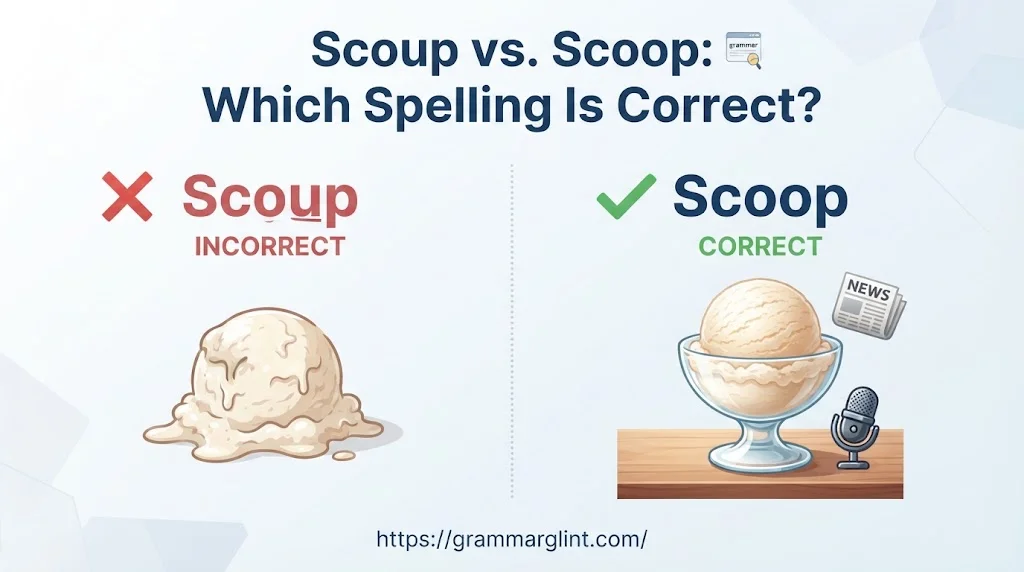
Incorrect vs. Correct
A quick correction table makes the spelling difference easy to remember.
| Incorrect in standard US English | Correct |
| a scoup of ice cream | a scoop of ice cream |
| two scoups of flour | two scoops of flour |
| He scouped the rice. | He scooped the rice. |
| She is scouping the soil. | She is scooping the soil. |
| The reporter got a scoup. | The reporter got a scoop. |
| What’s the scoup? | What’s the scoop? |
The correction is consistent.
If you mean the common English word, choose scoop and keep the double o.
Scoop vs. Scoopful: What’s the Difference?
Another useful comparison involves scoop and scoopful.
A scoop can refer to the tool or the amount it holds.
A scoopful specifically emphasizes the quantity contained in one scoop.
For example:
“She added a scoop of ice cream.”
This could refer to the familiar serving size or the portion itself.
“She added a scoopful of ice cream.”
This puts more emphasis on the amount that filled the scoop.
The distinction is subtle, and everyday speech often favors scoop.
Simple comparison
| Word | Meaning | Example |
| Scoop | A tool or portion | “Add one scoop of powder.” |
| Scoopful | An amount equal to one scoop | “He carried a scoopful of sand.” |
Don’t treat scoopful as a correction for scoup. They solve different problems.
Scoup is the spelling issue. Scoopful is a legitimate related word.
Scoop vs. Shovel: Are They the Same?
Not quite.
A scoop and a shovel can both move material. Their typical size, shape, and purpose often differ.
A shovel usually has a long handle and works well for digging or moving larger amounts of material.
A scoop can be smaller and more specialized. It often works with loose materials such as flour, grain, ice cream, pet food, or soil.
Consider these examples:
- You might use a shovel to move a pile of soil.
- You might use a scoop to transfer soil into a small flowerpot.
- You might use an ice cream scoop to serve dessert.
- You wouldn’t normally use an ice cream scoop to dig a garden bed.
The boundaries aren’t absolute. Large machines can have scoops capable of moving enormous quantities of earth.
The context tells you what the word means.
“The Scoop” in Everyday English
The phrase “the scoop” has become a familiar way to ask for information.
When someone says:
“What’s the scoop?”
they aren’t asking for a kitchen utensil.
They’re asking:
“What’s going on?”
“What’s the latest?”
“What information do you have?”
The expression is especially common in informal American English.
You might hear:
“Okay, what’s the scoop on the new manager?”
Or:
“Give me the scoop. Did the meeting happen?”
The phrase works because scoop developed a strong connection with information and news.
A journalist who gets information before competitors has a scoop. Eventually, the word became useful in everyday conversation for interesting or inside information more generally.
Why “Scoop” Has So Many Meanings
At first glance, the meanings of scoop may seem scattered.
A spoon-shaped tool.
A portion of ice cream.
A sweeping action.
A news exclusive.
A rounded neckline.
Yet these meanings developed around recognizable ideas of shape, removal, gathering, or a rounded depression.
The physical sense is the foundation.
A scoop can remove something from a larger mass. The action becomes scooping. The amount removed becomes a scoop. From there, the word develops figurative uses.
Journalism provides a good example.
A reporter who gets information first has effectively “taken” something valuable before competitors can get it. The language of physical gathering becomes a metaphor for gathering information.
That kind of semantic development happens constantly in English.
Words don’t always stay in one lane.
A Practical Case Study: Choosing the Right Spelling
Imagine a student writing this sentence:
“The bakery gave each customer one scoup of ice cream.”
The meaning is perfectly clear. The problem is the spelling.
The student may have heard the word many times but never noticed its written form.
Step one: Identify the meaning
The sentence refers to an amount of ice cream.
Step two: Identify the standard word
The English noun for that portion is scoop.
Step three: Check related forms
The plural is scoops.
The verb forms include:
- scoop
- scoops
- scooped
- scooping
Step four: Correct the sentence
“The bakery gave each customer one scoop of ice cream.”
The lesson is simple: meaning comes first, but spelling still needs to match the standard word.
Another Case Study: Journalism
Now consider this sentence:
“The reporter got a scoup about the election results.”
Again, the intended meaning is obvious.
The writer means exclusive information. In standard American English, the correct sentence is:
“The reporter got a scoop about the election results.”
The same spelling applies even though the meaning has changed from food to journalism.
That consistency makes scoop easier to remember.
Whether you’re talking about ice cream or breaking news, the spelling stays the same.
How to Remember the Spelling
Here’s a simple memory trick:
Remember the double O
Write it mentally as:
S-C-O-O-P
The two O’s sit together in the middle.
Think:
Two O’s make a scoop.
Then connect the spelling with familiar phrases:
- scoop of ice cream
- scoop of flour
- news scoop
- What’s the scoop?
The more often you see the correct form in meaningful phrases, the less likely you’ll be to write scoup.
You don’t need a complicated mnemonic. A strong visual association usually works better.
Is “Scoup” Ever Correct?
Yes, but the context matters.
Scoup has documented usage in Scots. It isn’t simply a modern misspelling created by people who don’t know how to spell scoop.
Historical Scots records contain the word with several regional meanings. Those meanings include terms connected with drinking, a spoonful or mouthful, a vessel’s projecting lip, and bailing a boat.
Scots also contains other related forms such as scuip, scoup(e), skoup, and scowp.
This linguistic background explains why a dictionary may contain scoup even though an American English spelling guide would tell you to use scoop.
The distinction is similar to the difference between a regional dialect form and the standard form taught in mainstream American writing.
So there are two separate questions:
Is “scoup” a documented word somewhere?
Yes.
Should you use “scoup” when you mean the ordinary American English word “scoop”?
No.
That distinction gives the most accurate answer to the scoup vs. scoop question.
Common Mistakes
Spelling isn’t the only potential problem. Writers sometimes misuse the word itself.
Mistake: Treating scoop as an exact measurement
A “scoop” doesn’t always represent a fixed quantity.
An ice cream shop may use a particular scoop size. A supplement manufacturer may provide a scoop with its product. A recipe might use the word informally.
Unless the context defines the size, one scoop isn’t necessarily a universal measurement.
Mistake: Confusing scoop with scoopful
These words overlap, but they’re not identical.
Use scoop for the tool or the general portion. Use scoopful when emphasizing the quantity contained by the scoop.
Mistake: Using scoup in standard writing
This remains the most common issue in this comparison.
If the intended meaning is the familiar English word, write:
scoop
not:
scoup
Mistake: Assuming every dictionary word belongs to standard US English
Dictionaries record regional, historical, technical, and specialized vocabulary.
Finding scoup in a dictionary doesn’t mean it’s the preferred spelling in American English.
Language has layers.
A word can be real without being appropriate for every audience or context.
Quick Reference Guide
| Question | Answer |
| Which spelling should you use in US English? | Scoop |
| Is scoop a noun? | Yes |
| Is scoop a verb? | Yes |
| Can scoop describe a portion? | Yes |
| Can scoop describe a tool? | Yes |
| Can scoop mean exclusive information? | Yes |
| Can scoop describe a news advantage? | Yes |
| Is scoup used in Scots? | Yes |
| Should you use scoup for an ice cream portion? | No |
| Should you write “What’s the scoop?”? | Yes |
| Is scoopful a word? | Yes |
| What is the easiest spelling tip? | Remember the double O |
Practice: Scoup or Scoop?
Test yourself with these examples.
Fill in the blanks
- She ordered a ___ of vanilla ice cream.
- The reporter landed an exclusive ___.
- He used a ___ to transfer the flour.
- She ___ the water out of the container.
- What’s the ___ on the new project?
- The child ___ up the scattered toys.
- Add two ___ of the mixture to the bowl.
Answer key
- scoop
- scoop
- scoop
- scooped
- scoop
- scooped
- scoops
Notice the pattern.
The word changes form depending on grammar, but the core spelling remains scoop.
Read More: Point of View: Meaning, Types, and How to Choose the Right One
FAQs
1. Is scoup a correct English word?
No. Scoup is generally a misspelling of scoop. Use scoop in standard English writing.
2. What is the correct spelling: scoup or scoop?
The correct spelling is scoop. It is the standard form used in dictionaries, professional writing, and everyday English.
3. What does scoop mean?
Scoop can mean a tool used for lifting or collecting something, an amount held by that tool, or the action of collecting something.
4. What does scoop mean in journalism?
In journalism, a scoop is an exclusive news story or important information that a journalist or news organization reports before others.
5. Can scoop refer to food?
Yes. In food-related contexts, scoop can describe a serving or measured portion of something, such as ice cream.
6. Why do people spell scoop as scoup?
The confusion usually comes from similar pronunciation. People may spell the word based on how they hear it instead of remembering its standard spelling.
7. Is scoop a noun or a verb?
Scoop can be both a noun and a verb. As a noun, it can describe a tool or an exclusive news story. As a verb, it can mean to collect, lift, or gather something.
8. Is “a scoop of ice cream” correct?
Yes. A scoop of ice cream is a common and natural English expression for a measured serving of ice cream.
9. Is “scoop up” correct English?
Yes. Scoop up means to lift or collect something, usually with a quick or curved motion. For example, “She scooped up the coins from the floor.”
10. How can I remember the spelling of scoop?
A simple trick is to remember that scoop contains “oo”, just like several familiar words such as pool and spoon. When you mean the tool, portion, collection, or exclusive news story, choose scoop.
Conclusion
The difference between scoup vs. scoop is straightforward once you remember that scoop is the correct standard spelling. Scoup is generally a spelling error, even though it may appear in informal writing because the two forms sound similar. Using the correct spelling is especially important in professional writing, online content, reports, emails, and other situations where accuracy matters.
Whether you are talking about a scoop of ice cream, a scoop used to collect material, or a journalistic scoop, the spelling remains the same. Remembering scoop as the standard form will help you avoid this common spelling mistake and communicate your meaning clearly.