Have you ever felt excited about something but also worried about what might happen next? These mixed feelings are a natural part of life, especially when you’re facing important decisions or unfamiliar experiences. Learning the right words to describe these conflicting emotions can help you express yourself more clearly. In this guide to 5 good synonyms for having mixed feelings, you’ll discover useful alternatives that capture different shades of emotional uncertainty.
The English language offers several nuanced alternatives, but each has a slightly different meaning and tone. Words such as ambivalent, conflicted, and torn can describe similar emotions, yet their correct usage depends on the context. Choosing the right synonym can improve your English usage, grammar, and formal writing.
In this article, we’ll explore five effective synonyms for having mixed feelings, explain their meanings, and provide practical examples. You’ll learn how to use these emotional expressions in everyday conversations, business communication, and academic writing. By the end, you’ll have a stronger vocabulary and greater confidence in expressing emotions with clarity and precision.
Quick Answer
The five useful synonyms and related expressions for having mixed feelings are conflicted, ambivalent, torn, indecisive, and of two minds. Each describes a slightly different experience.
- Conflicted: Experiencing opposing emotions, beliefs, or desires that create an internal struggle.
- Ambivalent: Having conflicting positive and negative feelings about the same person, situation, or decision.
- Torn: Feeling pulled between two choices, loyalties, or desires.
- Indecisive: Struggling to make a decision because you’re uncertain or unable to settle on an option.
- Of two minds: Feeling uncertain because you see reasons both for and against something.
Which word should you choose? Use ambivalent when you have opposing feelings, conflicted when those feelings create an inner struggle, and torn when you’re caught between competing options. Choose indecisive when you struggle to decide and of two minds for a conversational way to express uncertainty.
What Does Having Mixed Feelings Mean?
Having mixed feelings means experiencing different emotions about the same person, event, decision, or situation. Those emotions may agree with each other in some ways but conflict in others.
For example, you might feel proud when your best friend gets a job abroad while feeling sad because you’ll miss spending time together. Both reactions are genuine. Your happiness doesn’t cancel out your sadness.
Mixed feelings often arise when something has both benefits and drawbacks. A decision might promise personal growth while requiring a difficult sacrifice. Similarly, a relationship can bring affection and disappointment at the same time.
Here are some common examples:
- Relationships: You care about someone but feel hurt by their actions.
- Career decisions: You want a promotion but worry about the additional workload.
- Education: You’re excited about starting college but nervous about leaving home.
- Major purchases: You love a new car but feel uneasy about its price.
- Life changes: You’re ready to retire but concerned about losing your daily routine.
Mixed feelings aren’t necessarily a sign that something is wrong. They can reflect the fact that a situation matters to you in several different ways.
However, the phrase is broad. Words such as ambivalent and conflicted help you describe the experience more accurately.
5 Good Synonyms for Having Mixed Feelings
These five expressions overlap in meaning, but they aren’t interchangeable in every situation. Understanding their differences helps you choose the word that best captures what you’re experiencing.
Conflicted
Meaning: Experiencing opposing emotions, beliefs, desires, or values that create an internal struggle.
Conflicted is an excellent choice when two important parts of your life seem to pull you in different directions. You might want something while recognizing that it could hurt someone else or force you to sacrifice another priority.
For example, imagine that your employer offers you a promotion in another city. The position would improve your career prospects, but accepting it would mean leaving your family behind.
You want the opportunity. You also want to remain close to your loved ones. That tension makes you feel conflicted.
Example sentences:
- I’m conflicted about accepting the job because it pays well but requires frequent travel.
- She felt conflicted about ending the relationship because she still cared about her partner.
- He was conflicted between following his passion and meeting his family’s expectations.
When should you use it?
Choose conflicted when your feelings, responsibilities, or personal values clash. The word works particularly well when you understand both sides of a situation but struggle to reconcile them.
It’s also useful when the conflict involves more than two options. You can feel conflicted about a complicated situation without facing a simple either-or decision.
Conflicted vs. having mixed feelings: Having mixed feelings describes the general emotional experience. Feeling conflicted emphasizes the struggle created by those feelings.
Read More: 23 Best Replies to “It Is What It Is” Witty and Clever
Ambivalent
Meaning: Having opposing feelings or attitudes toward the same person, situation, object, or decision.
Ambivalent is one of the closest synonyms for having mixed feelings. It describes situations where you experience both positive and negative reactions toward the same thing.
Suppose you’ve received an offer to study at your dream university. You’re thrilled about the opportunity, but you’re also anxious about moving away and managing your expenses.
You want to attend, yet you have reservations. You feel ambivalent about the decision.
Example sentences:
- I’m ambivalent about moving abroad because I want a fresh start but will miss my family.
- She felt ambivalent about her promotion because she welcomed the recognition but disliked the added pressure.
- They were ambivalent about buying the house because they loved its location but worried about the repairs.
When should you use it?
Use ambivalent when you want to describe opposing feelings or attitudes toward one subject. It’s suitable for conversations about relationships, career choices, personal preferences, and major life changes.
The word also appears in formal writing when someone holds conflicting attitudes toward an issue.
One important distinction: ambivalent doesn’t mean indifferent. An indifferent person feels little interest or concern. An ambivalent person has competing feelings or attitudes.
For example:
- I’m indifferent about which restaurant we choose. Neither option matters much to me.
- I’m ambivalent about the restaurant. I like its food but dislike its high prices.
The first sentence expresses a lack of preference. The second describes conflicting reactions.
Torn
Meaning: Feeling pulled between competing choices, desires, relationships, or loyalties.
The word torn makes emotional tension easy to understand. It suggests that two or more things matter to you, yet choosing one may mean giving up something valuable.
Imagine that your closest friend plans a wedding on the same weekend as an important family gathering. You want to support your friend, but you also feel responsible for attending the family event.
You don’t simply feel uncertain. You’re torn between two commitments.
Example sentences:
- I’m torn between accepting the job and staying near my family.
- She felt torn about moving because she wanted adventure but loved her hometown.
- He was torn between helping his friend and protecting his own time.
When should you use it?
Choose torn when competing options create emotional pressure. It’s especially natural in everyday conversations about family, friendships, romantic relationships, career decisions, and personal sacrifices.
The expression often appears with between:
- Torn between two careers
- Torn between love and responsibility
- Torn between staying and leaving
- Torn between personal goals and family expectations
You can also use it without naming two explicit options: I’m torn about what to do next.
Torn vs. conflicted: These words are closely related. However, torn often highlights competing choices or loyalties, while conflicted can describe a wider internal struggle involving emotions, beliefs, or values.
Indecisive
Meaning: Having difficulty making a decision or choosing between alternatives.
Indecisive is useful when mixed feelings leave you unable to settle on a choice. However, it focuses on the difficulty of deciding rather than the emotions themselves.
Consider someone choosing between two university programs. One offers better career prospects, while the other focuses on a subject they enjoy more.
They keep comparing the options, changing their minds, and postponing the decision. Their indecision becomes the main problem.
Example sentences:
- I’m indecisive about which university to attend because both programs appeal to me.
- He became indecisive when he realized that each job offer had different benefits.
- She’s indecisive about buying the dress because she likes several different styles.
When should you use it?
Use indecisive when you want to emphasize difficulty reaching a decision. It’s appropriate for everyday choices, important purchases, education, career planning, and other situations where selecting an option feels difficult.
However, don’t treat it as a perfect synonym for having mixed feelings.
Someone can feel conflicted but make a decision quickly. Another person can be indecisive without experiencing strong opposing emotions.
For example, a shopper might spend twenty minutes choosing between two nearly identical phone cases. That person is indecisive, but the choice may not involve any meaningful emotional conflict.
Indecisive vs. ambivalent: Ambivalent describes conflicting feelings or attitudes. Indecisive describes difficulty choosing. The two experiences can overlap, but they don’t always occur together.
Of Two Minds
Meaning: Uncertain about a decision or opinion because you see reasons to support different sides.
Of two minds is a natural, conversational expression for having mixed feelings. It works particularly well when you can identify both the advantages and disadvantages of a situation.
Imagine that you’ve found an apartment near your workplace. The location is convenient, and the rooms are spacious. However, the rent is higher than you planned to pay.
You like the apartment, but the cost worries you. You’re of two minds about renting it.
Example sentences:
- I’m of two minds about accepting the offer because the salary is attractive but the commute is long.
- She’s of two minds about adopting a dog because she loves animals but travels frequently.
- We’re of two minds about renovating the kitchen because it needs improvement but the expense is substantial.
When should you use it?
Use of two minds in informal conversations, personal discussions, and everyday writing. It sounds natural when you’re weighing the pros and cons of a decision.
The expression commonly follows these patterns:
- Be of two minds about something: I’m of two minds about the proposal.
- Be of two minds about doing something: She’s of two minds about moving abroad.
Although the expression mentions two minds, it doesn’t mean that someone literally has two separate minds. It describes uncertainty between competing opinions or possibilities.
Of two minds vs. torn: Both expressions can describe difficulty choosing. However, of two minds emphasizes uncertainty or divided judgment, while torn often conveys a stronger emotional pull between competing options.

Comparison Table: Which Synonym Fits Best?
The following table highlights the main differences between these five expressions.
| Synonym | Main meaning | Best situation |
| Conflicted | Inner struggle between competing feelings or values | A decision challenges your beliefs or priorities |
| Ambivalent | Opposing feelings about the same thing | You experience both positive and negative emotions |
| Torn | Pulled between competing options or loyalties | Two important choices demand your attention |
| Indecisive | Difficulty making a decision | You struggle to settle on an option |
| Of two minds | Divided opinion or judgment | You see good reasons on both sides |
Here’s a quick way to remember them:
- If your emotions clash, you’re conflicted.
- If you feel both positive and negative emotions, you’re ambivalent.
- If two choices pull you in different directions, you’re torn.
- If you can’t settle on a choice, you’re indecisive.
- If you see convincing arguments on both sides, you’re of two minds.
These distinctions aren’t absolute. Language depends on context, and more than one expression may fit the same situation.
How to Choose the Right Synonym for Having Mixed Feelings
Choosing the right word becomes easier when you identify what makes your situation difficult. Instead of searching for a synonym that sounds sophisticated, focus on the meaning you want to communicate.
Identify the Main Source of Your Feelings
Start by asking yourself why you feel uncertain or emotionally divided.
Are you experiencing opposing emotions? Are two responsibilities competing for your attention? Or do you understand the options but struggle to make a decision?
Your answer points toward the most suitable expression.
For example, imagine that you’ve been offered a job with a higher salary.
- I’m ambivalent about the job. You have both positive and negative feelings about it.
- I’m conflicted about the job. The offer creates an internal struggle, perhaps because it clashes with your priorities.
- I’m torn between the job and my current position. You’re struggling between two alternatives.
- I’m indecisive about whether to accept. You’re having difficulty making a decision.
- I’m of two minds about the offer. You see reasons to accept it and reasons to decline it.
Each sentence communicates a slightly different emphasis.
Consider the Tone of Your Writing
Some expressions work better in formal writing, while others sound more natural in everyday conversation.
For formal or professional writing:
- Ambivalent
- Conflicted
- Indecisive
For everyday conversations:
- Torn
- Of two minds
- Conflicted
These are general tendencies rather than strict rules. You can use torn in professional writing and ambivalent in casual conversation when the context suits them.
For example, a report might say, Employees expressed ambivalence about the proposed policy. In a conversation, someone might say, I’m torn about whether to take the new position.
Both sentences communicate uncertainty, but their tones differ.
Match the Word to the Strength of the Feeling
The emotional intensity also matters.
If you’re mildly uncertain about a restaurant, of two minds may fit naturally. If a decision challenges your personal values, conflicted might communicate the deeper struggle more accurately.
Similarly, torn can suggest a painful choice between things you care about. However, it doesn’t always imply severe distress.
Consider these examples:
- Mild uncertainty: I’m of two minds about ordering dessert.
- Competing preferences: I’m ambivalent about moving to another city.
- A difficult personal choice: I’m torn between caring for my parents and pursuing a job abroad.
- An internal moral struggle: She felt conflicted about reporting her colleague’s mistake.
The best word expresses the actual situation rather than exaggerating it.
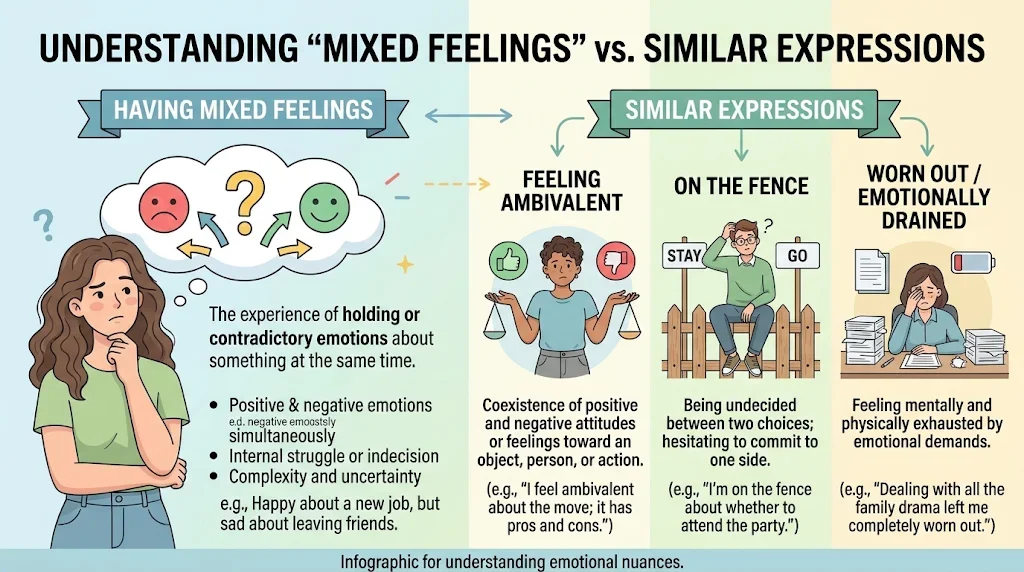
Having Mixed Feelings vs. Similar Expressions
Several English expressions overlap with having mixed feelings. Understanding their differences helps you avoid choosing a word that changes your intended meaning.
Mixed Feelings vs. Conflicted
Having mixed feelings is a broad description of experiencing different emotions about something. Conflicted emphasizes the struggle between those feelings, beliefs, or desires.
For example:
- I have mixed feelings about leaving my hometown. You feel both positive and negative emotions.
- I feel conflicted about leaving my hometown. Staying and leaving create an internal struggle.
The second sentence puts more emphasis on the difficulty of reconciling your competing priorities.
Mixed Feelings vs. Ambivalent
These expressions often communicate nearly the same idea. Both can describe positive and negative feelings about the same situation.
However, ambivalent offers a concise alternative when you want to describe conflicting attitudes.
For example:
I’m ambivalent about the new rules because they improve safety but limit flexibility.
You could also say, I have mixed feelings about the new rules.
Both sentences work. The difference is mainly one of wording and emphasis rather than a completely different meaning.
Mixed Feelings vs. Indecisive
Mixed feelings describe an emotional experience. Indecisiveness describes difficulty making a choice.
For example, someone might feel excited and nervous about moving abroad yet decide to go without hesitation. That person has mixed feelings but isn’t necessarily indecisive.
Conversely, someone might struggle to choose a shirt because several options look equally good. They may be indecisive without feeling emotionally conflicted.
Mixed Feelings vs. Confused
Confused generally means that you don’t understand something clearly or cannot make sense of the available information.
Mixed feelings, however, involve different emotional reactions.
For example:
- I’m confused about the instructions because they contradict each other.
- I’m conflicted about accepting the offer because it would help my career but hurt my personal life.
The first sentence describes a problem with understanding. The second describes competing priorities.
Of course, confusion and mixed feelings can occur together. You might struggle to understand a situation while also feeling anxious, disappointed, or hopeful about it.
Mixed Feelings vs. Indifferent
Indifferent describes a lack of strong interest, concern, or preference. It doesn’t normally express the emotional tension associated with mixed feelings.
Compare these sentences:
- I’m indifferent about where we eat. You have little preference for one restaurant over another.
- I’m ambivalent about where we eat. You have conflicting preferences or attitudes toward the options.
The distinction matters because indifferent and ambivalent can suggest very different attitudes.
Examples in Everyday Situations
Mixed feelings appear in ordinary life whenever a situation offers something desirable alongside a drawback. The following examples show how different synonyms fit real-world contexts.
Relationships
You might love someone while feeling disappointed by their behavior. Affection and frustration can exist together without either emotion being fake.
Example: I’m conflicted about giving him another chance because I still care about him but don’t want to repeat the same mistakes.
Here, conflicted emphasizes the internal struggle between affection and self-protection.
Another example would be feeling ambivalent about reconnecting with an old friend. You may miss the friendship while remembering why it ended.
Career Decisions
Career opportunities often require trade-offs between money, time, security, and personal fulfillment.
Example: She’s torn between accepting a promotion and staying in a role that gives her more time with her children.
The word torn captures the competing priorities. Both choices offer something valuable, so neither feels easy.
If she keeps postponing her decision, you could also describe her as indecisive. The best expression depends on whether you want to emphasize the competing priorities or her difficulty choosing.
Education
Starting university can bring excitement, anxiety, independence, and homesickness.
Example: I’m ambivalent about studying abroad because I want the experience but worry about being far from my family.
The word ambivalent captures the positive and negative emotions associated with the same opportunity.
You could also say you’re of two minds about studying abroad if you’re weighing the benefits against the financial and personal costs.
Major Purchases
Buying an expensive item can create conflicting feelings when you want it but question whether it’s worth the price.
Example: I’m of two minds about buying the laptop because its performance is excellent but it exceeds my budget.
This expression works naturally because you’re weighing reasons for and against the purchase.
Major Life Changes
Retirement, marriage, relocation, and parenthood can bring happiness alongside uncertainty.
Example: He feels conflicted about retiring because he’s ready to relax but worries about losing his sense of purpose.
This sentence illustrates how a positive life change can also create emotional challenges.
Having mixed feelings doesn’t mean you must reject the change. It simply means you’re considering several aspects of the situation at once.
Read More: In-Line vs. Inline vs. In Line: Meaning, Differences, and Examples
FAQs
1. What is the best synonym for having mixed feelings?
Ambivalent is one of the best synonyms for having mixed feelings. It describes experiencing conflicting emotions or having both positive and negative feelings about something.
Example: I feel ambivalent about accepting the new job because the salary is attractive, but the commute is too long.
2. What does it mean to feel ambivalent?
Feeling ambivalent means experiencing opposing emotions or having mixed opinions about a person, situation, or decision. You may want something while also feeling hesitant about it.
Example: She felt ambivalent about moving abroad because she wanted new opportunities but would miss her family.
3. What is another word for feeling torn between two choices?
Conflicted is a useful word for describing the struggle between two choices, especially when each option has advantages and disadvantages.
Example: He felt conflicted about attending the party because he wanted to see his friends but also needed to study.
4. Is “conflicted” the same as “ambivalent”?
The words have similar meanings, but they emphasize slightly different experiences. Ambivalent often describes having opposing feelings about something, while conflicted emphasizes the internal struggle those feelings create.
For example, you might feel ambivalent about a promotion but feel conflicted when deciding whether to accept it.
5. What is a formal way to say “I have mixed feelings”?
You can say, “I have conflicting emotions,” “I feel ambivalent,” or “I have reservations about this decision.”
Example: I have reservations about the proposal, although I recognize its potential benefits.
These expressions work well in professional conversations, academic writing, and formal discussions.
6. What is a casual way to describe having mixed feelings?
You can say you’re torn, unsure, or of two minds about something.
Example: I’m torn about buying the new phone because my current one still works perfectly.
These expressions sound natural in everyday conversations with friends, family, and coworkers.
7. Can you have mixed feelings about a person?
Yes. You can feel affection, admiration, frustration, or disappointment toward the same person. These emotions can exist together, even when they seem contradictory.
Example: I have mixed feelings about my former colleague. I admire her talent, but I didn’t appreciate how she treated the team.
8. What is the difference between mixed feelings and confusion?
Mixed feelings involve experiencing different or opposing emotions about something. Confusion means having difficulty understanding something or deciding what to believe or do.
For example, you might feel excited and nervous about a new job while still understanding exactly what the position involves.
9. How can I use synonyms for mixed feelings in a sentence?
Choose a synonym that matches the emotion and situation you’re describing.
- Ambivalent: I’m ambivalent about the proposed changes.
- Conflicted: She felt conflicted about leaving her hometown.
- Torn: I’m torn between two excellent opportunities.
- Of two minds: He’s of two minds about buying a house.
- Uncertain: They remain uncertain about the final decision.
Each expression communicates hesitation or emotional complexity in a slightly different way.
10. Why is it useful to learn synonyms for having mixed feelings?
Learning these synonyms helps you express emotions more accurately and avoid repeating the same phrases. It also improves your vocabulary, strengthens your writing, and makes conversations more meaningful.
For example, saying “I’m conflicted about this decision” communicates more specific emotional tension than simply saying “I’m not sure.”
Conclusion
Finding the right synonyms for having mixed feelings helps you describe complicated emotions with greater clarity. Words such as ambivalent, conflicted, and torn offer different ways to express uncertainty, hesitation, and opposing feelings. Although these terms overlap in meaning, each brings a slightly different emphasis to your message.
The key is to choose a word that fits your situation. Use ambivalent when describing opposing feelings, conflicted when emphasizing an internal struggle, and torn when you’re struggling to choose between options. With practice, you’ll expand your vocabulary, improve your English usage, and express your emotions more naturally in everyday conversations and formal writing.

Muhammad Haroon is the voice behind many of the clear, practical grammar guides you’ll find on Grammar Lantern. With a strong background in content writing and a genuine love for the English language, Haroon specializes in breaking down intimidating grammar topics into simple, digestible lessons. His goal is simple: to empower readers to write with confidence and clarity. Whether he’s explaining tricky tenses or demystifying punctuation, Haroon approaches each topic with patience, precision, and a touch of warmth—because he knows that learning grammar is a journey, not a race.