Have you ever paused while writing and wondered whether “saw” or “seen” is the correct word? The confusion between these two forms of the verb see is common, even among fluent English speakers. Understanding Saw and Seen: Correct Usage, Meaning, Rules, and Examples will help you choose the right word in everyday conversations, emails, and formal writing.
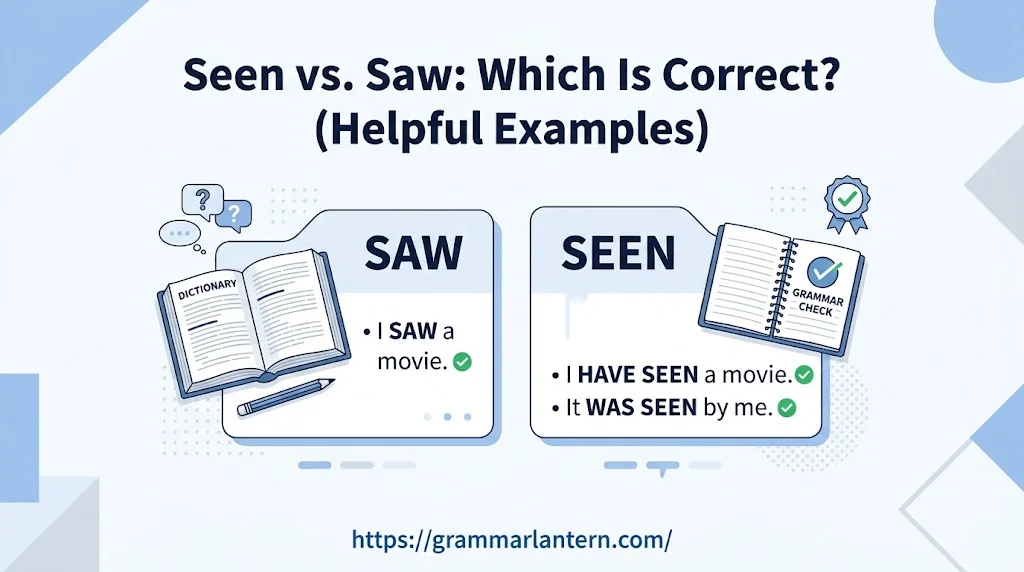
The main difference is simple: saw is the simple past tense, while seen is the past participle. You use saw to describe a completed action, as in “I saw him yesterday.” In contrast, seen usually appears with a helping verb, as in “I have seen that movie before.” Since see is an irregular verb, you cannot use these forms interchangeably.
Learning the correct usage of saw and seen helps you avoid common grammar mistakes and communicate more confidently. Whether you’re writing a social media post, sending a message, or preparing a professional document, knowing the rules makes a difference. In this guide, you’ll explore their meanings, grammatical differences, common mistakes, and practical examples to help you use both words correctly.
Quick Answer
Saw is the simple past tense of see, while seen is its past participle. Both are correct, but they follow different grammatical patterns.
- Saw: Use it to describe something you witnessed or viewed in the past. Example: I saw your brother at the store yesterday.
- Seen: Use it with a helping verb to form perfect tenses or with an appropriate auxiliary in passive constructions. Example: I have seen your brother at the store before.
| Feature | Saw | Seen |
| Verb form | Simple past tense | Past participle |
| Common use | Describing a completed past event | Forming perfect tenses |
| Typical sentence pattern | Subject + saw + object | Subject + have/has/had + seen + object |
| Example | We saw the new exhibit yesterday. | We have seen the new exhibit before. |
| Common mistake | “I have saw it.” | “I seen it yesterday.” |
Easy rule to remember: Say “I saw it” when reporting a past event and “I have seen it” when talking about an experience or using the present perfect. The surrounding sentence determines which form you need.
What Does Saw Mean?
Saw is the simple past tense of the verb see. It describes something you noticed, observed, watched, or witnessed at an earlier time.
When you use saw, you’re generally reporting an event that happened in the past. You don’t need have, has, or had before it in an ordinary simple past sentence.
For example:
- I saw a rainbow after the storm.
- Sarah saw her teacher at the grocery store.
- We saw an interesting documentary last night.
- They saw the accident happen near the intersection.
- He saw my message but didn’t reply.
In each example, saw tells the reader what someone observed in the past.
Saw as the Simple Past Tense of See
The verb see is irregular, which means it doesn’t form its past tense by simply adding -ed. Instead, its principal forms are:
| Verb form | Word | Example |
| Base form | See | I see the mountains. |
| Simple past | Saw | I saw the mountains yesterday. |
| Past participle | Seen | I have seen the mountains before. |
| Present participle | Seeing | I am seeing the mountains clearly. |
This distinction matters because you can’t use all four forms in the same grammatical position.
For instance, “I saw the mountains yesterday” is correct because saw expresses a past event. However, “I have saw the mountains” is incorrect in standard English because have requires the past participle seen.
When to Use Saw in a Sentence
Use saw when you want to describe something that happened in the past without using a perfect-tense construction.
Common situations include reporting an observation, describing an experience at a specific time, or telling someone what happened.
Consider these examples:
- Yesterday: I saw your car outside the office.
- Last week: We saw a great comedy at the theater.
- Two days ago: She saw her childhood friend.
- Earlier today: He saw a bird land on the windowsill.
- During a trip: They saw several historic buildings.
These sentences report past events directly. You don’t need a helping verb before saw.
However, questions and negative sentences follow a slightly different pattern. When you use did or didn’t, the main verb returns to its base form, see.
- Correct: Did you see the email?
- Incorrect: Did you saw the email?
- Correct: I didn’t see the sign.
- Incorrect: I didn’t saw the sign.
Why does this happen? The auxiliary did already carries the past-tense meaning, so the main verb stays in its base form.
Read More: Buses or Bus’s or Bus’? Correct Possessive Explained
Saw in Everyday Conversation
You’ll often use saw when telling a friend about something that happened during your day.
For example:
Alex: Did you go to the new restaurant?
Jordan: Yes, I saw the menu online first and decided to try it.
Here’s another example:
Mia: Did you see Daniel at the meeting?
Chris: Yes, I saw him near the entrance.
Notice that the questions use see after did, while the answers use saw to report past events.
This pattern is common in natural conversation. Once you recognize it, choosing the correct verb becomes much easier.
What Does Seen Mean?
Seen is the past participle of see. Unlike saw, it generally doesn’t function as the main verb in an ordinary affirmative simple past sentence.
Instead, seen commonly appears with helping verbs such as have, has, and had. It can also appear in passive constructions with forms of be.
For example:
- I have seen that movie three times.
- She has seen the doctor already.
- They had seen the warning before entering.
- The comet was seen across several regions.
In each sentence, seen serves a different grammatical purpose from saw.
Seen as the Past Participle of See
A past participle is a verb form used in certain grammatical constructions, including perfect tenses and passive voice.
For the verb see, the past participle is seen. You need to recognize this form because English uses different verb forms after different helping verbs.
Here are the three most common perfect-tense patterns:
Present perfect: Have/has + seen
Use this construction to discuss experiences or past actions connected to the present.
- I have seen that movie before.
- She has seen the results.
- We have seen significant improvements.
Past perfect: Had + seen
Use this construction when you want to show that one event happened before another past event.
- I had seen the warning before I entered the building.
- They had seen the performance before the theater closed.
- She had seen him once before their meeting.
Passive voice: Be + seen
Use this construction when the sentence focuses on the person or thing being observed rather than the observer.
- The stars were seen through the telescope.
- The painting can be seen from the entrance.
- The suspect was seen near the building.
These patterns show why seen doesn’t always need have, has, or had. The correct auxiliary depends on the construction.
When to Use Seen in a Sentence
Use seen when the sentence requires a past participle. In everyday writing, you’ll encounter it most often in present perfect and past perfect constructions.
For example, imagine someone asks whether you’ve watched a particular movie.
You might answer, “I have seen it already.”
Here, the speaker isn’t necessarily describing a specific viewing time. Instead, the sentence tells us that the experience happened at some point before now.
Compare these examples:
| Sentence | Why it works |
| I saw that movie last night. | The simple past describes an event at a specific past time. |
| I have seen that movie before. | The present perfect describes a previous experience. |
| I had seen that movie before my friends recommended it. | The past perfect places one event before another past event. |
| The movie was seen by millions of viewers. | The passive construction focuses on the movie and its viewers. |
The difference isn’t simply whether an event happened in the past. Both forms can refer to past events. The grammatical structure determines whether you need saw or seen.
Can Seen Be Used Without Have, Has, or Had?
Yes. Although seen often follows have, has, or had, those aren’t the only words that can precede it.
In passive constructions, seen can follow forms of the verb be, including is, was, were, and being.
Consider these examples:
- The rare bird was seen near the lake.
- The mountain can be seen from our hotel.
- The painting is being seen by thousands of visitors.
- Several changes were seen after the new policy took effect.
These sentences are grammatically different from “I seen the bird.”
In the passive examples, seen forms part of a passive construction. In the last example, the past participle follows were to describe an observed result.
The important point is that seen needs an appropriate grammatical structure. You shouldn’t automatically place it after a subject just because you’re talking about something that happened in the past.
Key Differences
The easiest way to understand seen vs. saw is to compare their roles within a sentence.
Saw expresses the simple past tense. Seen is the past participle used in perfect tenses and certain other constructions.
Look at these examples:
- I saw the new employee yesterday.
- I have seen the new employee before.
- I had seen the new employee before the interview.
- The new employee was seen entering the building.
All four sentences refer to seeing someone, but their structures communicate different information.
Saw vs. Seen in the Past Tense
One common source of confusion is that both saw and seen can describe events that occurred in the past.
However, the simple past and past participle aren’t interchangeable.
Suppose you attended a concert last Saturday. You would naturally say:
“I saw my favorite singer last Saturday.”
The simple past works because the sentence reports a completed event at a specific time.
Now imagine someone asks whether you’ve ever attended that singer’s concert. You could respond:
“I have seen my favorite singer perform live.”
This sentence uses the present perfect to describe a past experience without specifying when it occurred.
The difference becomes clearer when you compare the sentence structures.
| Simple past | Perfect construction |
| I saw the presentation yesterday. | I have seen the presentation before. |
| She saw the doctor on Monday. | She has seen the doctor already. |
| We saw the results last week. | We have seen the results. |
| They saw the building before sunset. | They had seen the building before sunset. |
Remember that time expressions provide useful clues, but they don’t replace grammatical rules. You still need to consider the complete sentence.
Saw vs. Have Seen
The difference between saw and have seen is especially important in everyday English.
Use saw when you want to report a past event, particularly when the time is stated or understood.
Use have seen when you’re discussing an experience or past action connected to the present.
For example:
- “I saw that episode last night.”
- “I have seen that episode before.”
The first sentence tells you when the viewing happened. The second tells you that the viewing occurred previously.
Here’s another practical example:
Imagine your coworker asks whether you’ve read an important email.
You might say, “I have seen it, but I haven’t replied yet.”
This response connects the past action with the current situation. You saw the email earlier, and you still need to respond.
However, if your coworker asks what happened yesterday, you might say, “I saw the email after lunch.”
Both sentences are correct. Your choice depends on the meaning you want to communicate.
Saw vs. Had Seen
Both saw and had seen can describe past events, but the past perfect adds a specific relationship between two events.
Use had seen when you want to make clear that one event occurred before another past event.
For example:
- “I saw the doctor before lunch.”
- “I had seen the doctor before my symptoms worsened.”
The first sentence simply reports a past appointment. The second places the appointment before another event: the worsening symptoms.
Consider another situation involving travel.
“I saw the museum before it closed” tells us that you visited the museum before closing time.
“I had seen the museum before my family arrived” makes the order of two past events clear. Your visit happened before your family’s arrival.
You don’t need the past perfect every time you mention two past events. If their order is already obvious, the simple past may work perfectly well.
Use had seen when the earlier timing matters to the reader.
Example Sentences
Examples make the difference easier to remember. The following sentences show how each verb form works in situations you might encounter at home, at work, or while talking with friends.
Examples of Saw in Sentences
Use saw to describe a past observation or experience.
- I saw a beautiful sunset on my way home.
- She saw her favorite author at the bookstore.
- We saw a deer crossing the road yesterday.
- He saw the mistake before submitting the report.
- They saw their cousins during the holiday.
- My teacher saw me helping another student.
- I saw your missed call this morning.
- The children saw a rainbow after the rain.
- We saw several historic buildings during our trip.
- Daniel saw the final goal during the championship game.
Each sentence uses saw to report something that happened in the past.
Notice that the subject changes from sentence to sentence, but the verb form stays the same. In the simple past, saw works with I, you, he, she, we, and they.
Examples of Seen in Sentences
Use seen when the sentence requires a past participle.
- I have seen that movie twice.
- She has seen the new office already.
- We have seen better results this month.
- They had seen the warning before the storm arrived.
- Have you seen my notebook?
- He hasn’t seen the final version yet.
- I had never seen such a beautiful beach before that trip.
- The rare animal was seen near the forest.
- This painting can be seen from the main entrance.
- Several improvements have been seen since the changes were introduced.
These examples demonstrate that seen can appear in questions, negative statements, perfect tenses, and passive constructions.
Pay attention to the words that come before it. They help establish the correct grammatical pattern.
Saw vs. Seen in Side-by-Side Examples
Compare these sentence pairs to see how the meaning and structure change.
| Saw | Seen | Main difference |
| I saw the movie yesterday. | I have seen the movie before. | A specific past event versus a previous experience. |
| She saw him at work. | She has seen him at work before. | A past observation versus repeated or previous experience. |
| We saw the results last week. | We had seen the results before the meeting. | A simple past event versus an earlier past event. |
| Did you see the photograph? | Have you seen the photograph? | A simple past question versus a present perfect question. |
| They saw the warning. | They had seen the warning before leaving. | A past observation versus an observation that preceded another event. |
| I saw the bird outside. | The bird was seen outside. | Active voice versus passive voice. |
The final pair highlights an additional distinction. In “I saw the bird outside,” the subject performs the action of seeing. In “The bird was seen outside,” the sentence focuses on the bird rather than identifying the observer.
Is It Correct to Say “I Seen”?
In standard written English, “I seen” is generally incorrect when used alone as the main verb in an ordinary past-tense statement.
If you want to describe something that happened yesterday, say:
- Incorrect in standard English: I seen your brother yesterday.
- Correct: I saw your brother yesterday.
If you’re describing a previous experience, use the present perfect:
- Incorrect in standard English: I seen that movie before.
- Correct: I have seen that movie before.
The difference comes from the grammatical role of each word. Saw is the simple past form, while seen is the past participle.
However, language varies across communities. Some regional and social varieties of English use constructions such as “I seen it” in everyday speech. These patterns can be part of a dialect’s grammar rather than random mistakes.
For school assignments, formal emails, professional reports, and other situations that call for standard written English, use “I saw” or “I have seen,” depending on your intended meaning.
Why Do People Say “I Seen It”?
People may say “I seen it” because they learned a regional variety of English in which that construction occurs naturally.
Everyday speech doesn’t always follow the conventions expected in formal writing. People also learn language through family conversations, local communities, and the speech patterns they hear around them.
It’s helpful to distinguish between dialect and formal written conventions. A construction that occurs in a particular dialect may differ from the form expected in a school essay or business report.
For example, if someone says, “I seen him at the store,” you can understand the intended meaning. In standard written English, however, the usual form is “I saw him at the store.”
The goal isn’t to judge how someone speaks. It’s to understand which form fits the setting and the grammatical convention you’re expected to follow.
Is “I Have Saw” Correct?
No. “I have saw” is incorrect in standard English because the auxiliary verb have requires the past participle seen in this construction.
The correct sentence is:
- Incorrect: I have saw that movie.
- Correct: I have seen that movie.
The same rule applies when you use has or had:
- Incorrect: She has saw the message.
- Correct: She has seen the message.
- Incorrect: We had saw the building before.
- Correct: We had seen the building before.
A useful way to remember this rule is to learn the verb forms together: see, saw, seen.
Whenever you use have, has, or had to form a perfect tense, choose seen rather than saw.
Common Mistakes
Even confident English speakers sometimes mix up irregular verbs. Fortunately, a few simple rules can help you avoid the most common errors.
Using Seen Without the Required Auxiliary
Incorrect: I seen the new teacher yesterday.
Correct: I saw the new teacher yesterday.
In a standard simple past statement, use saw. If you want to use seen, you need a suitable grammatical construction, such as “I have seen the new teacher before.”
Using Saw After Have or Has
Incorrect: I have saw that movie.
Correct: I have seen that movie.
The perfect-tense construction requires the past participle. Remember that have doesn’t take the simple past form saw in this pattern.
Using Saw After Had
Incorrect: I had saw the sign before turning.
Correct: I had seen the sign before turning.
The past perfect follows the same participle rule. After had, use seen to show that the observation occurred before another past event.
Using Saw After Did
Incorrect: Did you saw him at the party?
Correct: Did you see him at the party?
The auxiliary did already marks the question as past tense. Therefore, the main verb must remain in its base form, see.
Using Saw After Didn’t
Incorrect: I didn’t saw your message.
Correct: I didn’t see your message.
The same rule applies to negative sentences. After didn’t, use see, not saw or seen.
Here’s a quick reference table:
| Incorrect sentence | Correct sentence | Rule |
| I seen the dog. | I saw the dog. | Use the simple past. |
| I have saw the dog. | I have seen the dog. | Use the past participle after have. |
| She has saw it. | She has seen it. | Use the past participle after has. |
| Did you saw it? | Did you see it? | Use the base form after did. |
| We didn’t seen it. | We didn’t see it. | Use the base form after didn’t. |
| I had saw it before. | I had seen it before. | Use the past participle after had. |
In Questions and Negative Sentences
Questions and negative statements can be tricky because helping verbs affect the form of the main verb.
The key is to identify which auxiliary the sentence uses before choosing see, saw, or seen.
Asking Questions Correctly
Use see after did and seen after have, has, or had in perfect-tense questions.
For example:
- Did you see the announcement?
- Have you seen the announcement?
- Has she seen the announcement?
- Had they seen the announcement before the meeting?
These questions may seem similar, but their grammatical structures differ.
“Did you see the announcement?” asks about a past event. “Have you seen the announcement?” asks whether the experience has occurred by now. “Had they seen the announcement before the meeting?” places the experience before another past event.
The question word doesn’t change the rule. Whether you begin with when, why, where, or how, the auxiliary determines which verb form follows.
For instance:
- When did you see the doctor?
- Why have you seen the manager twice?
- Where had you seen that painting before?
Forming Negative Sentences
Negative sentences follow the same grammatical patterns.
Use didn’t see for the simple past and haven’t seen, hasn’t seen, or hadn’t seen for perfect constructions.
Examples include:
- I didn’t see your message yesterday.
- We haven’t seen the new schedule yet.
- She hasn’t seen that film before.
- They hadn’t seen the warning when they entered.
Avoid forms such as “didn’t saw” and “haven’t saw.” They combine grammatical patterns that don’t work together in standard English.
How to Remember the Difference
If you regularly confuse these words, focus on the sentence pattern instead of memorizing dozens of examples.
Here’s a simple memory trick:
Saw stands alone in ordinary simple past statements. Seen usually needs a helping verb or another appropriate auxiliary construction.
Compare these three sentences:
- Yesterday, I saw the movie.
- I have seen the movie before.
- I had seen the movie before my friends recommended it.
The first sentence uses the simple past. The second uses the present perfect. The third uses the past perfect.
You can also remember the three principal forms as a sequence:
See → Saw → Seen
Think of see as the base form, saw as the simple past, and seen as the past participle. Learning these forms together makes it easier to choose the right word when writing or speaking.
Remember that the memory trick isn’t an absolute rule for every construction. Passive sentences such as “The bird was seen” are also grammatically correct.
Practice: Saw or Seen?
Choose the correct word to complete each sentence.
- I _____ a shooting star last night.
- Have you ever _____ snow in the mountains?
- She had _____ the message before the meeting began.
- Did you _____ my keys on the kitchen table?
- We have _____ this movie several times.
- The rare bird was _____ near the lake.
- He _____ his cousin at the airport yesterday.
- They hadn’t _____ the final report before the deadline.
Answer key
- Saw — The sentence describes an event last night.
- Seen — The present perfect uses have plus the past participle.
- Seen — The past perfect uses had plus the past participle.
- See — Use the base form after did.
- Seen — The present perfect requires the past participle.
- Seen — The passive construction uses was plus the past participle.
- Saw — The sentence reports a completed past event.
- Seen — The past perfect negative uses hadn’t plus the past participle.
If you answered all eight correctly, you’ve grasped the central difference. If a few answers were tricky, review the auxiliary verbs in each sentence. They’re often the clearest clues.
Read More: 8 Words for Someone Who Follows the Rules
FAQs
1. What is the main difference between saw and seen?
Saw is the simple past tense of see, while seen is the past participle. Use saw for a completed past action and seen with helping verbs such as have, has, or had.
2. Is it correct to say “I seen it”?
No, “I seen it” is grammatically incorrect in standard English. The correct sentence is “I saw it” or “I have seen it.”
3. Should I use saw or seen with yesterday?
Use saw when describing an event that happened yesterday. For example, “I saw my friend yesterday.” You can also say, “I had seen my friend before yesterday,” if the context supports the past perfect tense.
4. Is “I have saw” correct?
No, “I have saw” is incorrect in standard English. After have, use the past participle seen. The correct sentence is “I have seen that movie.”
5. Can I use seen without a helping verb?
Yes, seen can appear without a helping verb in certain constructions, especially passive sentences or phrases with modal verbs. For example, “The movie can be seen online.” However, in ordinary active sentences, it usually needs a helping verb.
6. What are the three forms of the verb see?
The three main forms are:
- Present: See
- Simple past: Saw
- Past participle: Seen
For example, “I see the bird,” “I saw the bird,” and “I have seen the bird.”
7. Is “I had seen him” grammatically correct?
Yes, “I had seen him” is correct. The past perfect tense uses had followed by the past participle seen. It often describes an action that happened before another past event.
8. Is saw always a verb?
No, saw can also be a noun referring to a tool used for cutting wood, metal, or other materials. For example, “He used a saw to cut the wood.” In discussions about eyesight, however, saw is the past tense of see.
9. Which is correct: “I saw that movie” or “I have seen that movie”?
Both sentences are correct, but they emphasize different things. “I saw that movie” refers to a past event, while “I have seen that movie” emphasizes the experience without specifying when it happened.
10. How can I remember when to use saw and seen?
Remember this simple rule: saw stands alone in the simple past, while seen usually needs a helping verb in active sentences.
For example:
- Correct: “I saw her at school.”
- Correct: “I have seen her at school.”
- Incorrect: “I seen her at school.”
Conclusion
Understanding saw and seen becomes easier when you remember their roles in English grammar. Saw is the simple past tense of see, while seen is the past participle used with helping verbs such as have, has, and had. Knowing this difference helps you form accurate sentences and avoid common mistakes in everyday conversations and formal writing.
The easiest way to remember the rule is to practice using both words in context. Say “I saw the movie last night” when describing a specific past event, and “I have seen the movie before” when talking about a past experience. With regular practice, you’ll learn to choose the correct form naturally and communicate with greater confidence.