
When describing the sound of thunder, choosing the right word can make your writing more vivid. The 7 Good Words for the Sound of Thunder can help you find a good, descriptive term for different storm scenes. A distant rumble may feel gentle, while a sudden crack can sound sharp and powerful. The intensity of thunder can change from a soft roll to an immense burst that fills the sky.
One useful method is onomatopoeia, where words imitate or suggest real sounds. Words such as rumble, crack, and boom can make readers almost hear the thunder as they read. The best choice depends on the storm and the feeling you want to create. A strong word can show power, while softer wording can describe distant or calmer thunder.
To achieve a natural description, understand the mood and scene first. A carefully chosen descriptive expression can give your writing energy without sounding exaggerated. You can combine the sound of thunder with other sensory details to create a fuller picture. The goal is to choose the best term that clearly shows the storm’s character, movement, and emotional effect.
Quick Answer
The best words for the sound of thunder include rumble, boom, crash, crack, clap, roar, and peal.
Each word creates a different impression:
| Word | What It Suggests | Best Use |
| Rumble | Low, deep, rolling sound | Distant or prolonged thunder |
| Boom | Deep, powerful burst | Loud thunderclaps |
| Crash | Sudden, forceful noise | Dramatic thunder |
| Crack | Sharp, abrupt sound | Sudden nearby thunder |
| Clap | Distinct burst of sound | A thunderclap |
| Roar | Deep, powerful, sustained noise | Intense storms |
| Peal | Loud burst or succession of sound | Literary descriptions |
Among these, rumble is particularly useful for describing thunder that continues in the distance. Boom works well for a deep and powerful blast. Crack suggests something sharper and more sudden.
What Is Onomatopoeia?
Onomatopoeia refers to a word that imitates, echoes, or strongly suggests a natural sound.
Common English examples include:
- buzz for the sound of an insect
- hiss for a sharp breath or escaping gas
- splash for liquid hitting a surface
- bang for a sudden loud noise
- pop for a short bursting sound
- crackle for a series of small sharp sounds
Thunder provides excellent examples because its sound has many different qualities.
A single storm can produce a low rumble followed by a sharp crack and then a deep boom. English sound words allow you to represent those changes rather than treating every thunderstorm as if it makes the same noise.
It’s also worth remembering that not every descriptive word is pure onomatopoeia. Some words describe the quality or effect of a sound rather than directly imitating it. That distinction matters when discussing words such as roar and peal.
Rumble: A Deep, Rolling Sound
Rumble is one of the most natural words for describing thunder.
It refers to a deep, low, continuous, or repeated sound. When thunder travels across the sky and seems to roll from one side of the horizon to another, rumble captures that experience particularly well.
Imagine standing indoors during a distant storm. You don’t hear one enormous explosion. Instead, you hear a low sound that seems to continue for several seconds.
That’s a rumble.
Examples of Rumble for Thunder
- The thunder rumbled in the distance.
- A deep rumble rolled across the valley.
- The storm began with a low rumble.
- Thunder was rumbling beyond the hills.
The word also works beautifully in descriptive writing:
A low rumble of thunder moved across the darkening sky.
Here, rumble emphasizes duration and depth rather than suddenness.
Rumble vs. Boom
These two words are often confused, but they create different images.
Rumble suggests movement or continuation. Boom usually suggests a stronger, more distinct burst.
For example:
- Thunder rumbled for several seconds.
- A powerful boom shook the windows.
The first sentence feels continuous. The second feels sudden and forceful.
Boom: A Deep and Powerful Burst
Boom is one of the strongest everyday onomatopoeic words for thunder.
It represents a deep, loud, resonant sound. When thunder suddenly fills the sky, boom can make the description feel immediate.
The word often suggests considerable force.
Examples of Boom for Thunder
- A huge boom of thunder startled everyone.
- The thunder boomed overhead.
- A deep boom echoed across the countryside.
- One enormous boom followed the flash of lightning.
The verb boomed is especially useful in storytelling because it gives the sound movement.
Instead of:
The thunder was very loud.
You can write:
Thunder boomed above the house.
The second version gives the reader something to hear.
When Should You Use Boom?
Use boom when thunder sounds:
- Deep
- Loud
- Resonant
- Powerful
- Sudden
- Heavy
A particularly strong thunderclap may be described as a deafening boom, although adding too many dramatic adjectives can make the sentence feel exaggerated.
Crash: A Sudden and Forceful Thunder Sound
Crash describes a loud, forceful, sudden sound. It can work well for thunder when the storm feels dramatic and explosive.
Unlike rumble, which suggests continuity, crash creates an image of abrupt impact.
Examples of Crash for Thunder
- Thunder crashed across the sky.
- A crash of thunder woke the sleeping children.
- The storm grew darker as thunder crashed overhead.
- Lightning flashed before thunder crashed through the night.
The expression a crash of thunder is particularly effective in narrative writing.
Consider the difference:
Thunder was loud.
versus:
Thunder crashed above the rooftops.
The second sentence has movement, energy, and atmosphere.
Crash vs. Boom
Although both can describe loud thunder, they don’t feel identical.
Boom emphasizes depth and resonance. Crash emphasizes sudden force and dramatic impact.
A storm might therefore be described as:
Thunder boomed in the distance before crashing directly overhead.
That sentence creates a progression from distant power to immediate intensity.
Read More: Some Is vs. Some Are: Is “Some” Singular or Plural?
Crack: A Sharp, Sudden Sound
Crack is another excellent choice when looking for words that describe the sound of thunder.
It suggests a short, sharp, abrupt noise. A close lightning strike can produce thunder that seems almost instantaneous.
That’s where crack becomes especially useful.
Examples of Crack for Thunder
- A sharp crack of thunder broke the silence.
- Thunder cracked overhead.
- A sudden crack startled the hikers.
- The lightning flashed, followed almost immediately by a crack of thunder.
The word crack can make a storm feel closer and more startling.
Crack vs. Rumble
The difference becomes clear when you imagine two parts of the same storm.
A distant storm may rumble.
A nearby thunderclap may crack.
For example:
Distant thunder rumbled while a sharp crack suddenly erupted overhead.
The two words work together because they describe different sound qualities.
Clap: The Sound Behind “Thunderclap”
Clap may seem surprising at first. After all, people usually associate clapping with hands. However, English has long used clap in the expression clap of thunder.
A thunderclap refers to a sudden, loud burst of thunder.
Examples of Clap for Thunder
- A clap of thunder shook the quiet room.
- The first clap of thunder sent the birds flying.
- A sudden thunderclap broke the silence.
- The storm produced one enormous clap after another.
The compound word thunderclap is especially useful when you want to identify one distinct burst rather than describe the entire storm.
Why “Clap of Thunder” Works
The word clap suggests a short, forceful burst. It doesn’t necessarily describe the long rolling sound that can follow.
That’s why these phrases create different impressions:
- A rumble of thunder — low and continuing
- A boom of thunder — deep and powerful
- A clap of thunder — sudden and distinct
Each one paints a slightly different acoustic picture.
Roar: Thunder That Feels Overwhelming
Roar describes a loud, deep, powerful, often sustained sound.
It’s commonly associated with animals, engines, crowds, waterfalls, and other powerful sources. It can also describe thunder when a storm produces a huge, continuous wall of sound.
Examples of Roar for Thunder
- Thunder roared across the sky.
- The storm roared through the night.
- A deep roar of thunder echoed between the mountains.
- Thunder continued to roar as heavy rain fell.
The word works particularly well when you’re trying to make the storm feel enormous.
Roar in Creative Writing
Writers often use roar when they want to give nature a sense of power.
For example:
The thunder roared above the mountains as rain swept across the valley.
The thunder almost becomes a character in the scene. It feels active rather than merely present.
However, roar isn’t as precise an example of sound imitation as boom or crack. It primarily describes the quality and force of the sound.
Peal: A Loud Burst or Succession of Thunder
Peal is a more literary word that can describe a loud, ringing, or prolonged burst of sound.
The phrase a peal of thunder is a well-established expression in English.
Examples of Peal for Thunder
- A peal of thunder echoed across the hills.
- The first peal of thunder announced the approaching storm.
- Several peals of thunder followed the lightning.
- A distant peal rolled across the countryside.
Peal can be particularly effective when the sound seems to echo or arrive in successive bursts.
Unlike boom, it doesn’t simply emphasize loudness. It can also suggest the way the sound travels and resonates.
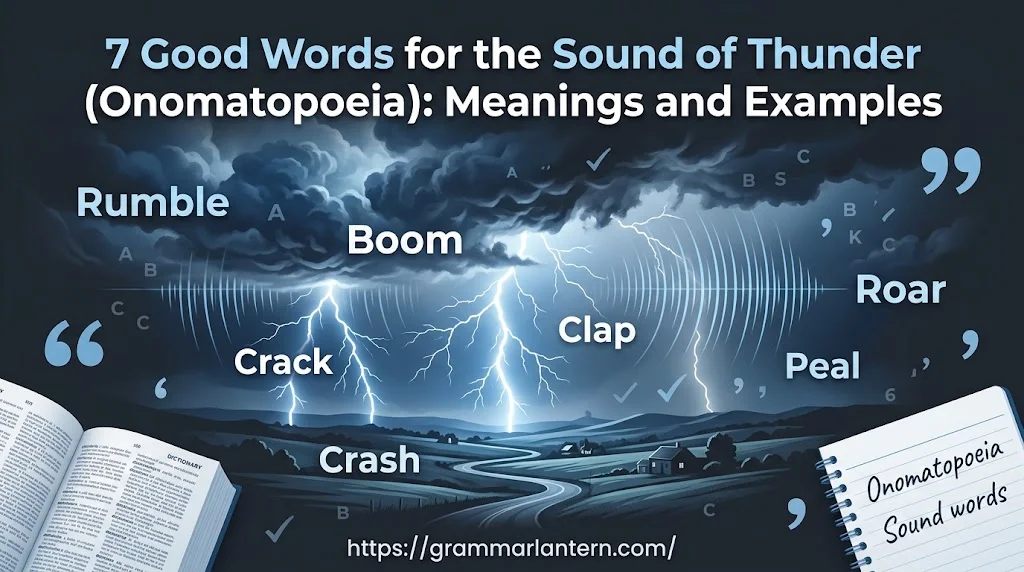
Comparing the Seven Words for the Sound of Thunder
Choosing the right word becomes easier when you focus on what you actually hear.
| Word | Main Sound Quality | Duration | Feeling |
| Rumble | Deep and rolling | Long or repeated | Distant, ominous |
| Boom | Deep and resonant | Usually short | Powerful |
| Crash | Loud and forceful | Short | Dramatic |
| Crack | Sharp and abrupt | Very short | Startling |
| Clap | Sudden burst | Short | Distinct |
| Roar | Deep and overwhelming | Often sustained | Powerful |
| Peal | Loud and resonant | Variable | Literary, dramatic |
This table shows why using seven different words doesn’t mean repeating the same idea seven times.
Each word highlights a different feature of thunder.
Rumble vs. Boom vs. Crack
These three words are among the most useful choices for everyday writing.
Rumble
Use rumble when the sound rolls, continues, or comes from far away.
Example:
Thunder rumbled beyond the mountains.
Boom
Use boom when the thunder sounds deep, heavy, and powerful.
Example:
A sudden boom shook the windows.
Crack
Use crack when the sound is sharp, sudden, and startling.
Example:
A crack of thunder broke the silence.
A simple way to remember the distinction is:
Rumble rolls. Boom bursts. Crack snaps.
That isn’t a scientific rule. It’s a useful writing shortcut.
How to Choose the Best Thunder Sound Word
Before choosing a word, ask what kind of thunder you want the reader to imagine.
For Distant Thunder
Choose:
- Rumble
- Peal
- Roar
Example:
A low rumble of thunder drifted across the distant hills.
For Sudden Thunder
Choose:
- Crack
- Clap
- Boom
Example:
A sharp crack of thunder startled everyone in the room.
For Extremely Powerful Thunder
Choose:
- Boom
- Crash
- Roar
Example:
Thunder crashed overhead with a force that rattled the windows.
For Literary Writing
Choose:
- Peal
- Roar
- Rumble
- Clap
These words can add atmosphere without making the sentence sound overly technical.
How to Use Thunder Onomatopoeia in Sentences
Thunder sound words can function in several grammatical ways.
As Nouns
A sound word can identify the sound itself.
- A boom shook the windows.
- A crack of thunder broke the silence.
- The rumble grew louder.
As Verbs
Some words can show the sound happening.
- Thunder rumbled overhead.
- The storm roared through the night.
- Thunder boomed across the valley.
- The sky seemed to crack with thunder.
As Participles
Participles can create a continuous atmosphere.
- Rumbling thunder filled the distance.
- Roaring thunder echoed through the mountains.
- Booming thunder interrupted the conversation.
This technique works particularly well in fiction because it lets the sound become part of the setting.
Case Study: Turning a Weak Thunder Description Into a Strong One
Consider this basic sentence:
The thunder was very loud and scary.
The sentence communicates the general idea, but it doesn’t give the reader much to imagine.
Now consider:
A sharp crack of thunder broke the silence, followed by a deep rumble that rolled across the valley.
The second version gives you several useful details.
- Sharp crack suggests suddenness.
- Deep rumble suggests low frequency and duration.
- Broke the silence shows the effect of the sound.
- Rolled across the valley creates a sense of movement and space.
The improvement doesn’t come from adding fancy vocabulary. It comes from choosing precise sound words.
Thunder Sound Words in Different Types of Writing
The best choice can depend on your purpose.
| Type of Writing | Useful Words | Why They Work |
| Everyday description | Rumble, boom, crack | Natural and familiar |
| Fiction | Boom, crack, crash, roar | Creates action and atmosphere |
| Poetry | Peal, rumble, roar, clap | Strong imagery and rhythm |
| Children’s writing | Boom, bang, rumble | Easy to understand |
| Weather description | Rumble, peal, boom | Describes storm development |
| Dramatic scene | Crash, crack, roar | Creates tension |
A children’s story might say:
BOOM! Thunder shook the house.
A literary story might say:
A low peal of thunder rolled beyond the darkened hills.
Both work. The difference lies in audience and tone.
Common Mistakes
Even a good sound word can feel awkward when used in the wrong context.
Using Every Sound Word Interchangeably
Rumble, boom, and crack aren’t perfect synonyms.
A long distant sound doesn’t usually feel like a crack. A sudden sharp thunderclap doesn’t necessarily feel like a gentle rumble.
Choose based on the sound you’re trying to represent.
Using Too Many Sound Words
A sentence such as this can become cluttered:
The thunder boomed, crashed, cracked, roared, rumbled, clapped, and pealed.
Unless the writing intentionally describes several stages of a storm, this sounds excessive.
One or two precise words usually have more impact.
Relying Only on “Loud”
Loud tells the reader about volume. It doesn’t tell them what the sound feels like.
Compare:
The thunder was loud.
with:
A deep boom rolled across the valley.
The second sentence provides much more sensory information.
Confusing Sound With Effect
Words such as deafening, terrifying, and shocking describe the effect thunder has on someone. They don’t imitate the sound itself.
For example:
- Boom → sound
- Deafening → volume or effect
- Terrifying → emotional response
- Distant → location or perceived distance
Strong descriptions often combine these categories carefully.
Facts About Thunder That Help You Describe It Accurately
Understanding the physical nature of thunder can improve word choice.
Thunder happens because lightning rapidly heats the surrounding air. The air expands extremely quickly and creates a pressure wave that travels outward as sound.
Several factors affect what thunder sounds like to a listener:
- Distance from the lightning
- Shape and length of the lightning channel
- Atmospheric conditions
- Terrain
- Buildings and other surfaces that reflect sound
- The intensity and structure of the lightning discharge
A nearby lightning strike can produce an abrupt, sharp sound. More distant lightning often produces the familiar rolling rumble because different parts of the sound reach the listener at slightly different times.
This explains why thunder can seem to travel or roll across the sky.
Why Thunder Sometimes Sounds Like a Crack
When lightning occurs relatively close to the listener, the initial pressure wave can arrive as a sharp report.
That’s why crack is such an effective word for sudden nearby thunder.
Why Distant Thunder Sounds Like a Rumble
As the sound travels over greater distances, the individual components can reach the listener at different times. Reflections and the shape of the lightning channel can also influence the sound.
The result can feel extended and rolling.
That’s where rumble becomes the natural choice.
A Practical Thunder Word Guide
When writing a sentence, use this quick decision guide:
Is the sound low and continuous?
Use rumble.
Is it deep and explosive?
Use boom.
Is it sudden and forceful?
Use crash.
Is it sharp and startling?
Use crack.
Is it a distinct thunderclap?
Use clap.
Does the storm sound huge and sustained?
Use roar.
Does the sound arrive in a loud burst or succession?
Use peal.
This approach helps you avoid choosing a word simply because it sounds dramatic.
Examples of Thunder Descriptions
Here are several examples showing how different words can change the mood.
Calm but Ominous
A distant rumble of thunder moved across the horizon.
Sudden and Frightening
A violent crack of thunder shattered the quiet night.
Powerful
A deep boom echoed through the valley.
Dramatic
Thunder crashed overhead as rain swept across the fields.
Overwhelming
The storm roared above the city for hours.
Literary
A peal of thunder rolled beyond the dark hills.
Simple and Direct
Thunder boomed after the lightning flashed.
Each sentence uses a different word because each one creates a different soundscape.
Are All Seven Words Technically Onomatopoeic?
Not necessarily in exactly the same way.
Boom, crack, and clap have strong sound-imitating qualities. They resemble the type of noises they describe.
Rumble, crash, and roar can also function as sound-imitating or sound-symbolic words depending on context.
Peal is more descriptive and literary. It identifies a particular quality or pattern of loud sound rather than directly copying thunder.
So, if the goal is strict sound imitation, boom, crack, clap, and rumble are especially useful. If the goal is vivid thunder description, all seven can contribute.
Read More: 5 Ways to Describe the Sound of Rain: Onomatopoeia
FAQs
1. What are some good words for the sound of thunder?
Some good words include rumble, boom, crack, clap, pang, and fumfum. Each word can describe a different quality or intensity of thunder.
2. What is the most common word for the sound of thunder?
Rumble is one of the most common words used to describe thunder, especially when the sound is deep, low, and continuous.
3. Is “boom” a good word for thunder?
Yes. Boom works well when thunder sounds loud, sudden, and powerful. It can make a storm scene feel dramatic.
4. What word describes distant thunder?
Rumble is a good choice for distant thunder. It suggests a low, rolling sound that can be heard from far away.
5. What word describes a sudden sound of thunder?
Crack can describe a sudden, sharp burst of thunder. It works especially well when the sound feels loud and unexpected.
6. Is thunder an example of onomatopoeia?
Some words used to describe thunder are onomatopoeic because they imitate or suggest the sound itself. Words such as “boom” and “crack” can create this effect.
7. How can I describe thunder in creative writing?
Choose a word based on the sound you want readers to imagine. Use rumble for deep thunder, boom for loud thunder, and crack for a sharp, sudden sound.
8. Can “clap” describe the sound of thunder?
Yes. Clap can describe a sharp burst of thunder, particularly when the sound resembles a loud clap or sudden explosion in the sky.
9. What is the best word for a very loud thunder sound?
Boom is a strong choice for very loud thunder. You can also use crack when the sound is sudden and forceful.
10. Why are descriptive thunder words useful?
Descriptive words make storm scenes more vivid. Instead of simply saying that thunder is loud, words like rumble, crack, and boom help readers imagine how the storm actually sounds.
Conclusion
The right words can make the sound of thunder much easier to imagine. Words such as rumble, boom, crack, clap, pang, and fumfum offer different ways to describe a storm’s sound and intensity. Choosing the right term depends on whether the thunder is distant, soft, sudden, or powerful.
Using these descriptive sounds can make your writing more engaging and natural. Whether you are writing a story, poem, article, or simple description, a carefully chosen thunder word can help readers feel closer to the scene and almost hear the storm for themselves.




[…] Read More: 7 Good Words for the Sound of Thunder and Onomatopoeia […]
[…] Read More: 7 Good Words for the Sound of Thunder and Onomatopoeia […]