Have you ever stopped while writing and wondered whether Charles’ or Charles’s is the correct choice? You’re not alone! Names ending in S can make possessive grammar tricky, even for experienced writers. Both forms indicate ownership or possession, but the right choice depends on the grammar rules and style guide you’re following. Understanding this small punctuation difference can make your English writing clearer and more professional. After all, a misplaced or missing apostrophe can leave readers questioning your intended meaning.
In standard English grammar, Charles’s follows the common rule of adding an apostrophe and S to a singular name. For example, you would write Charles’s book or Charles’s office. However, some style guides prefer Charles’, using only an apostrophe after the final S. Both forms have established usage, so knowing when to use each one matters.
In this guide, you’ll learn the difference between Charles’ and Charles’s, explore important possessive rules, and discover helpful writing examples. We’ll also look at popular style-guide preferences, common mistakes, and practical tips for maintaining consistency in emails, reports, academic assignments, and professional communication. By the end, you’ll know how to choose the appropriate possessive form with confidence.
Quick Answer
Both Charles’ and Charles’s are correct ways to show possession when referring to one person named Charles. The difference comes down to the writing style you follow.
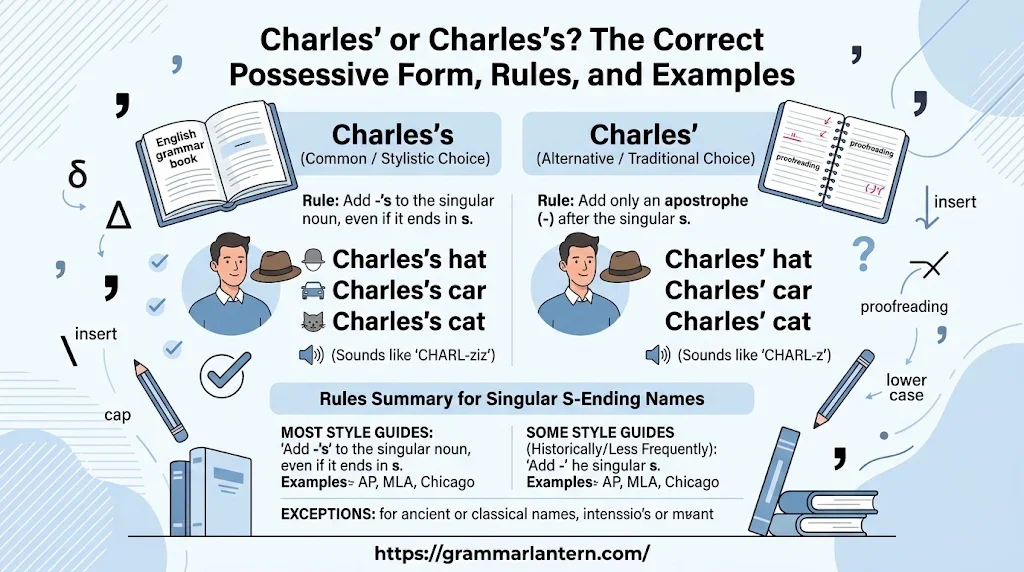
- Charles’s: Add an apostrophe followed by another s. The Chicago Manual of Style and MLA convention generally use this form.
- Charles’: Add only an apostrophe after the existing s. The Associated Press (AP) Stylebook uses this form for singular proper names ending in s.
Examples:
- Charles’s car is parked outside.
- Charles’ car is parked outside.
Both sentences communicate the same meaning: the car belongs to Charles.
| Form | Grammatical use | Style preference |
| Charles’s | Singular possessive | Chicago and MLA |
| Charles’ | Singular possessive | AP |
| Charles | Singular name | Standard spelling |
| Charleses | Plural noun | Multiple people named Charles |
| Charleses’ | Plural possessive | Something belonging to multiple people named Charles |
The easiest rule to remember: Follow your required style guide. If nobody specifies one, choose either accepted possessive form and use it consistently.
What Does Charles’s Mean?
Charles’s is the singular possessive form of the proper name Charles. It indicates that something belongs to, relates to, or is associated with one person named Charles.
To create this form, start with the name Charles. Add an apostrophe and another s at the end.
The result is Charles’s.
This construction follows the general possessive rule for singular nouns. Most singular nouns form their possessives by adding apostrophe plus s, even when the noun already ends in s.
For example:
- Charles’s bicycle needs a new tire.
- Charles’s sister works at a hospital.
- Charles’s office has two large windows.
- Charles’s presentation impressed the audience.
- Charles’s phone is ringing.
In each sentence, the possessive form connects Charles to something.
Importantly, possession doesn’t always mean physical ownership. It can also describe relationships, responsibilities, experiences, and associations.
For example, Charles’s manager identifies the manager associated with Charles. Similarly, Charles’s birthday identifies an event connected to him.
Read More: Auxiliary vs. Auxillary: Which Spelling Is Correct?
When Should You Use Charles’s?
Use Charles’s when your chosen writing convention adds an apostrophe and another s to singular proper names ending in s.
This form works particularly well in Chicago-style writing and MLA-style documents.
Consider these situations:
- Personal belongings: Charles’s laptop contains the project files.
- Family relationships: Charles’s brother lives in Texas.
- Professional responsibilities: Charles’s supervisor approved the proposal.
- Academic work: Charles’s research examines language development.
- Personal spaces: Charles’s bedroom overlooks the garden.
- Important events: Charles’s graduation ceremony starts tomorrow.
The extra s doesn’t change the meaning. It simply follows a particular grammatical and editorial convention.
What Does Charles’ Mean?
Charles’ is another accepted singular possessive form of the name Charles. Instead of adding another s, you place an apostrophe immediately after the existing final letter.
This construction is common in AP-style writing and other editorial systems that omit the additional s after singular proper names ending in s.
For example:
- Charles’ car is parked outside.
- Charles’ sister works at a hospital.
- Charles’ office is on the second floor.
- Charles’ presentation impressed the audience.
- Charles’ phone is ringing.
Each sentence expresses the same possessive relationship as its Charles’s counterpart.
The difference is purely stylistic rather than a difference in ownership or grammatical meaning.
When Should You Use Charles’?
Choose Charles’ when your publication, employer, assignment, or editorial guidelines follow AP style.
Journalists often encounter this convention because AP style favors an apostrophe alone after singular proper names ending in s.
You might see it in:
- Newspaper articles
- News reports
- Editorial content
- Press releases
- Business publications
- Organization newsletters
For example:
Charles’ statement addressed the concerns raised during the meeting.
This sentence follows the AP convention. The apostrophe indicates possession without adding another s.
Remember that Charles’ isn’t a shortcut that works in every writing situation. Its suitability depends on the style standard you’re following.
What’s the Difference?
The main difference between Charles’ and Charles’s is their spelling. Both forms indicate singular possession, but different style guides prefer different constructions.
Neither form automatically makes a sentence more correct than the other.
Comparison Table
| Feature | Charles’ | Charles’s |
| Grammatical function | Singular possessive | Singular possessive |
| Apostrophe placement | After the existing s | Before the additional s |
| Additional s | No | Yes |
| Meaning | Ownership or association | Ownership or association |
| AP style | Preferred | Not the standard AP form |
| Chicago style | Not preferred | Preferred |
| MLA convention | Not preferred | Preferred |
Understanding the Main Differences
1. Spelling
Charles’ contains one apostrophe after the final s. Charles’s contains an apostrophe followed by another s.
This is the most visible difference.
2. Grammatical meaning
Both forms show that something belongs to or relates to one person named Charles.
For example:
- Charles’ house needs painting.
- Charles’s house needs painting.
Neither sentence changes the basic meaning.
3. Editorial preference
The biggest practical difference comes from style guides. AP generally prefers Charles’, while Chicago and MLA generally prefer Charles’s.
4. Consistency
Writers should avoid changing possessive conventions without a reason. If your article uses Charles’s, use the same approach for comparable singular names ending in s.
A consistent document looks more polished and professional.
The Grammar Rule for Singular Names Ending in S
Why does this issue exist in the first place? The answer comes from the way English forms possessives.
For most singular nouns, writers add an apostrophe followed by s to indicate possession.
Examples include:
- Teacher → Teacher’s
- Student → Student’s
- John → John’s
- Maria → Maria’s
However, names ending in s create an additional stylistic question.
Should you add another s, or should you place an apostrophe after the existing one?
English writing conventions recognize both approaches.
The Apostrophe Plus S Rule
The first approach adds ‘s to a singular noun, regardless of its final letter.
Examples:
- Charles → Charles’s
- James → James’s
- Chris → Chris’s
- Thomas → Thomas’s
- Lucas → Lucas’s
This method appears in Chicago style and MLA conventions.
For instance:
James’s bicycle was stolen yesterday.
The additional s follows the same possessive pattern used with other singular names.
The Apostrophe-Only Rule
The second approach adds only an apostrophe when a singular proper name already ends in s.
Examples:
- Charles → Charles’
- James → James’
- Chris → Chris’
- Thomas → Thomas’
- Lucas → Lucas’
AP style follows this approach.
For example:
James’ bicycle was stolen yesterday.
The sentence still communicates that the bicycle belongs to James.
Why Do Both Rules Exist?
English doesn’t have one universal editorial rule for every possessive situation. Different publishers and style guides have developed conventions that serve their readers and editorial preferences.
Some prefer the additional s because it follows the general singular possessive pattern. Others omit it to keep the written form simpler.
Neither approach changes the underlying grammatical relationship.
The important point is to understand your chosen convention rather than randomly switching between the two.
What Do Major Style Guides Say About Charles’ and Charles’s?
Choosing between Charles’ and Charles’s becomes easier when you understand the major writing standards. Different style guides have different preferences for singular proper names ending in s.
Let’s look at the most relevant conventions.
The Chicago Manual of Style
The Chicago Manual of Style recommends adding an apostrophe and another s to singular proper names, including names that already end in s.
Therefore, Chicago-style writing uses:
- Charles’s car
- James’s book
- Chris’s computer
- Thomas’s house
- Harris’s statement
Chicago follows this approach because it treats singular possessives consistently, regardless of the final letter of the name.
For example:
Charles’s decision changed the direction of the entire project.
This construction follows Chicago’s possessive convention.
Associated Press (AP) Style
The Associated Press Stylebook takes a different approach. It recommends adding only an apostrophe to singular proper names ending in s.
Under AP style, you would write:
- Charles’ car
- James’ book
- Chris’ computer
- Thomas’ house
- Harris’ statement
For example:
Charles’ decision changed the direction of the entire project.
This spelling follows AP’s editorial convention and is commonly encountered in newspaper and news-related writing.
MLA Style
The Modern Language Association (MLA) follows the general rule of adding apostrophe plus s to singular proper nouns ending in s.
Examples include:
- Charles’s essay
- James’s argument
- Dumas’s novels
- Athens’s history
Therefore, when following MLA conventions, Charles’s is the appropriate choice.
This distinction matters in academic writing, particularly when preparing research papers, literary analyses, and other formal assignments.
Other Writing and Editorial Conventions
Not every organization follows Chicago, AP, or MLA style. Some publishers, universities, businesses, and government agencies maintain their own editorial standards.
For instance, an organization might prefer the apostrophe-only construction for all singular proper names ending in s. Another might require the additional s.
Before submitting an important document, check its editorial requirements.
| Style guide | Preferred spelling | Example |
| Chicago | Charles’s | Charles’s office |
| AP | Charles’ | Charles’ office |
| MLA | Charles’s | Charles’s office |
Practical advice: Never assume that one spelling works for every publication. Follow the specific style guide your audience or organization expects.
How to Pronounce
Spelling isn’t the only part of this discussion that confuses writers. Pronunciation also raises questions.
Do you pronounce Charles’ differently from Charles’s?
Generally, both forms have the same possessive pronunciation. The possessive ending commonly adds an extra syllable after the existing s sound.
The name Charles has one syllable. Its possessive form is commonly spoken with two syllables.
For example:
- Charles: One syllable.
- Charles’s: Commonly pronounced with two syllables.
- Charles’: Also commonly pronounced with two syllables.
The additional syllable sounds like the ending in buses or dishes.
However, pronunciation can vary with individual speech habits and context. The spelling convention doesn’t require a different spoken meaning.
Why Does the Additional S Sound Matter?
The name Charles already ends with an s sound. When you express possession, English pronunciation commonly adds an extra syllable to make the possessive ending clear.
Consider this sentence:
Charles’s new apartment is near the university.
When spoken naturally, the possessive ending helps distinguish the name from the possessive phrase.
The apostrophe-only spelling doesn’t necessarily mean you should remove that spoken ending. AP’s spelling convention is an editorial choice, not an instruction to pronounce the word differently.
Practical Examples
Examples make grammar rules easier to understand. Instead of memorizing punctuation instructions, compare the following sentences.
Both possessive forms can express the same relationships.
Examples Using Charles’s
Here are practical sentences that use Charles’s correctly under Chicago and MLA conventions.
Personal belongings
- Charles’s jacket is hanging behind the door.
- Charles’s laptop needs a software update.
- Charles’s bicycle is parked near the entrance.
- Charles’s wallet contains his identification cards.
Family relationships
- Charles’s sister is studying medicine.
- Charles’s parents live in California.
- Charles’s brother recently started a new business.
- Charles’s daughter enjoys reading historical novels.
Work and professional responsibilities
- Charles’s manager approved the proposal.
- Charles’s office is located on the third floor.
- Charles’s presentation covered the company’s latest developments.
- Charles’s team completed the assignment before the deadline.
Academic work
- Charles’s research explores modern communication.
- Charles’s professor recommended another reference book.
- Charles’s essay discusses the history of English.
- Charles’s examination results arrived yesterday.
Personal experiences and events
- Charles’s birthday falls in December.
- Charles’s graduation ceremony begins at noon.
- Charles’s vacation starts next Monday.
- Charles’s experience helped him make a better decision.
Notice that the possessive form works in several contexts. It doesn’t only indicate ownership of physical objects.
Examples Using Charles’
The following sentences use Charles’ under AP style and other conventions that prefer an apostrophe alone.
- Charles’ jacket is hanging behind the door.
- Charles’ laptop needs a software update.
- Charles’ sister is studying medicine.
- Charles’ parents live in California.
- Charles’ manager approved the proposal.
- Charles’ office is located on the third floor.
- Charles’ research explores modern communication.
- Charles’ professor recommended another reference book.
- Charles’ birthday falls in December.
- Charles’ vacation starts next Monday.
Each example expresses the same relationship as its Charles’s counterpart.
Comparing Charles’ and Charles’s Side by Side
Sometimes the easiest way to understand a grammar distinction is to compare identical sentences.
| Charles’s | Charles’ |
| Charles’s car is expensive. | Charles’ car is expensive. |
| Charles’s dog is friendly. | Charles’ dog is friendly. |
| Charles’s house is beautiful. | Charles’ house is beautiful. |
| Charles’s mother is a teacher. | Charles’ mother is a teacher. |
| Charles’s office is spacious. | Charles’ office is spacious. |
| Charles’s phone is missing. | Charles’ phone is missing. |
| Charles’s idea was excellent. | Charles’ idea was excellent. |
The meaning stays the same throughout the table. Only the spelling convention changes.
Charles’s vs. Charleses vs. Charleses’: Understanding the Difference
Here’s where another common grammar mistake appears.
Some writers confuse Charles’s with Charleses because the two forms look similar. However, they serve entirely different grammatical purposes.
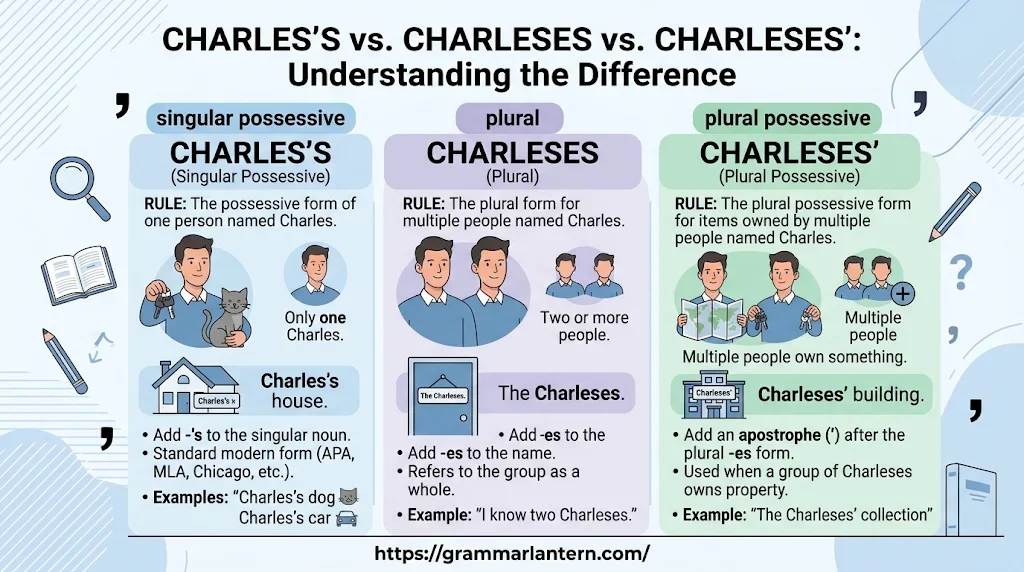
Charles’s is a singular possessive. Charleses is the plural form of the name Charles.
Charleses’ is the plural possessive form.
Understanding these differences prevents confusion when writing about one person, multiple people, or an entire family.
Charles: The Singular Name
Charles refers to one person.
For example:
Charles is attending the meeting tomorrow.
There is no apostrophe because the sentence doesn’t express possession.
Charles’s: The Singular Possessive
Charles’s indicates that something belongs to or relates to one person named Charles.
For example:
Charles’s house has a large garden.
The apostrophe and additional s follow Chicago and MLA conventions.
Under AP style, the equivalent spelling is Charles’.
Charleses: The Plural Form
Charleses refers to multiple people named Charles or a family with the surname Charles.
To form the plural, add es to the name.
For example:
The Charleses invited their neighbors to dinner.
Here, Charleses identifies more than one person. No apostrophe is necessary because the sentence doesn’t show possession.
Charleses’: The Plural Possessive
Charleses’ shows that something belongs to multiple people named Charles or members of the Charles family.
For example:
The Charleses’ house stands near the river.
The apostrophe appears after the final s because the plural noun already ends in s.
Comparison Table: Charles, Charles’s, and Charleses
| Form | Grammatical purpose | Example |
| Charles | Singular | Charles is my neighbor. |
| Charles’s | Singular possessive | Charles’s car is new. |
| Charles’ | Alternative singular possessive | Charles’ car is new. |
| Charleses | Plural | The Charleses are visiting. |
| Charleses’ | Plural possessive | The Charleses’ home is beautiful. |
Remember: Apostrophes don’t normally create plurals in English. They primarily indicate possession or missing letters in contractions.
A Simple Family Example
Imagine a family whose last name is Charles.
You want to describe the family members attending a neighborhood celebration.
You could write:
The Charleses arrived early and brought dinner for everyone.
Now suppose you want to describe something belonging to the entire family:
The Charleses’ garden looks beautiful in spring.
Finally, imagine that one family member named Charles owns a bicycle:
Charles’s bicycle is leaning against the garage.
These sentences demonstrate three separate grammatical situations. The correct punctuation depends on whether you’re describing one person, several people, or ownership.
Common Mistakes to Avoid
Even experienced writers sometimes make possessive apostrophe mistakes. Most errors happen when people confuse singular and plural forms or apply different style rules inconsistently.
Here are the mistakes worth avoiding.
Treating Charles’ as a Plural Form
Charles’ doesn’t automatically refer to multiple people.
For example:
Charles’ car needs repairs.
This sentence describes one person’s car under the apostrophe-only convention.
The plural form is Charleses, not Charles’.
Assuming Charles’s Is Always Incorrect
Some writers believe that adding another s after a name ending in s creates a spelling mistake.
That’s incorrect.
Chicago and MLA conventions accept Charles’s as the standard singular possessive form.
Assuming Charles’ Is Always Incorrect
The opposite mistake is equally common.
Charles’ isn’t universally wrong. AP style accepts this spelling for singular proper names ending in s.
The correct choice depends on your editorial requirements.
Writing Charles’s’s
Adding another apostrophe and another s to an already formed possessive creates an unnecessary construction.
Incorrect: Charles’s’s car is outside.
Correct: Charles’s car is outside.
The possessive marker appears only once.
Confusing Charleses With Charles’s
These forms have different meanings.
- Charles’s refers to something associated with one person.
- Charleses refers to multiple people.
- Charleses’ indicates possession by multiple people.
For example:
The Charleses’ children attend the same school.
Here, the apostrophe follows the plural family name.
Using an Apostrophe to Create a Plural
An apostrophe doesn’t usually make a name plural.
Incorrect: The Charles’s are coming over tonight.
Correct: The Charleses are coming over tonight.
The second sentence correctly identifies multiple members of the Charles family.
Switching Between Possessive Styles
Imagine writing a report that contains these sentences:
- Charles’s office is upstairs.
- James’ office is downstairs.
- Thomas’s desk is near the window.
Although readers can understand these sentences, the inconsistent punctuation may look careless if no editorial reason explains the differences.
Choose a convention and apply it consistently.
Read More: Sponser or Sponsor: Which Spelling Is Correct?
How to Choose the Correct Form in Your Writing
Choosing between Charles’ and Charles’s doesn’t have to be complicated. You only need to consider a few things before deciding.
Identify Whether You’re Describing One Person or Multiple People
First, determine whether Charles refers to one person or several people.
If you’re describing one person’s belongings or relationships, use a singular possessive form.
Examples:
- Charles’s shoes are near the door.
- Charles’ shoes are near the door.
If you’re referring to several people named Charles, use the plural form.
Example:
The Charleses attended the annual family reunion.
If something belongs to the entire family, use the plural possessive.
Example:
The Charleses’ house hosted the reunion.
This first step helps you avoid confusing singular possession with plural nouns.
Check Your Required Style Guide
Next, identify the writing convention your document must follow.
- Use Charles’s for Chicago style.
- Use Charles’ for AP style.
- Use Charles’s for MLA style.
- Follow your organization’s editorial guidelines when they provide a different rule.
This matters because academic institutions, newspapers, publishers, and businesses don’t always follow identical punctuation standards.
Consider Your Audience and Document Type
Your writing environment can help determine which convention makes sense.
For example:
- Academic essays: Follow the required academic style, such as MLA or Chicago.
- Newspaper articles: Follow AP style when the publication requires it.
- Books and manuscripts: Follow the publisher’s editorial requirements.
- Business reports: Follow your company’s writing guidelines.
- Personal writing: Choose either accepted form and remain consistent.
Maintain Consistency Throughout Your Document
Consistency makes writing easier to read and edit.
If you choose Charles’s, apply the same approach to comparable singular names ending in s.
For example:
- Charles’s presentation
- James’s assignment
- Thomas’s office
- Chris’s computer
If your document follows AP style, use the apostrophe-only convention instead:
- Charles’ presentation
- James’ assignment
- Thomas’ office
- Chris’ computer
Don’t switch between the two approaches without a clear editorial reason.
Quick Reference Table
Need a quick reminder while editing? This table summarizes the most important forms and their uses.
| Writing situation | Correct form |
| One person named Charles | Charles |
| Something belonging to Charles (Chicago) | Charles’s |
| Something belonging to Charles (AP) | Charles’ |
| Multiple people named Charles | Charleses |
| Something belonging to the Charles family | Charleses’ |
| Chicago-style possessive | Charles’s |
| AP-style possessive | Charles’ |
| MLA-style possessive | Charles’s |
| Charles’s personal belongings | Charles’s belongings |
| The belongings of multiple Charles family members | The Charleses’ belongings |
Quick editing tip: Ask yourself whether you’re describing one person or multiple people. Then apply the correct possessive convention.
FAQs
1. Is Charles’ or Charles’s correct?
Both Charles’ and Charles’s are correct possessive forms of the name Charles. However, Charles’s follows the general rule of adding apostrophe S to a singular noun. Some style guides, including AP style, prefer Charles’. Choose the form that matches your preferred writing style.
2. Should I write Charles’s name or Charles’ name?
Both versions are acceptable, but Charles’s name follows the standard singular possessive rule. For example, “Charles’s name appeared on the guest list.” Use the same format consistently throughout your writing.
3. Why does Charles’s have two S letters?
The name Charles already ends in S. When you add the possessive ending, another S follows the apostrophe. That’s why Charles’s contains two S letters. This follows the common grammatical pattern for forming the possessive of singular names.
4. Does AP style use Charles’ or Charles’s?
The Associated Press (AP) Stylebook generally prefers Charles’ for singular proper names ending in S. For example, AP-style writing uses “Charles’ book” rather than “Charles’s book.” This preference helps maintain consistency with AP punctuation conventions.
5. Does Chicago style prefer Charles’ or Charles’s?
The Chicago Manual of Style generally recommends Charles’s for singular proper names ending in S. This approach follows the traditional practice of adding apostrophe S to singular nouns, regardless of their final letter.
6. Is Charles’ the plural form of Charles?
No, Charles’ is not the plural form of Charles. It is a possessive form that indicates ownership. The plural form depends on the context, but when referring to multiple people named Charles, you can write “the Charleses.” Their shared possession would be “the Charleses’ house.”
7. How do I pronounce Charles’s?
Charles’s is generally pronounced with an additional syllable at the end, sounding like “CHARLZ-iz.” The pronunciation makes the possessive ending easier to recognize when speaking. In contrast, Charles’ is commonly pronounced the same as Charles.
8. Can I use Charles’s in formal writing?
Yes, Charles’s is appropriate for formal writing, academic assignments, professional emails, reports, and business documents. It follows the general singular possessive rule. However, always check your organization’s preferred style guide before choosing a particular format.
9. What is the difference between Charles’ book and Charles’s book?
There is no difference in meaning between these expressions. Both indicate that a book belongs to Charles. The difference comes from punctuation preferences and style-guide conventions. Charles’s book follows the general grammatical rule, while Charles’ book follows certain alternative style preferences.
10. How can I remember the correct possessive form of Charles?
An easy way to remember is to start with the general rule: add apostrophe S to a singular name to show ownership. Therefore, Charles’s is the standard choice in many writing situations. If you’re following a style guide that prefers only an apostrophe, use Charles’ instead. Consistency is the key.
Conclusion
Choosing between Charles’ and Charles’s doesn’t have to be confusing. Both forms show ownership, but they follow different style-guide preferences. In general English grammar, Charles’s is the commonly recommended singular possessive form because you add apostrophe S to a singular name, even when it already ends in S. However, some style guides, such as AP style, prefer Charles’. Understanding this difference helps you avoid punctuation mistakes and make your writing clearer.
The easiest approach is to choose one recognized style and follow it consistently. Use Charles’s for general, academic, and Chicago-style writing unless your required guidelines specify otherwise. If you’re preparing professional emails, business reports, or other formal documents, check the relevant style requirements before making your choice. Once you understand the rule, you’ll find it much easier to handle other names ending in S and use possessive forms confidently.

Muhammad Haroon is the voice behind many of the clear, practical grammar guides you’ll find on Grammar Lantern. With a strong background in content writing and a genuine love for the English language, Haroon specializes in breaking down intimidating grammar topics into simple, digestible lessons. His goal is simple: to empower readers to write with confidence and clarity. Whether he’s explaining tricky tenses or demystifying punctuation, Haroon approaches each topic with patience, precision, and a touch of warmth—because he knows that learning grammar is a journey, not a race.