When writing about noon, should you use midday or mid-day? The correct spelling is midday, a standard form in modern English. It refers to the middle of the day, usually around twelve o’clock. You may use it as a noun or adjective, depending on the sentence.
The word midday is written as a single, closed compound word without a hyphen or space. For example, you can write, “The midday sun made the afternoon extremely hot.” Although Mid-Day sometimes appears in older texts and specific publications, it is now considered a rare or outdated spelling. Similarly, Mid Day is nonstandard because it separates the word unnecessarily.
Most modern style guides recommend using midday in everyday and professional writing. Following this spelling convention improves clarity and grammatical accuracy. Whether you’re writing an email, an article, or a daily schedule, choosing the correct form keeps your English natural and consistent.
Quick Answer
Midday is the standard and preferred spelling in modern American English. Write it as one word without a hyphen when referring to the middle of the day.
Mid-day is a recognized alternative spelling that appears in some publications and established names. However, most everyday writing doesn’t require the hyphen.
The form mid day, written as two separate words, isn’t the conventional spelling of this compound noun.
| Spelling | Correctness and usage | Recommendation |
| Midday | Standard closed compound | Use this form |
| Mid-day | Hyphenated variant | Use only when a style or proper name requires it |
| Mid day | Nonstandard form in ordinary usage | Avoid it |
Examples:
- We plan to meet at midday.
- The temperature usually reaches its peak around midday.
- I’ll finish the assignment before midday.
- The restaurant gets busy around midday.
Easy rule to remember: If you’re talking about the middle of the day, write midday as one word.
What Does Midday Mean?
Midday refers to the middle part of the day, particularly the period around noon. People commonly use it when discussing daily schedules, lunch breaks, appointments, weather conditions, and daytime activities.
The word combines two elements:
- Mid: The middle or central part of something.
- Day: The period of daylight or the broader 24-hour daily cycle, depending on context.
Together, they describe the central portion of the day.
In everyday communication, midday often refers to approximately 12:00 p.m. However, it doesn’t always identify one exact minute. Someone who says they’ll arrive at midday might mean noon or a short period around that time.
For example:
- We usually eat lunch at midday.
- The sun appears high in the sky around midday.
- The school organizes outdoor activities before midday.
- She scheduled her appointment for midday.
Does Midday Always Mean 12:00 P.M.?
Not necessarily. Although people often associate midday with noon, the two expressions aren’t always identical.
Noon identifies 12:00 p.m., while midday can describe a broader period surrounding the middle of the day.
For instance, consider these sentences:
- The meeting begins at noon. This identifies a specific clock time.
- The meeting begins around midday. This allows some flexibility.
This distinction matters when you’re arranging appointments or communicating deadlines. If someone needs an exact time, noon is usually clearer.
Read More: Flake vs. Hake: What’s the Difference? Taste, Nutrition, and Uses
Why Is Midday Written as One Word?
English contains many compound words that began as separate words. Over time, writers joined some of these combinations into single, established spellings.
Midday follows this pattern. It combines mid and day to create a word with its own established meaning. Modern English treats it as a closed compound rather than two independent words.
The word also has historical roots. Oxford traces it to Old English middæg, showing that the combined form has a long history.
Oxford Learner’s Dictionaries+1
Understanding Closed Compound Words
A closed compound consists of two or more word elements written together without spaces or hyphens.
Here are some familiar examples:
| Compound word | Word elements | Meaning |
| Midday | Mid + day | Middle of the day |
| Midnight | Mid + night | Middle of the night |
| Midweek | Mid + week | Middle of the week |
| Midpoint | Mid + point | Central point |
| Midstream | Mid + stream | Middle of a stream or process |
These examples show why midday doesn’t need a hyphen. Its spelling follows an established compound-word pattern.
Does Every Word Beginning With Mid- Need a Hyphen?
No. The prefix mid- doesn’t automatically require a hyphen.
Some words use a hyphen, while others appear as closed compounds. The correct spelling depends on the individual word and accepted usage.
For example:
- Midday: The preferred spelling is one word.
- Midnight: Always written as one word in ordinary usage.
- Mid-July: The hyphen helps distinguish the prefix from the capitalized month.
- Mid-Atlantic: The hyphenated form is standard in this geographical expression.
Therefore, don’t apply one hyphenation rule to every word beginning with mid. Check the established spelling of the particular expression.
Is Mid-Day Ever Correct?
The hyphenated spelling mid-day isn’t simply a random typing mistake. Readers may encounter it in older publications, stylistic writing, and certain names or titles.
However, that doesn’t make it the preferred choice for ordinary modern American English.
When writing a general sentence about lunchtime, appointments, or daytime activities, midday is the safer option.
Consider these examples:
- Preferred: We expect the delivery around midday.
- Less preferred: We expect the delivery around mid-day.
Both sentences communicate the same basic idea. The difference concerns spelling preference rather than meaning.
Why Do Some Writers Use Mid-Day?
Several factors explain why the hyphenated form continues to appear.
1. Older spelling conventions
English spelling conventions have changed over time. Older books, newspapers, and printed materials may preserve forms that modern writers rarely use.
2. Editorial preferences
Some publications follow individual house styles. An editor might retain a hyphenated form for consistency with a particular publication or established title.
3. Visual separation
Some writers prefer the hyphen because it makes the two elements easier to recognize. However, visual preference doesn’t automatically establish standard spelling.
4. Proper names and branding
A newspaper, business, event, or organization might deliberately use Mid-Day in its official name. In that situation, preserve the organization’s chosen spelling.
The important distinction is simple: mid-day can appear in real writing, but midday remains the recommended everyday form.
Key Differences
At first glance, the difference between these spellings seems minor. Both contain the same letters and communicate the same general idea.
However, their presentation differs.
Midday is the established closed compound. Mid-day uses a hyphen to connect the same elements.
| Comparison | Midday | Mid-Day |
| Structure | One combined word | Two elements joined by a hyphen |
| Meaning | Middle of the day | Middle of the day |
| General use | Modern everyday writing | Less common variant |
| Readability | Direct and familiar | Visually separated |
| American English | Preferred | Usually unnecessary |
| Recommendation | Use regularly | Follow specific style requirements |
Does the Hyphen Change the Meaning?
No. Adding a hyphen doesn’t normally change what the expression means.
For example:
- The employees gathered at midday.
- The employees gathered at mid-day.
Both sentences describe employees gathering around the middle of the day. However, the first follows the preferred modern spelling.
Think of the hyphen as a formatting difference rather than a change in meaning.
Which Form Should You Use in Formal Writing?
Choose midday for formal and informal writing unless an established name or publication style requires another form.
This recommendation works well for:
- Business emails
- Academic assignments
- Blog articles
- Newspaper content
- Reports and presentations
- Professional schedules
- General correspondence
Consistency matters, too. If your article uses midday throughout, don’t randomly switch to mid-day in later paragraphs.
How to Use Midday in a Sentence
Understanding the spelling is only half the job. You also need to know how the word functions grammatically.
Midday primarily works as a noun. It can also function as an adjective when it describes another noun.
Both uses are common in modern English.
Midday as a Noun
As a noun, midday identifies the middle part of the day or the time around noon.
You can use it as the subject or object of a sentence. It also commonly appears after prepositions such as at, around, before, and by.
Examples:
- Midday is often the busiest time at the restaurant.
- We arrived shortly before midday.
- The meeting will begin at midday.
- She usually takes a break around midday.
- The delivery should arrive by midday.
Notice how the word identifies a time or period in each sentence.
Midday as an Adjective
An adjective describes a noun. When midday appears before another noun, it can identify something associated with the middle of the day.
This use is particularly common in descriptions of weather, meals, news, and activities.
Examples:
- The midday sun made the walk uncomfortable.
- We enjoyed a midday meal with our colleagues.
- She watched the midday news before leaving.
- The midday heat forced everyone indoors.
- Our midday break lasted thirty minutes.
In these examples, midday tells readers which type of sun, meal, news, heat, or break the sentence describes.
Midday in Everyday Communication
People use the word in many ordinary situations. It makes time references sound natural without always requiring an exact clock time.
Here are some practical examples:
| Situation | Example sentence |
| Work schedule | I’ll complete the report before midday. |
| Restaurant | The restaurant becomes crowded around midday. |
| Travel | Our train reaches the station at midday. |
| Weather | The midday sun feels particularly intense. |
| School | Students return to class after their midday break. |
| Appointments | Can we schedule the appointment for midday? |
These examples also demonstrate why midday works in both professional and casual communication.
Midday vs. Noon: Are They the Same?
Midday and noon are closely related. In many everyday sentences, you can use either word without changing the basic meaning.
However, they aren’t always interchangeable.
Noon specifically identifies 12:00 p.m. Midday can identify that time or the broader period surrounding it.
English meaning – Cambridge Dictionary+1
| Feature | Midday | Noon |
| Basic meaning | Middle of the day | 12:00 p.m. |
| Time reference | Around the middle of the day | Specific clock time |
| Flexibility | Can describe a broader period | More precise |
| Common usage | Daily routines and general descriptions | Appointments and exact schedules |
When Should You Use Midday?
Choose midday when you mean the general middle portion of the day.
Examples:
- The midday heat made the journey difficult.
- We usually eat lunch around midday.
- The children returned home shortly after midday.
These sentences describe a period or general time rather than emphasizing an exact minute.
When Should You Use Noon?
Choose noon when a specific clock time matters.
Examples:
- The interview begins at noon.
- Please submit your application before noon.
- The train departs at exactly noon.
If punctuality matters, noon removes unnecessary ambiguity.
Can You Write 12 P.M. Instead of Midday?
Yes. You can write 12 p.m. when you want to communicate the clock time numerically.
However, be careful with 12 a.m. and 12 p.m. because people sometimes confuse them.
- 12 p.m. means noon.
- 12 a.m. means midnight.
For important appointments, writing noon or midnight can prevent misunderstandings.
Midday vs. Midnight: Understanding the Difference
Although midday and midnight look similar, they describe opposite points in the daily cycle.
Midday refers to the middle of the daytime period. Midnight refers to the middle of the night.
Both words are closed compounds, so neither requires a hyphen.
| Word | Meaning | Clock time |
| Midday | Middle of the day | 12:00 p.m. |
| Midnight | Middle of the night | 12:00 a.m. |
Examples of Midday
- We plan to leave at midday.
- The sun was bright during the midday hours.
- Her lunch break begins around midday.
Examples of Midnight
- The movie ended at midnight.
- He submitted the application just before midnight.
- The streets became quiet after midnight.
Remembering this contrast makes both expressions easier to use correctly.
Is Midday One Word, Two Words, or Hyphenated?
The standard spelling is midday, written as one word.
However, writers sometimes encounter three different forms:
Midday: The preferred closed compound.
Mid-day: A less common hyphenated variant that may appear in particular editorial contexts.
Mid day: A nonstandard separation in ordinary writing.
The following examples make the distinction clearer:
| Form | Example | Recommendation |
| Midday | We arrived at midday. | Correct and preferred |
| Mid-day | We arrived at mid-day. | Less preferred |
| Mid day | We arrived at mid day. | Avoid |
The simplest approach is to use the established closed compound consistently.
Don’t add spaces or punctuation simply because the word contains two recognizable elements.
Common Spelling and Grammar Mistakes
Even familiar words can cause problems when writers aren’t sure how to spell or use them. Fortunately, most mistakes involving midday are easy to correct.
Here are the errors worth watching for.
Writing Mid Day as Two Separate Words
One common mistake is separating the compound into two words.
Incorrect: We will meet at mid day.
Correct: We will meet at midday.
The standard compound spelling joins both elements. Use the closed form in ordinary writing.
Adding an Unnecessary Hyphen
Some writers automatically insert a hyphen between mid and day. However, this isn’t necessary for the standard spelling.
Less preferred: The mid-day meeting starts soon.
Preferred: The midday meeting starts soon.
Choose the closed form unless a particular name or editorial requirement specifies otherwise.
Confusing Midday With Noon
Although these expressions overlap, they don’t always communicate exactly the same thing.
For example:
- Less precise: I’ll call you around midday.
- More precise: I’ll call you at noon.
The second sentence identifies a specific time. The first allows a little flexibility.
Using Midday as an Adjective Incorrectly
Midday can function as an adjective, but writers should place it where it clearly describes a noun.
Correct: We enjoyed the midday sunshine.
Correct: The midday meal was delicious.
Incorrect: We enjoyed the midday sunshine time period.
The last example is unnecessarily complicated. A simpler sentence communicates the idea more naturally.
Switching Between Different Spellings
Consistency is essential in professional writing.
Imagine reading an article that uses midday in the introduction, mid-day in the middle, and mid day near the conclusion. Such inconsistency distracts readers.
Choose midday and maintain that spelling throughout the document.
In American and British English
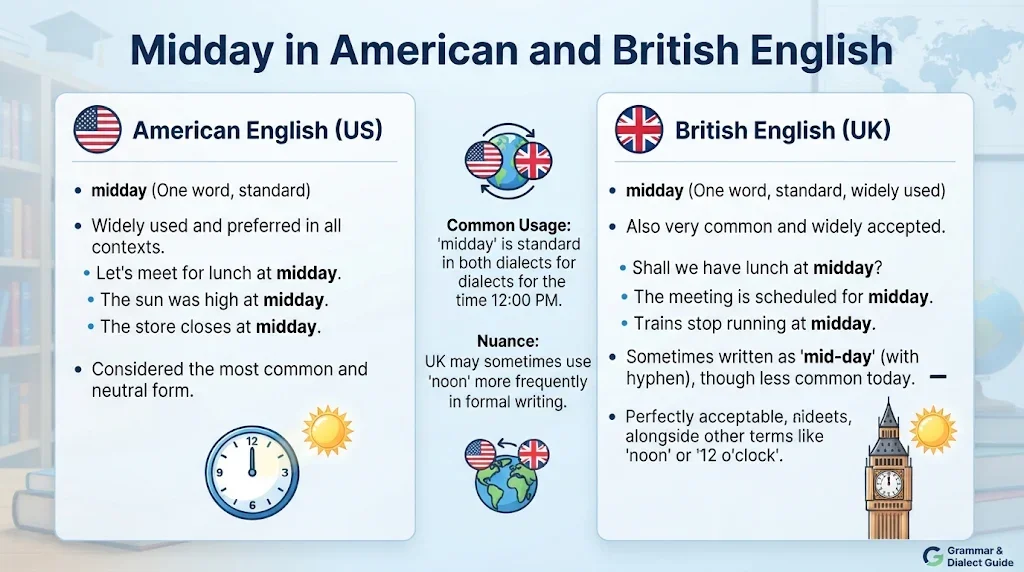
American and British English sometimes use different spellings for the same word. However, midday is widely recognized in both varieties.
The standard closed compound doesn’t change simply because the audience lives in a different English-speaking country.
| English variety | Preferred spelling | Example |
| American English | Midday | We arrived at midday. |
| British English | Midday | The train arrives at midday. |
Major English dictionaries, including Cambridge and Oxford, list midday as the headword. Both recognize its meaning as the middle of the day or noon.
English meaning – Cambridge Dictionary+2
Does British English Prefer Mid-Day?
No general British English rule requires the hyphenated spelling.
British writers commonly use midday in everyday communication, journalism, and formal documents.
Likewise, American writers generally prefer the closed form.
You may still encounter mid-day in individual publications or historical material. That reflects a particular spelling choice rather than a major difference between American and British English.
Which Spelling Should International Writers Use?
If you’re writing for an international audience, choose midday.
It’s widely understood and follows the standard spelling recognized by major English dictionaries.
This choice works well for:
- International business communication
- Educational websites
- Academic assignments
- News articles
- General blog content
- Professional reports
There’s no need to complicate a familiar word with an unnecessary hyphen.
In Professional and Everyday Writing
Knowing the correct spelling becomes especially useful when you write emails, schedules, reports, and appointment confirmations.
Although midday is a simple word, it can make time-related communication clearer.
Using Midday in Business Emails
Business emails often contain deadlines, meeting arrangements, and delivery schedules.
You can use midday when the recipient doesn’t need an exact minute.
Examples:
- I’ll send you the completed report by midday.
- Could we arrange a quick discussion around midday?
- The client expects an update before midday.
- Our team will review the proposal during the midday break.
However, if a deadline is strict, provide an exact time.
For example, write 12:00 p.m. instead of around midday when the recipient must submit something at precisely noon.
Using Midday in Meeting Schedules
Meeting invitations should communicate time clearly.
Consider these examples:
General scheduling:
Our project discussion will take place around midday on Thursday.
Precise scheduling:
Our project discussion will begin at 12:00 p.m. on Thursday.
The first sentence allows some flexibility. The second identifies a specific start time.
Using Midday in Academic Writing
Academic writers often use midday when describing observations, experiments, or daily patterns.
Examples:
- Researchers recorded the temperature around midday.
- Participants completed the second assessment before midday.
- The study examined changes in sunlight during midday hours.
In scientific writing, precise measurements are important. Therefore, use an exact clock time whenever the research method requires one.
A Practical Case Study: Choosing Between Midday and Noon
Imagine a company organizing a staff meeting.
The manager sends an email saying:
“We’ll meet at midday on Monday.”
Employees understand that the meeting will happen around lunchtime. However, some might arrive at 11:50 a.m. while others expect 12:15 p.m.
Now consider a revised message:
“We’ll meet at noon on Monday.”
The second message provides a clearer time reference.
If the meeting must begin at exactly 12:00 p.m., the manager can write:
“The meeting starts at 12:00 p.m. sharp on Monday.”
This example highlights an important distinction: midday is useful for general timing, while noon is better for precision.
Synonyms and Related Expressions
Sometimes repeating the same word makes writing sound dull. Fortunately, English offers several expressions that can replace midday depending on the context.
However, these alternatives don’t all have identical meanings.
| Word or expression | Meaning | Best context |
| Noon | 12:00 p.m. | Exact time references |
| Noontime | The time around noon | General time descriptions |
| Lunchtime | The usual period for lunch | Meals and breaks |
| Around noon | Approximately 12:00 p.m. | Flexible scheduling |
| Middle of the day | Central part of the day | General explanations |
| Early afternoon | The period shortly after noon | Later daytime activities |
| Noonday | Relating to or occurring around noon | Descriptive or literary writing |
Noon
Noon is the closest everyday alternative to midday when you mean 12:00 p.m.
Example: The appointment is scheduled for noon.
Lunchtime
Lunchtime refers to the period when people usually eat lunch. Its exact timing depends on individual routines and workplace schedules.
Example: The cafeteria becomes crowded during lunchtime.
Noontime
Noontime refers to the time around noon.
Example: The children returned home at noontime.
Early Afternoon
Early afternoon describes the period shortly after noon. It doesn’t mean exactly 12:00 p.m.
Example: We’ll continue the discussion in the early afternoon.
Middle of the Day
This expression provides a straightforward alternative to midday.
Example: The temperature usually reaches its highest point in the middle of the day.
Choose your replacement based on the intended meaning. A synonym should make the sentence clearer, not introduce a different time reference.
Practical Tips for Remembering the Correct Spelling
Remembering midday becomes easier when you connect it with familiar compound words and everyday expressions.
Here are several useful techniques.
1. Remember the closed compound
Write midday as one word. Don’t separate its elements or add unnecessary punctuation.
2. Compare it with midnight
Both words combine mid with another time-related word.
- Midday
- Midnight
Seeing them together makes the spelling pattern easier to remember.
3. Use noon for exact scheduling
If someone needs to arrive at precisely 12:00 p.m., use noon or the numerical time.
4. Avoid unnecessary hyphens
Don’t assume every word containing a prefix needs a hyphen. Check the accepted spelling of the complete word.
5. Maintain consistency
Use midday throughout your articles, emails, reports, and assignments.
6. Read your sentence aloud
Reading can help you notice awkward expressions. Although pronunciation won’t tell you whether a hyphen belongs in the spelling, it can reveal unclear wording.
A Quick Midday Spelling Practice
Test your understanding with these sentences.
- We usually eat lunch at ______.
- The ______ sun made the afternoon walk uncomfortable.
- The manager scheduled the meeting for ______.
- The train will arrive around ______.
ANSWER KEY
- Midday
- Midday
- Midday
- Midday
All four examples use the standard closed compound.
Read More: Charles’ or Charles’s? The Correct Possessive Form
FAQs
1. Is Midday or Mid-Day the Correct Spelling?
Midday is the correct and standard spelling in modern English. It is written as one word without a hyphen.
2. What Does Midday Mean?
Midday means noon or the middle of the day, usually around 12:00 p.m.
3. Is Mid-Day Incorrect?
Mid-Day is an outdated or uncommon spelling. Although it appears in some older publications, modern writing generally uses midday.
4. Is Mid Day Written as Two Words Correct?
No. Mid Day is considered nonstandard in modern English. The accepted spelling is midday.
5. Is Midday One Word or Two?
Midday is one word. It is a closed compound word, meaning its parts are joined without a space or hyphen.
6. Can Midday Be Used as a Noun?
Yes. You can use midday as a noun when referring to noon. For example, “We agreed to meet at midday.”
7. Can Midday Be Used as an Adjective?
Yes. Midday can describe something happening or existing around noon. For example, “The midday heat was unbearable.”
8. Should I Use Midday in Formal Writing?
Yes. Midday is appropriate for formal writing, academic work, business communication, emails, and everyday conversations.
9. Why Do Some People Write Mid-Day?
Some writers use Mid-Day because of older spelling habits, publication styles, or personal preferences. However, midday is the preferred modern spelling.
10. Do Modern Style Guides Recommend Midday?
Yes. Modern English style guides generally favor midday as one closed word without a hyphen or space.
Conclusion
Choosing between midday, mid-day, and mid day becomes easier when you understand modern English spelling conventions. Midday is the standard and recommended form because it follows the accepted closed-compound spelling. Although you might encounter the hyphenated version in older texts or specific publications, it isn’t the usual choice today.
Whether you’re writing an email, preparing an article, or creating a daily schedule, use midday to keep your writing clear and grammatically correct. A simple spelling choice can make your communication more polished and professional.

Muhammad Haroon is the voice behind many of the clear, practical grammar guides you’ll find on Grammar Lantern. With a strong background in content writing and a genuine love for the English language, Haroon specializes in breaking down intimidating grammar topics into simple, digestible lessons. His goal is simple: to empower readers to write with confidence and clarity. Whether he’s explaining tricky tenses or demystifying punctuation, Haroon approaches each topic with patience, precision, and a touch of warmth—because he knows that learning grammar is a journey, not a race.