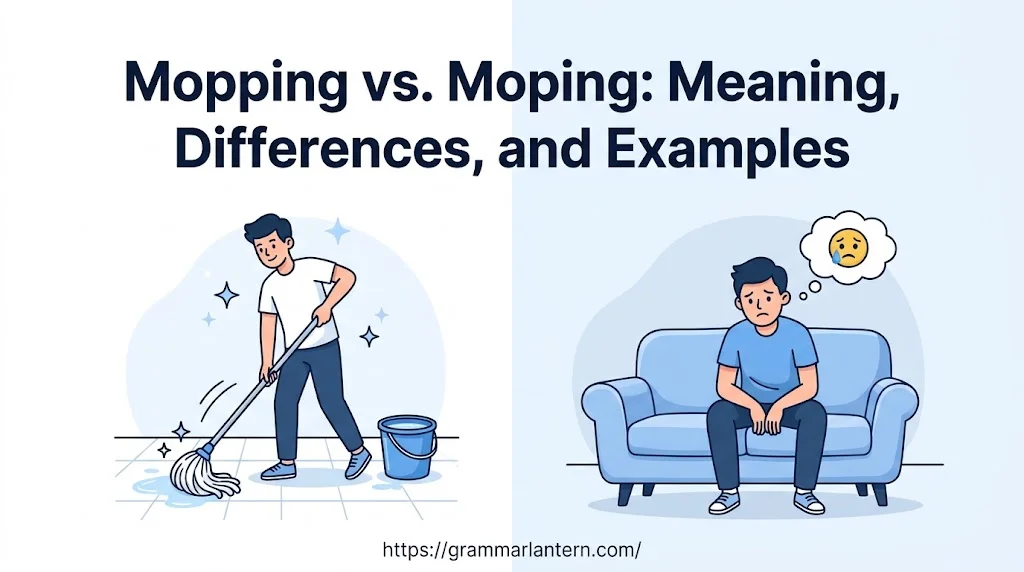
Mopping vs. Moping can be confusing because both words look similar, but they have different meanings. Mopping means cleaning a floor with a wet mop, while moping means feeling sad or unhappy. Understanding these words helps you improve your English vocabulary, spelling, and grammar.
Mopping is a physical action related to cleaning. You can use a mop, sponge, or cloth with water and cleaner to wash floors, clean surfaces, or wipe up spills. For example, she spent the afternoon mopping the kitchen floor. Remember that mopping has two p’s because it comes from the verb mop.
In contrast, moping describes a person’s emotional state. It can involve sadness, disappointment, low spirits, or feeling down. For example, he was moping around the house after his team lost a game. Unlike mopping, which involves household chores, moping describes behavior linked to a gloomy mood. Understanding this difference helps you choose the correct word in everyday writing.
Quick Answer
Mopping means cleaning a floor or surface with a mop. Moping means behaving sadly, feeling gloomy, or dwelling on disappointment.
| Word | Base verb | Meaning | Example |
| Mopping | Mop | Cleaning with a mop | Sarah is mopping the kitchen floor. |
| Moping | Mope | Acting sad or discouraged | Jake is moping because his team lost. |
The easiest way to remember the difference is to connect each word with its base verb:
- Mop → Mopping: Someone is cleaning a surface.
- Mope → Moping: Someone is feeling or acting gloomy.
The spelling follows two different rules. Mop doubles its final p before adding -ing, while mope drops its silent e before adding the same ending.
What Does Mopping Mean?
Mopping is the -ing form of the verb mop. It refers to cleaning a floor or another surface with a mop, usually by using water or a cleaning solution.
People mop floors in homes, schools, offices, restaurants, hospitals, and other buildings. The goal is to remove dirt, dust, spills, or stains that sweeping alone might not remove.
For example, if you spill juice on the kitchen floor and clean it with a wet mop, you’re mopping the floor. The same word applies when a cleaner washes a hallway after a busy day.
Mopping can also describe cleaning up a spill or removing something that remains after an event. The exact meaning depends on the sentence.
Examples of Mopping in Sentences
Here are several examples showing how to use mopping naturally.
- Household chores: My brother is mopping the kitchen while I wash the dishes.
- Workplace cleaning: The janitor spent an hour mopping the school hallway.
- Cleaning after a spill: Lisa is mopping up the water near the refrigerator.
- Restaurant maintenance: The staff began mopping the dining area after closing time.
- Everyday conversation: I can’t go outside yet because I’m mopping the floor.
- Routine activities: Mopping the bathroom regularly helps keep the floor clean.
Notice that each example describes a physical cleaning activity. The word doesn’t express sadness, disappointment, or a person’s emotional state.
How Mopping Works in Grammar
Mopping can perform several grammatical roles. Recognizing these roles helps you understand how the word fits into different sentences.
As a present participle: Mopping can form part of a continuous verb tense.
- She is mopping the living room.
- They were mopping when the manager arrived.
- I will be mopping the kitchen tomorrow.
In these examples, forms of be combine with mopping to describe an ongoing or future activity.
As a gerund: Mopping can function as a noun. It names an activity rather than directly stating what someone is doing.
- Mopping takes longer when the floor is dirty.
- I dislike mopping after everyone has gone to bed.
- Regular mopping keeps the tiles looking fresh.
A useful test is to ask whether the word names an activity or forms part of a verb phrase. Both uses are correct, but the surrounding grammar determines its role.
Common Expressions With Mopping
The word mopping appears in several everyday expressions.
- Mopping the floor: Cleaning a floor with a mop.
- Mopping up a spill: Removing spilled liquid or another substance.
- Mopping up water: Collecting or removing unwanted water from a surface.
- Mopping up the mess: Cleaning or dealing with the remaining mess.
The expression mop up can also have a figurative meaning. For instance, a team might mop up the remaining work after a busy project. In that case, nobody needs a bucket or cleaning supplies.
However, the core idea remains similar: removing what remains or dealing with something that needs attention.
What Does Moping Mean?
Moping is the -ing form of the verb mope. It describes behaving in a sad, gloomy, discouraged, or withdrawn way.
Someone might mope after receiving disappointing news, losing a competition, missing a friend, or experiencing a setback. The word often suggests that the person spends time dwelling on negative feelings rather than engaging with their usual activities.
For example, imagine that Daniel planned a weekend trip with his friends. When the trip gets canceled, he spends Saturday sitting quietly in his room and showing little interest in anything else. You might say, “Daniel is moping because the trip was canceled.”
Unlike mopping, moping has nothing to do with cleaning. It describes a person’s mood or behavior.
Moping doesn’t necessarily mean someone has a mental health condition. People sometimes feel down temporarily after ordinary disappointments. The word describes an observable mood or pattern of behavior, not a diagnosis.
Examples of Moping in Sentences
These examples demonstrate how moping works in different situations.
- Disappointment: She’s moping because she didn’t get the job.
- Loneliness: The little boy was moping around the house while his friends were away.
- A missed opportunity: Instead of moping about the canceled concert, Mia made new plans.
- A sports defeat: The players were moping after losing the championship.
- A personal setback: Stop moping over one mistake and focus on what you can learn.
- Everyday conversation: He’s been moping in his bedroom all afternoon.
Each sentence describes sadness, discouragement, or low spirits. None refers to a cleaning task.
Read More: MYF Meaning in Text: What Does MYF Stand For?
Common Expressions With Moping
Moping frequently appears alongside words that describe a person’s location, behavior, or reason for feeling upset.
- Moping around the house: Moving about or spending time at home in a gloomy mood.
- Moping in your room: Staying in your room while feeling sad or discouraged.
- Moping about something: Feeling unhappy because of a particular event or situation.
- Sitting around moping: Spending time feeling sorry or unhappy instead of doing something else.
- Moping over a loss: Dwelling on the disappointment of losing something or someone.
Consider these two examples:
“Emma is moping about her exam results.”
“Emma is moping around the house.”
The first sentence identifies the reason for her mood. The second describes where or how she’s spending her time.
Both are natural uses of the word. The exact details change, but the central meaning stays the same.
Key Differences
Although mopping and moping share several letters, they aren’t interchangeable. Choosing between them requires understanding what the sentence communicates.
Mopping describes a cleaning action. Moping describes a gloomy mood or behavior.
The following table summarizes their main differences.
| Feature | Mopping | Moping |
| Base verb | Mop | Mope |
| Main meaning | Cleaning with a mop | Acting sad or discouraged |
| Typical context | Housework, spills, maintenance | Disappointment, loneliness, setbacks |
| Vowel sound | Short vowel, as in hop | Long vowel, as in hope |
| Spelling pattern | Doubles the final consonant | Drops the final silent e |
| Example | He is mopping the hallway. | He is moping after the argument. |
The most reliable way to choose the correct word is to consider the intended meaning before checking the spelling.
Ask yourself one simple question: Is the person cleaning something or feeling down?
If the sentence describes cleaning, use mopping. If it describes sadness or gloomy behavior, use moping.
Mopping vs. Moping: Why the Spellings Differ
The spelling difference comes from the rules for adding -ing to English verbs.
Although the rules are straightforward, the two base verbs follow different patterns.
Why Does Mopping Have Two P’s?
The base verb mop has one syllable and ends in a consonant-vowel-consonant pattern:
- M: Consonant
- O: Vowel
- P: Consonant
When a one-syllable verb follows this pattern and ends with a single consonant after a single short vowel, you generally double the final consonant before adding -ing.
That’s why the correct form is:
Mop + ing = mopping
The final p doubles to preserve the spelling pattern associated with the short vowel sound.
Other examples follow the same rule:
- Hop → hopping
- Sit → sitting
- Run → running
- Plan → planning
- Stop → stopping
The pattern explains why mopping has two p’s. Writing moping when you mean cleaning would change the word entirely.
Why Does Moping Have One P?
The base verb mope ends with a silent e. When you add -ing to most verbs ending in a silent e, you drop that final letter.
The result is:
Mope − e + ing = moping
Here are some other examples of the same spelling rule:
- Hope → hoping
- Write → writing
- Smile → smiling
- Dance → dancing
- Take → taking
Unlike mop, mope doesn’t require a doubled consonant. Its spelling changes by removing the final silent e.
These rules explain the distinction clearly:
- Mopping: Double the final consonant.
- Moping: Drop the silent e.
Mopping vs. Moping: Pronunciation Differences
The two words also sound different when spoken aloud.
In common American English pronunciation, mopping has a short vowel sound, while moping has a long vowel sound, often described as a long O.
Their pronunciations can be represented using the International Phonetic Alphabet (IPA):
- Mopping: /ˈmɑpɪŋ/
- Moping: /ˈmoʊpɪŋ/
The exact vowel in mopping can vary by American regional accent. The important contrast is the short vowel in mopping versus the long O sound in moping.
Compare these familiar word pairs:
- Hop and hope
- Cop and cope
- Not and note
The same vowel contrast helps distinguish mopping from moping.
Try saying both words aloud in a sentence:
“I’m mopping the kitchen.”
“I’m moping because I missed the party.”
The different vowel sounds make the meanings easier to recognize during conversation. However, pronunciation alone isn’t always enough to catch a spelling mistake, especially when you type quickly.
How to Use Correctly
The best way to choose between these words is to start with the meaning you want to communicate. Don’t let their similar spelling trick you into using the wrong one.
When to Use Mopping
Use mopping when someone cleans a floor or surface with a mop. You can also use it when describing the removal of a spill or referring to mopping as an activity.
For example:
- I’m mopping the kitchen before our guests arrive.
- The cleaner is mopping the office entrance.
- Mopping the floor takes longer when it has stubborn stains.
- We were mopping up the spilled water when the lights went out.
In each sentence, the context involves cleaning or removing a mess.
If you can naturally replace the word with “cleaning with a mop,” then mopping is probably the word you need.
When to Use Moping
Use moping when someone feels or acts sad, discouraged, or gloomy.
For example:
- He’s moping because his vacation ended.
- I spent the morning moping after hearing the disappointing news.
- Stop moping around and come join us.
- She was moping about the argument instead of discussing the problem.
Here, the word describes an emotional state or behavior.
A useful substitution test is to see whether “acting gloomy” fits the sentence. If it does, moping may be the right choice.
Remember that moping isn’t always a deliberate choice. Someone may feel disappointed or withdrawn without intending to behave that way.
Common Mistakes
Because these words differ by only one vowel, it’s easy to mix them up while writing. The good news is that context usually makes the intended meaning clear.
Here are common mistakes and their corrections.
| Incorrect sentence | Correct sentence | Why it’s correct |
| I’m moping the kitchen floor. | I’m mopping the kitchen floor. | Cleaning requires mopping. |
| She’s mopping because she lost. | She’s moping because she lost. | Losing a competition can make someone feel gloomy. |
| He is moping up the spilled milk. | He is mopping up the spilled milk. | Removing a spill is a cleaning action. |
| They were mopping after the disappointing news. | They were moping after the disappointing news. | The sentence describes their emotional reaction. |
| Moping the floor is my least favorite chore. | Mopping the floor is my least favorite chore. | The sentence refers to a household task. |
The second and fourth examples show that the correct word depends on the situation. A person can mop a floor after receiving disappointing news, but the cleaning action itself doesn’t become moping.
Mistake: Choosing a Word by Appearance
One common error is assuming that similar-looking words have similar meanings. English contains many word pairs that differ by just one letter but express unrelated ideas.
For example, hoping means expecting or wishing for something, while hopping means jumping. Likewise, moping and mopping have distinct meanings despite their similar appearance.
Instead of relying on visual similarity, identify the action or feeling described in your sentence.
Mistake: Forgetting the Spelling Rules
Another common mistake is applying the same spelling rule to both words.
Remember these two patterns:
- Short vowel followed by a final consonant in a suitable one-syllable verb: double the consonant before -ing.
- Silent e at the end of a verb: usually drop the e before -ing.
That’s why mop becomes mopping, while mope becomes moping.
Mistake: Ignoring Sentence Context
Sometimes the words surrounding a verb make its meaning obvious.
Consider these sentences:
- “He was mopping the hallway with a bucket nearby.”
- “He was moping in the hallway after his friends left.”
The first sentence includes a bucket and a cleaning activity. The second describes someone’s gloomy behavior.
Reading the entire sentence before choosing a spelling can prevent many errors.
A Realistic Case Study: Mopping or Moping at Home?
Imagine two roommates, Alex and Jordan, preparing their apartment for a family visit.
Alex spills coffee on the kitchen floor and grabs a mop. Meanwhile, Jordan learns that a planned weekend trip has been canceled and sits on the couch looking disappointed.
Later, Alex tells a friend, “I’ve been mopping all morning, and Jordan has been moping all afternoon.”
Both words fit because they describe two different activities.
Alex is mopping.
Alex is using a mop to clean the coffee spill and prepare the apartment for visitors. The word describes a physical task.
Jordan is moping.
Jordan feels disappointed about the canceled trip and spends the afternoon looking gloomy. The word describes an emotional response.
This example illustrates an important point: the two words don’t describe different levels of the same activity. They refer to entirely different meanings.
You can remember the distinction by asking whether the sentence describes something a person does with a mop or how a person feels after a setback.
Easy Ways to Remember
A simple memory trick can make these spellings easier to recall, even when you’re writing quickly.
Connect Mopping With a Mop
The word mopping contains the base word mop. Picture a mop touching a wet kitchen floor.
That mental image links the spelling directly to the cleaning activity.
Memory tip: Two p’s in mopping help you remember the mop used for cleaning.
Connect Moping With Feeling Low
Think of moping as spending time feeling low after something disappointing happens.
Perhaps you didn’t get the job you wanted or your favorite team lost. You might spend some time moping before moving on.
Memory tip: Mope loses its final e when -ing arrives, leaving moping.
Use the Vowel Sound
The difference between the short vowel in mopping and the long O in moping provides another helpful clue.
Compare hop with hope. The same vowel contrast appears in mop and mope.
Saying the words aloud can reinforce the spelling distinction, especially if you’re learning English or working on pronunciation.
Ask One Simple Question
When you’re unsure, ask yourself:
- Is someone cleaning a surface? Use mopping.
- Is someone acting sad or discouraged? Use moping.
This quick test works for most everyday sentences.
In Everyday English
These words appear in different situations, so recognizing the context is particularly useful in casual writing.
In Text Messages
Suppose a friend asks why you haven’t finished cleaning your apartment.
You might reply, “I’m still mopping the kitchen.”
If your friend asks why you’re unusually quiet after a disappointing conversation, you might say, “I’m moping a little today.”
Both sentences sound natural because the chosen word matches the intended meaning.
In Workplace Communication
A cleaning supervisor might write:
“The staff will be mopping the lobby after closing.”
Here, mopping describes a scheduled cleaning task.
In a different situation, a manager might say:
“Don’t spend the whole afternoon moping about the rejected proposal. Let’s review the feedback.”
Here, moping describes discouragement following an unsuccessful outcome.
The distinction matters because the wrong word can change the entire message.
In Stories and Personal Narratives
Writers use mopping to describe physical movement and moping to communicate a character’s mood.
For example:
“Maria was mopping the kitchen when the phone rang.”
This sentence establishes what Maria is doing.
“Maria was moping in her bedroom after the argument.”
This sentence reveals something about Maria’s emotional state.
The verbs help readers picture different scenes without lengthy explanations.
Practice: Mopping vs. Moping
Test your understanding by choosing the correct word for each sentence. Pay attention to the context rather than the spelling alone.
Choose the correct word
0 of 8 answered
1. The cleaner is ___ the hallway before the guests arrive.
mopping
moping
2. After missing the final shot, Ben spent the evening ___.
mopping
moping
3. I need to start ___ the kitchen floor.
mopping
moping
4. She was ___ around the house because her friends had left.
mopping
moping
5. We were ___ up the water after the pipe leaked.
mopping
moping
6. Instead of ___ about the rejection, he decided to try again.
mopping
moping
7. ___ the floors is part of my weekend routine.
Mopping
Moping
8. Why are you ___ when nothing bad has happened?
mopping
moping
Check answersTry again
The key is to focus on meaning. Once you know whether the sentence refers to cleaning or a gloomy mood, the correct spelling becomes much easier to identify.
Read More: Snowball Kisses Meaning: What Does It Mean in Slang?
FAQs
1. What is the difference between mopping and moping?
Mopping means cleaning a floor with a wet mop, while moping means feeling sad, gloomy, or unhappy.
2. Is mopping spelled with one p or two p’s?
Mopping is spelled with two p’s. The final consonant in mop doubles before adding -ing.
3. What does moping mean?
Moping means feeling unhappy, showing disappointment, or behaving sadly because something has upset you.
4. Is moping a real English word?
Yes, moping is a correct English word. It is the -ing form of the verb mope.
5. What is an example of mopping in a sentence?
“She spent the morning mopping the kitchen floor to remove dirt and spills.”
6. What is an example of moping in a sentence?
“He was moping around the house after his favorite team lost the match.”
7. Why does mopping have two p’s?
The word mop ends in a consonant preceded by a single vowel. In standard English spelling, the final consonant doubles when adding -ing, producing mopping.
8. Can moping describe a person’s mood?
Yes, moping can describe someone who feels sad, disappointed, or discouraged and shows it through their behavior.
9. Are mopping and moping pronounced the same way?
No. They have different vowel sounds: mopping has the short vowel sound in hot, while moping has the long vowel sound in hope.
10. How can I remember the difference between mopping and moping?
Remember that mopping involves a mop and cleaning, while moping relates to a low mood or sadness.
Conclusion
Understanding mopping vs. moping is simple when you focus on their meanings and spelling. Mopping refers to cleaning floors or surfaces with water and a mop, while moping describes feeling sad, gloomy, or disappointed.
To use these words correctly, connect mopping with household chores and moping with emotions. Practicing both words in everyday sentences will help you improve your spelling, grammar, and English vocabulary.

Muhammad Haroon is the voice behind many of the clear, practical grammar guides you’ll find on Grammar Lantern. With a strong background in content writing and a genuine love for the English language, Haroon specializes in breaking down intimidating grammar topics into simple, digestible lessons. His goal is simple: to empower readers to write with confidence and clarity. Whether he’s explaining tricky tenses or demystifying punctuation, Haroon approaches each topic with patience, precision, and a touch of warmth—because he knows that learning grammar is a journey, not a race.